Last updated: June 14, 2026, 3:30 PM ET
Market context: U.S. employment data (nonfarm payrolls), released by the Bureau of Labor Statistics.
This article is for informational and educational purposes only. It is not financial advice, investment advice, or a recommendation to buy, sell, or hold any security, cryptocurrency, or financial product. Always verify data with official sources before making financial decisions.
Short answer: what the May 2026 jobs report showed
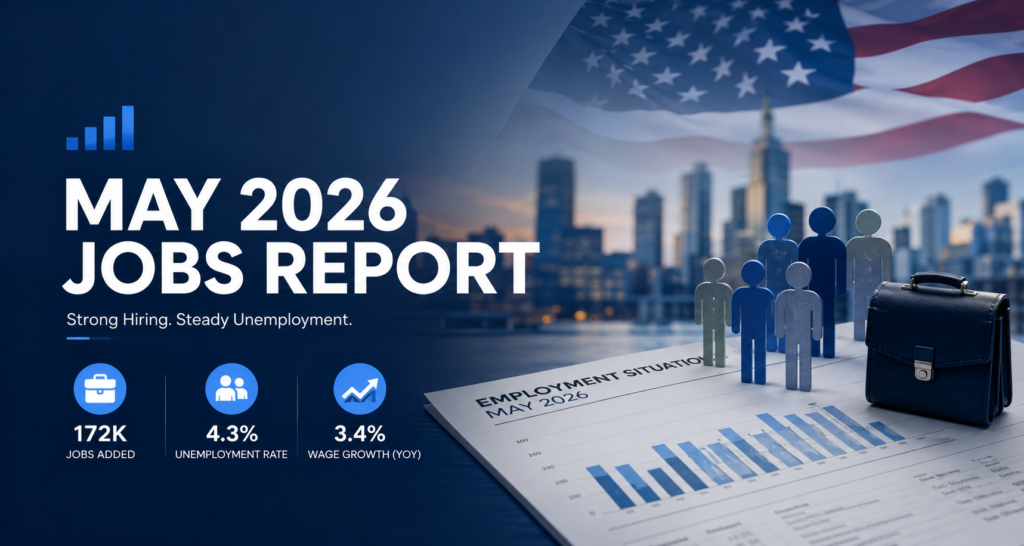
The U.S. economy added 172,000 nonfarm payroll jobs in May 2026, according to the Bureau of Labor Statistics report released June 5, 2026. That came in well above the consensus estimate (reported around 80,000–88,000) and was only slightly below April’s upwardly revised 179,000. The unemployment rate held at 4.3%, and average hourly earnings rose 0.3% on the month and 3.4% year-over-year. Together, the figures pointed to a labor market that stayed resilient despite higher energy prices and inflation.
Sources checked
- U.S. Bureau of Labor Statistics — Employment Situation, May 2026 (released June 5, 2026)
- BLS establishment and household survey tables
- Reported consensus estimates from major financial outlets
Data snapshot
| Metric | May 2026 | Prior (April 2026) | Consensus |
|---|---|---|---|
| Nonfarm payrolls | +172,000 | +179,000 (revised up) | ~80,000–88,000 |
| Unemployment rate | 4.3% | 4.3% | 4.3% |
| Avg hourly earnings (MoM) | +0.3% | — | +0.3% |
| Avg hourly earnings (YoY) | +3.4% | — | +3.4% |
| Labor force participation | 61.8% | 61.8% | — |
What happened
Job gains were led by leisure and hospitality (reported around 70,000, mostly food services), local government (around 55,000, largely education-related), and health care (around 35,000). Financial activities fell by about 22,000. The household survey, used to calculate the unemployment rate, also held steady, with participation unchanged at 61.8%. March and April were revised higher, reinforcing the stronger-hiring picture.
Why it matters
The monthly jobs report is one of the most market-moving U.S. data releases, affecting the dollar, bonds, and equities. A clear beat with steady unemployment lands just before the June 16–17 Federal Reserve meeting. Several outlets noted that an above-consensus jobs print gives the Fed less reason to ease policy soon, especially with headline inflation elevated. Wage growth of 3.4% year-over-year ran slightly below the headline inflation rate at the time, a detail economists watch for real-income trends.
Key signals table
| Signal | What it suggests | Caveat |
|---|---|---|
| Payrolls beat (+172K vs ~85K) | Hiring stronger than expected | One month is not a trend |
| Unemployment steady at 4.3% | Labor market not loosening sharply | Revisions can change the picture |
| Upward March/April revisions | Momentum better than first reported | Future revisions cut both ways |
| Wages +3.4% YoY | Pay growth near, not above, inflation | Real wage gap depends on the inflation gauge |
What changed versus prior context
Compared with earlier 2026 reports that suggested cooling, May extended a run of firmer prints with positive revisions. The combination of a payroll beat and a steady jobless rate shifted the narrative toward labor-market resilience rather than deterioration — a notable change given concerns about energy prices and consumer sentiment.
Risks, uncertainty, and limits
- BLS payroll figures are routinely revised in the following two months.
- Survey response rates and seasonal adjustments can affect month-to-month readings.
- A strong jobs print does not, by itself, determine Fed policy.
- This article explains the reported data; it does not predict the next report or market direction.
What to watch next
- June 16–17, 2026: FOMC meeting and updated projections.
- Late June: PCE inflation, the Fed’s preferred gauge.
- First Friday of July 2026: the June employment report.
- Weekly jobless claims for a higher-frequency labor read.
What this report does not conclude
This explainer does not tell readers what to buy, sell, or hold, and it does not forecast hiring or Fed action. It summarizes the BLS data, the sector detail, and the calendar items markets watch next.
How many jobs were added in May 2026?
The BLS reported 172,000 nonfarm payroll jobs added in May 2026, above the consensus estimate of roughly 80,000–88,000.
What was the unemployment rate in May 2026?
The unemployment rate held steady at 4.3%, unchanged from April.
Did wages keep up with inflation?
Average hourly earnings rose 3.4% year-over-year. At the time, that ran slightly below headline inflation, which several outlets noted when discussing real wages.
When is the next jobs report?
The Employment Situation is typically released on the first Friday of each month at 8:30 a.m. ET. Confirm the exact date on the BLS schedule.
Sources
- U.S. Bureau of Labor Statistics — Employment Situation, May 2026 (June 5, 2026).
- BLS establishment/household survey tables and sector detail.
- Major financial outlets’ coverage of consensus and market reaction.