Last updated: June 14, 2026, 3:30 PM ET
Topic: U.S. inflation gauges (educational explainer).
This article is for informational and educational purposes only. It is not financial advice, investment advice, or a recommendation to buy, sell, or hold any security, cryptocurrency, or financial product. Always verify data with official sources before making financial decisions.
Short answer: PCE vs CPI, what’s the difference?
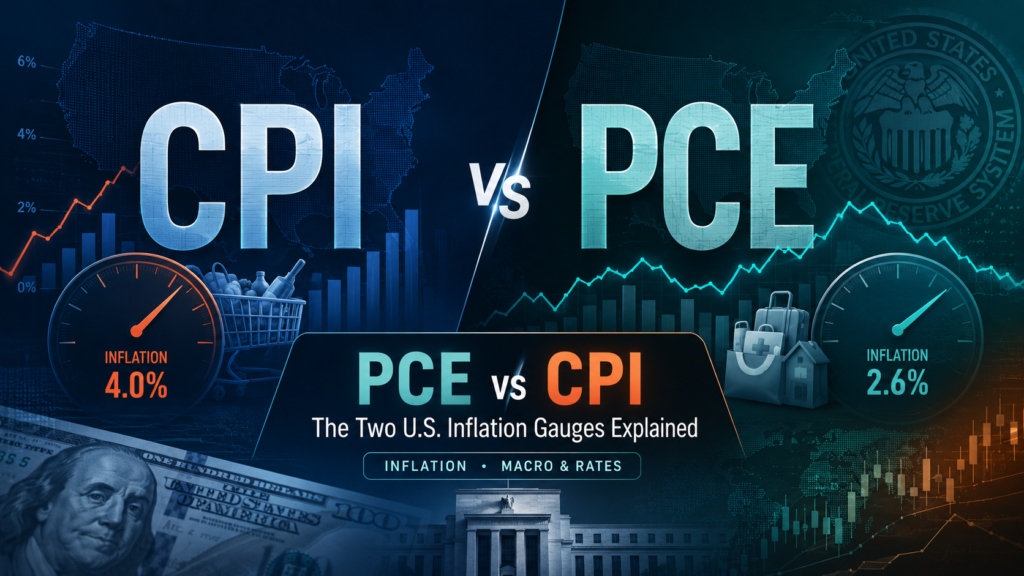
CPI (Consumer Price Index) and PCE (Personal Consumption Expenditures price index) are both official U.S. inflation gauges, but they are produced by different agencies and built differently. CPI comes from the Bureau of Labor Statistics and tends to run a bit higher; PCE comes from the Bureau of Economic Analysis and is the gauge the Federal Reserve cites for its 2% target. They usually move together but can diverge in any given month because of differences in weighting, scope, and methodology.
Side-by-side comparison
| Feature | CPI | PCE |
|---|---|---|
| Published by | Bureau of Labor Statistics (BLS) | Bureau of Economic Analysis (BEA) |
| Fed’s preferred? | Watched, but not the target gauge | Yes — the 2% target is on PCE |
| Typical level | Often slightly higher | Often slightly lower |
| Weighting | Fixed-basket, updated periodically | Adjusts as spending shifts (substitution) |
| Scope | Out-of-pocket urban consumer spending | Broader, includes spending on consumers’ behalf (e.g., employer health care) |
| Release timing | Mid-month, for prior month | Late month, for prior month |
Why the two can diverge
The biggest structural differences are weighting and scope. PCE adjusts for consumers substituting cheaper goods when prices rise, which can pull its readings lower than CPI. PCE also captures categories CPI does not weight as heavily — notably health care paid on a consumer’s behalf. Housing carries a larger weight in CPI, so when shelter inflation is hot, CPI can look hotter than PCE.
A real-world example
In May 2026, headline CPI rose 4.2% year-over-year, driven heavily by energy, while core CPI was 2.9%. The Fed, however, frames policy around core PCE. That is one reason a hot CPI headline and a calmer Fed stance can coexist: the gauges and the components the Fed emphasizes are not identical. Watching both, and especially the core versions, gives a fuller picture than either alone.
Where these show up on EskiSignal
- May 2026 CPI Report — the latest CPI reading and components.
- CPI Release Dates 2026 — the BLS release calendar.
- June 2026 FOMC Meeting — how the Fed frames inflation.
Mini glossary
| Term | Plain-English meaning |
|---|---|
| Headline inflation | All items, including food and energy |
| Core inflation | Excludes food and energy to show the underlying trend |
| Substitution effect | Consumers buying cheaper alternatives when prices rise |
| Shelter | Housing costs, a large CPI component |
Risks, uncertainty, and limits
- Both gauges are revised; PCE in particular is revised as data updates.
- A single month’s gap between CPI and PCE is not a trend.
- This is an educational explainer, not advice or a forecast.
What to watch next
- Late June 2026: the next PCE release (the Fed’s preferred gauge).
- July 2026: the next CPI release.
- Core readings on both gauges, which the Fed weighs most heavily.
What this article does not conclude
This explainer defines the two gauges and how they differ. It does not predict either reading or recommend any action.
What is the difference between CPI and PCE?
Both measure U.S. inflation, but CPI (from the BLS) uses a fixed basket and tends to run higher, while PCE (from the BEA) adjusts for spending shifts and is the gauge the Fed targets at 2%.
Which inflation gauge does the Fed use?
The Federal Reserve’s 2% target is set on PCE inflation, specifically core PCE, though it monitors CPI as well.
Why is CPI usually higher than PCE?
Differences in weighting and scope — including a larger housing weight in CPI and PCE’s substitution adjustment — tend to make CPI read slightly higher.
When is PCE released?
PCE is published by the BEA late in the month for the prior month, typically after CPI. Confirm exact dates on the BEA schedule.
Sources
- U.S. Bureau of Labor Statistics — CPI methodology.
- U.S. Bureau of Economic Analysis — PCE price index methodology.
- Federal Reserve communications on its inflation target.