Last updated: June 17, 2026, 10:30 AM ET
Topic: monetary policy mechanics (educational explainer).
This article is for informational and educational purposes only. It is not financial advice, investment advice, or a recommendation to buy, sell, or hold any security, cryptocurrency, or financial product. Always verify data with official sources before making financial decisions.
Short answer: what does it mean when the Fed holds rates?
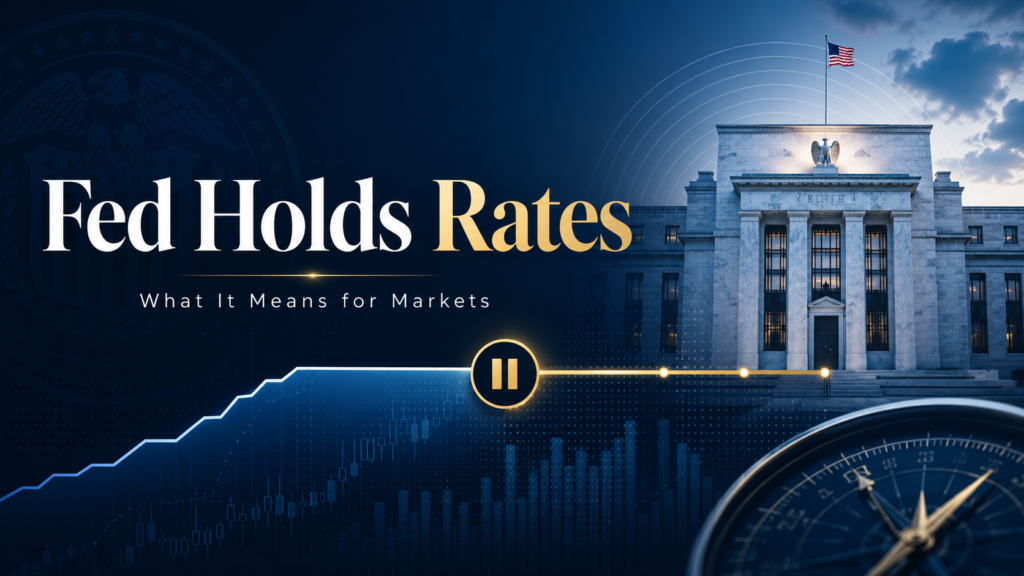
When the Federal Reserve “holds” rates, it leaves the federal funds target range unchanged at a policy meeting rather than raising or cutting. As of mid-June 2026, that range was 3.50%–3.75%, held since late 2025. A hold does not mean nothing happened: the Fed still issues a statement, and at four of its eight annual meetings (March, June, September, December) it also publishes updated economic projections — the “dot plot.” Markets often react more to the statement language and projections than to the unchanged rate itself.
What a hold affects
| Channel | What a hold tends to mean | Caveat |
|---|---|---|
| Borrowing costs | Rates on loans/credit stay roughly where they are | Market rates can still move on expectations |
| Savings/CDs | Yields hold near current levels | Banks set their own rates |
| Mortgages | Tied more to long-term yields than the policy rate | Can move independently of a hold |
| Stocks | Removes immediate rate-change risk | Tone/projections still move markets |
| The dollar | Depends on how the hold compares to expectations | Relative to other central banks |
Why a hold can still move markets
A hold is only the headline. Investors parse three things around it: the statement language (any shift in how the Fed describes inflation or its policy bias), the dot plot at projection meetings (the median path for future rates), and the press conference tone. A hold paired with a more hawkish projection can pressure rate-sensitive assets even though the rate did not change — and vice versa.
Hold vs hike vs cut
| Action | What it signals | Typical market focus |
|---|---|---|
| Hold | Wait-and-see; assess incoming data | Statement and projections |
| Hike | Fighting inflation / tightening | Pace and end point |
| Cut | Supporting growth / easing | How many more to come |
A real-world framing
Heading into the June 17, 2026 meeting, futures markets priced a very high probability of a hold, with attention on the updated dot plot and the new Fed chair’s first press conference. That is a textbook example of why a “nothing-changed” rate decision can still be a major market event: the information is in the projections and the tone, not the rate line.
Where this shows up on EskiSignal
- June 2026 FOMC Meeting — the specific meeting and dot plot.
- When Will the Fed Cut Rates? — the conditions for a cut.
- Will Mortgage Rates Go Down? — how rates flow to mortgages.
Mini glossary
| Term | Plain-English meaning |
|---|---|
| Federal funds rate | The Fed’s main policy interest rate (a target range) |
| Hold | Leaving the target range unchanged |
| Dot plot | Policymakers’ projected future rate path |
| Hawkish / dovish | Leaning toward higher / lower rates |
Risks, uncertainty, and limits
- Market reaction to a hold depends on expectations going in.
- Mortgage and savings rates do not move mechanically with the policy rate.
- This is educational content, not a forecast or advice.
What this article does not conclude
This explainer describes what a rate hold means and why markets still react. It does not predict the decision or recommend any action.
What does it mean when the Fed holds interest rates?
It means the Federal Reserve leaves its federal funds target range unchanged at a meeting. The Fed still issues a statement and, at four meetings a year, updated projections.
Why do markets react if rates didn’t change?
Because investors focus on the statement language, the dot plot, and the press conference tone, which can shift expectations for future policy even when the current rate is unchanged.
Does a Fed hold affect mortgage rates?
Not directly. Mortgage rates track long-term Treasury yields more than the policy rate, so they can move independently of a hold.
What is the federal funds rate now?
As of mid-June 2026, the target range was 3.50%–3.75%. Confirm the current level with the Federal Reserve.
Sources
- Federal Reserve — FOMC statements and the Summary of Economic Projections.
- Federal Reserve education materials on monetary policy.