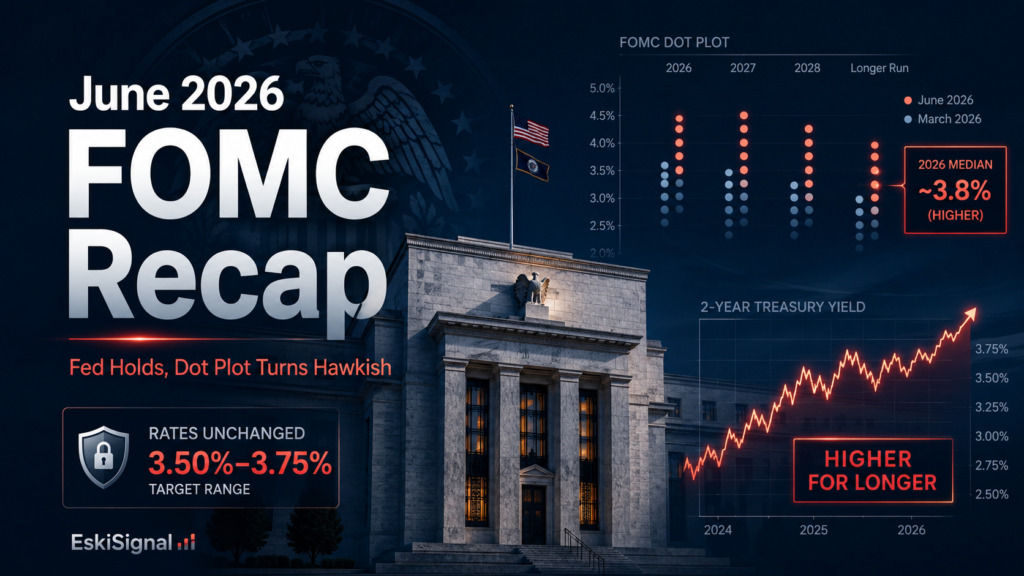
Kevin Warsh ran his first meeting as Fed chair on June 17, 2026, and the rate itself was the least surprising part of the day. The Federal Open Market Committee voted 12-0 to keep the federal funds target range at 3.50% to 3.75% — the fourth straight hold. What actually moved markets was everything underneath: a new set of projections that erased the rate cut policymakers had still penciled in back in March, and a noticeably shorter, more hawkish-reading statement.
Informational and educational content only. Nothing here is financial or investment advice, or a recommendation to buy, sell, or hold anything. Verify figures against official sources before acting on them.
The numbers that mattered
The vote was unanimous, but the projections were not. Of the 18 officials who submitted forecasts, nine expected at least one rate hike before the end of 2026, eight saw no change, and only one still projected a cut. That pushed the median year-end 2026 rate up to roughly 3.8%, a quarter point above the current range. That was a full flip from the 3.4% median back in March, which had still implied a cut.
| Projection (median) | June 2026 | March 2026 |
|---|---|---|
| Year-end 2026 fed funds rate | ~3.8% | ~3.4% |
| Core PCE inflation, 2026 | ~3.3% | 2.7% |
| Unemployment rate, 2026 | 4.3% | 4.4% |
| Real GDP growth, 2026 | 2.2% | 2.4% |
| Longer-run rate | 3.1% | 3.1% |
The longer-run dot held at 3.1%, which is worth pausing on. Officials did not change their view of where rates eventually settle. They simply expect to stay above that level for longer than they thought a few months ago, mainly because inflation has run hotter on the back of the energy shock that came out of the Iran war.
A shorter statement, and a missing dot
Two things made this meeting distinctly Warsh’s. First, the policy statement came in at roughly 130 words — about a third the length of April’s — and dropped the forward-guidance language that had leaned dovish. Warsh described it as shorter, simpler, and stripped of older phrasing, framing it as a deliberate move away from signaling future policy.
Second, Warsh did not submit his own dot. The SEP reflected 18 participants rather than the usual 19, and he confirmed in the press conference that he had encouraged colleagues to contribute while abstaining himself. He has previously suggested the dot plot should eventually become “a relic,” so the omission read as more than a scheduling quirk.
How markets took it
Stocks slipped and short-term yields jumped as investors digested half the committee penciling in a hike. The reaction fit a pattern Citi had flagged going in: first meetings under a new chair tend to be used to establish inflation-fighting credibility, and the 2-year Treasury typically sells off more than at a routine meeting. By the following weeks, CME FedWatch pricing had shifted toward a meaningful chance of a hike later in 2026 rather than the cut markets once assumed.
What Warsh signaled beyond rates
The press conference doubled as a preview of how he intends to run the institution. He announced five task forces to review monetary policy operations, communications, data sources, productivity, and the causes and measurement of inflation, with most expected to report by year-end. He reaffirmed the 2% target and said he saw no reason to revisit it until it is met. He also indicated no near-term plans to shrink the Fed’s roughly $6.7 trillion balance sheet, keeping the “ample reserves” framework in place for now.
Why it matters for the rest of 2026
The takeaway is not the hold — that was priced in. It is that the committee’s center of gravity moved toward higher-for-longer, with the balance of risks tilted to the upside on inflation. Whether that hardens into an actual hike depends heavily on incoming data, and several strategists, including at J.P. Morgan, still argue the spring oil spike will fade and leave the Fed on hold. The gap between the hawkish dots and that more benign base case is the thing worth tracking into the next projection meeting.
One useful lens, and not a forecast: a higher-for-longer rate path can mean two very different things depending on what is driving it. Sticky inflation and genuine economic strength can produce the same dots while carrying opposite messages. The June meeting leaned toward the inflation-stickiness read, but the data over the summer will settle which story dominates.
What did the Fed decide in June 2026?
The FOMC held the federal funds rate at 3.50% to 3.75% by a unanimous 12-0 vote on June 17, 2026. The bigger news was the dot plot, which removed the 2026 rate cut and lifted the median year-end rate to about 3.8%.
Why was the meeting seen as hawkish if rates didn’t change?
Because the projections flipped from implying a cut in March to implying a possible hike, and the statement dropped its easing-leaning forward guidance. Half the committee now sees at least one hike in 2026.
Did Kevin Warsh submit a dot?
No. Warsh abstained from the dot plot in his first meeting, so the projections reflected 18 participants instead of 19. He has signaled he favors moving away from the dot plot over time.
Will the Fed hike rates later in 2026?
This article does not forecast that. The projections show many officials expect a hike, and futures pricing has leaned that way, but the outcome depends on incoming inflation and labor data.
Sources
- Federal Reserve — June 17, 2026 FOMC statement and Summary of Economic Projections.
- CNBC, Fox Business, Chase, and J.P. Morgan coverage of the decision and press conference.
- CME FedWatch implied probabilities as reported.