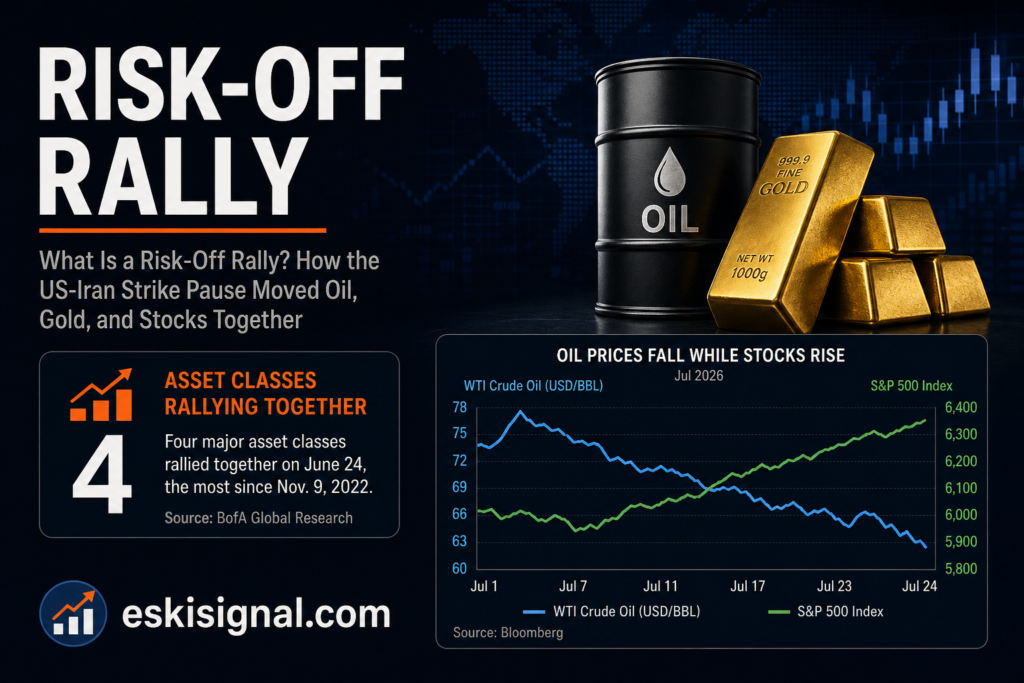
Oil fell, gold rose, bonds gained, and stocks rallied on the same morning — four asset classes that don’t usually move together, moving together. The trigger was simple: Washington and Tehran stepped back from further military action, and markets that had spent days pricing in escalation suddenly had to price in de-escalation instead. That’s a risk-off rally running in reverse, and it’s worth understanding the mechanics, because this exact pattern will repeat the next time geopolitical risk spikes and then fades.
This article is for informational and educational purposes only. It is not financial advice, investment advice, or a recommendation to buy, sell, or hold any security, cryptocurrency, or financial product. Always verify data with official sources before making financial decisions.
Quick answer: what is a risk-off rally?
Quick answer: “Risk-off” describes a shift toward safer, more defensive assets — Treasuries, gold, the dollar, defensive equity sectors — and away from riskier ones like growth stocks, high-yield credit, and commodities exposed to conflict, typically triggered by rising geopolitical or macro uncertainty. A risk-off rally, somewhat confusingly, usually refers to relief buying in risk assets once that uncertainty fades — stocks and other risk assets “rally” precisely because the risk-off pressure that had been weighing on them lifts. Late July 2026 saw exactly this pattern: as the U.S. and Iran refrained from further strikes, oil fell, and stocks, bonds, and gold all gained together in a relief move.
Why oil, gold, bonds, and stocks moved the same direction
Under normal conditions, oil and stocks often move independently, and gold and stocks can move in opposite directions since gold is a classic safe haven. The reason all four moved together here is that the underlying driver — war-risk premium in the Middle East — had been distorting all of them simultaneously in the same direction, and removing that one variable let each asset revert toward its own fundamentals at once. Oil had been carrying a geopolitical risk premium on fears that a wider conflict could disrupt shipping through the Strait of Hormuz, so a pause in strikes let crude give back that premium. Equities had been discounting the same disruption risk to global growth and energy costs, so the same news lifted stocks. Gold and bonds, which had both been bid as safe havens during the escalation, gave back some of that safe-haven premium — yet stocks and bonds still gained together here because falling oil prices also eased inflation-expectations pressure on yields, a secondary effect layered on top of the initial relief.
| Asset class | Typical move on escalation | Move on the strike pause |
|---|---|---|
| Oil (WTI/Brent) | Rises on supply-disruption fears | Fell as the disruption risk eased |
| Gold | Rises as a safe haven | Gained, alongside bonds, on the broader relief move |
| US Treasuries | Gain (yields fall) on safe-haven demand | Gained further as oil-driven inflation fears eased |
| Equities (S&P 500, Dow) | Fall on growth/energy-cost risk | Rallied across most sectors |
Which sectors led, and which lagged
The sector split on the day of the rally told the same story from a different angle. Communications and consumer-defensive stocks were among the morning’s top performers — sectors that had been holding up regardless of the conflict and simply rode the broader lift. Technology and energy, by contrast, ended the session in the red even on a relief-rally day, because both sectors were dealing with their own separate pressures: energy from the very oil-price decline that was driving the broader rally, and technology from a rotation out of AI-related names on capex concerns that had nothing to do with the Middle East. That’s a useful reminder that a single day’s macro catalyst doesn’t override every stock-specific story running underneath it.
Why the “pause” framing matters
Markets reacted to a pause in strikes, not a resolution or a formal ceasefire agreement — an important distinction. Relief rallies built on a pause rather than a durable settlement tend to be more fragile, because the underlying risk hasn’t been removed, only deferred. That’s part of why crude and safe-haven assets can snap back quickly if hostilities resume, and why traders tend to treat these moves as tradeable relief rather than a new baseline.
Risks and limits
- Geopolitical de-escalation can reverse quickly, and markets that rally on a pause can give those gains back just as fast if the situation changes.
- Cross-asset correlations described here reflect this specific episode; correlations between oil, gold, bonds, and equities are not fixed and shift depending on what’s driving each asset at a given time.
- This is educational content describing market mechanics around a specific news event, not a forecast of future oil, gold, bond, or equity prices.
Why did stocks and gold rise together if gold is a safe haven?
Normally gold and equities can diverge, but here both were reacting to the same underlying shift: falling oil-driven inflation pressure supported bonds and gold, while reduced conflict risk supported equities — different mechanisms pointing the same direction at the same time.
Is a strike pause the same as a ceasefire?
No. A pause means active strikes have stopped for now, without necessarily reflecting a formal, durable agreement — which is why markets often treat pause-driven rallies as more reversible than moves built on a signed deal.
Why did tech and energy stocks fall even during the relief rally?
Energy stocks were pressured by the falling oil prices that were driving the broader rally, while tech stocks were dealing with a separate rotation away from AI-capex-heavy names — both sector-specific pressures that outweighed the day’s broader macro relief.
Sources
- Market wrap coverage of U.S. equity, oil, gold, and bond moves, July 27, 2026.
- Reporting on the U.S.-Iran military de-escalation and its market impact, late July 2026.