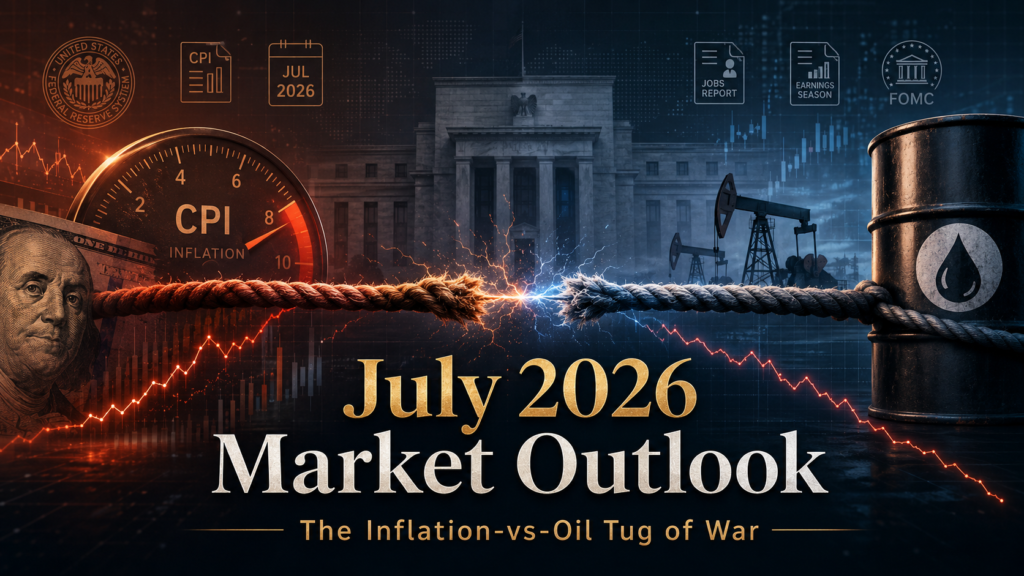
Heading into July 2026, the market is balancing two stories that point in opposite directions. On one side, the Fed has turned more hawkish and inflation is still running well above target. On the other, oil has dropped sharply since the U.S.–Iran framework deal, which could pull the main driver of the spring inflation spike back down. July’s data will largely decide which of those forces wins out for the rest of the summer. This is a map of the month’s catalysts and themes — not a prediction of where prices go.
Informational and educational content only. Nothing here is financial or investment advice, or a recommendation to buy, sell, or hold anything. Verify figures against official sources before acting on them.
The setup coming into the month
June ended with the Fed holding rates at 3.50%–3.75% but signaling, through its dot plot, that the next move was now more likely a hike than a cut. At the same time, the energy shock that pushed May CPI to a 4.2% annual rate began to unwind after oil fell back toward $80 on the de-escalation in the Middle East. Equities had been resilient through all of it, with the S&P holding up on the same AI-productivity theme the new Fed chair likes to cite.
Three themes to watch in July
| Theme | What it hinges on | Key dates |
|---|---|---|
| Is inflation rolling over? | Whether lower oil feeds into CPI and PCE | CPI ~Jul 15; PCE ~Jul 31 |
| Is the labor market still tight? | June payrolls and wage growth | Jobs report ~Jul 2 |
| Hike or hold into the fall? | The July FOMC statement and tone | FOMC Jul 29–30 |
Earnings season ramps up
July also kicks off second-quarter earnings. Big banks traditionally report first in mid-July, followed by the large-cap technology names later in the month. With index performance leaning heavily on a handful of mega-cap and AI-linked companies, those reports carry outsized weight for the broad market. The question investors will be asking is whether AI-driven capital spending and margins are still expanding at the pace the valuations imply.
Cross-asset backdrop
Beyond stocks and rates, a few markets are worth keeping in view. Oil’s direction matters more than usual this summer because it sits at the center of the inflation debate. Gold has been trading near historic highs on central-bank buying and lingering geopolitical caution. And the front end of the Treasury curve has repriced toward a Fed that stays put — or tightens — rather than one that eases. Each of these is a thread connected to the same core question about inflation’s path.
- Oil: a sustained drop would ease inflation pressure; a rebound would revive it.
- Gold: elevated, sensitive to real rates and the dollar.
- Short-term yields: reflect higher-for-longer expectations after June’s dots.
- Mega-cap tech earnings: the swing factor for index direction.
How to use a monthly outlook
An outlook like this is a checklist, not a crystal ball. The point is to know in advance which dates and which markets are likely to set the tone, so that when a number lands you already understand why it matters and what it would change. The releases are scheduled; the reactions are not. Pairing this with the month’s data calendar gives you the full picture without needing to predict any single outcome.
What should investors watch in July 2026?
The big three are the June jobs report (early July), June CPI (mid-July), and the July 29–30 FOMC meeting, alongside the start of Q2 earnings season. Oil’s direction is the connecting thread for the inflation story.
Will the Fed hike rates in July 2026?
This article does not predict that. June’s projections showed many officials expect a hike this year, but July is not a projection meeting, so the focus is the statement and tone rather than new dots.
Why does oil matter so much this summer?
Energy drove the spring inflation spike. With oil falling after the U.S.–Iran de-escalation, whether that drop sticks and feeds into CPI and PCE is central to the inflation outlook.
When does Q2 2026 earnings season start?
Large banks typically report in mid-July, with big technology names following later in the month. Those reports carry heavy weight for index direction given concentration in mega-cap stocks.
Sources
- Federal Reserve — June 2026 FOMC statement and projections.
- U.S. BLS and BEA — July release schedules.
- Public reporting on oil, gold, and Q2 earnings timing.