Last updated: June 14, 2026, 3:30 PM ET
Market context: gold prices and safe-haven demand (commodities explainer).
This article is for informational and educational purposes only. It is not financial advice, investment advice, or a recommendation to buy, sell, or hold any security, cryptocurrency, or financial product. Always verify data with official sources before making financial decisions.
Short answer: why has gold been rising in 2026?
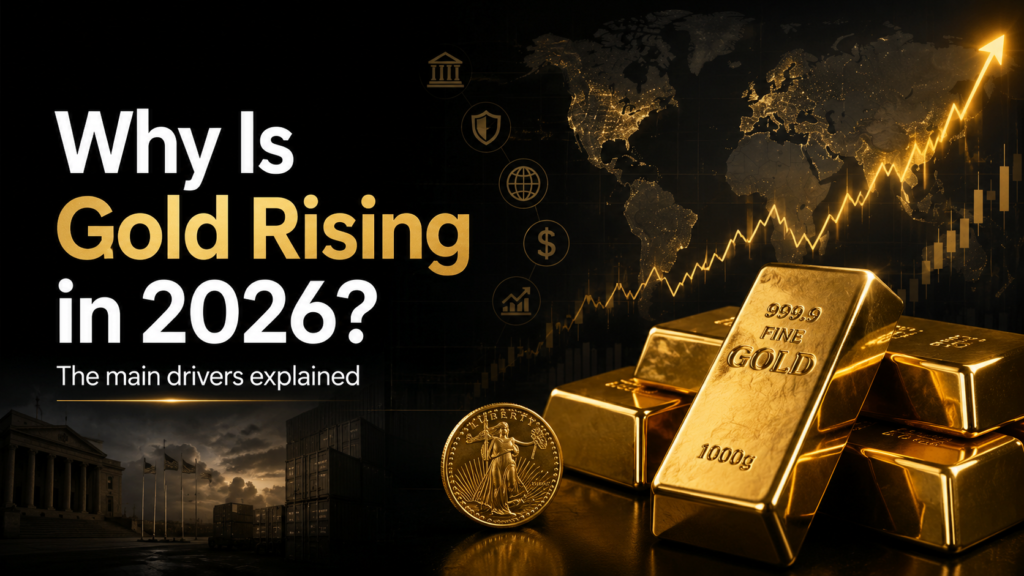
Gold has traded at historically high levels through 2026, reaching record territory earlier in the year before volatile swings. Analysts and institutions point to a recurring set of drivers rather than a single cause: strong central-bank buying, elevated geopolitical risk (including the Iran conflict), inflation concerns, expectations around interest rates, and questions about the U.S. dollar’s role. Because gold pays no yield, it tends to attract demand when investors seek a store of value and diversification, especially in uncertain environments.
Sources checked
- World Gold Council — central-bank demand data and analysis
- Major bank research notes (e.g., J.P. Morgan, Goldman Sachs) on gold drivers and forecasts
- Public reporting on 2026 price action and geopolitical context
The main drivers, at a glance
| Driver | Why it supports gold | Caveat |
|---|---|---|
| Central-bank buying | Diversification away from the dollar | Pace can slow or reverse |
| Geopolitical risk | Safe-haven demand in crises | Eases if tensions de-escalate |
| Inflation concerns | Gold seen as a store of value | Relationship is not mechanical |
| Rate expectations | Lower real rates reduce gold’s opportunity cost | Rate hikes can pressure gold |
| Dollar questions | De-dollarization narratives | A stronger dollar can weigh on gold |
What happened
Reporting described gold surging to records in early 2026, with intraday highs well above prior peaks, followed by sharp pullbacks — including a notable monthly decline in March 2026. Institutions have continued to publish elevated price targets while acknowledging that investor interest ebbs and flows. The throughline in 2026 coverage is that the same structural forces — central banks, geopolitical risk, and monetary credibility questions — keep underpinning demand even through volatile swings.
Why it matters
Gold is a widely watched barometer of risk sentiment and a hedge many investors use for diversification. Its moves often reflect broader concerns about inflation, currencies, and geopolitics. But gold is also volatile and yield-free, so a high price is not a one-way signal. Several research notes caution that easing tensions, higher real rates, or a stronger dollar could pressure gold lower.
Key signals table
| Signal | What it can indicate | Caveat |
|---|---|---|
| Central-bank purchases | Structural, longer-term demand | Reported pace varies |
| Real interest rates | Lower real rates tend to help gold | Can reverse with rate moves |
| Dollar index (DXY) | Weaker dollar often supports gold | Correlation is not constant |
| Geopolitical headlines | Short-term safe-haven flows | Can fade quickly |
What changed versus prior context
Compared with earlier years, 2026 featured both record highs and unusually large swings, reflecting gold trading at elevated levels where volatility tends to rise. The geopolitical backdrop — particularly the Iran conflict and energy-market stress — reinforced safe-haven themes, even as some analysts noted gold consolidating between technical levels at times.
Risks, uncertainty, and limits
- Gold pays no yield; holding it has an opportunity cost when rates are high.
- Price targets from banks are forecasts and frequently revised.
- De-escalation, higher real rates, or a stronger dollar could weigh on gold.
- This article explains drivers; it does not predict gold’s price or recommend any action.
What to watch next
- Central-bank gold purchase data from the World Gold Council.
- Real interest rates and the U.S. dollar index.
- Geopolitical developments, including the Middle East situation.
- Upcoming inflation data (CPI, PCE) and Fed communications.
What this article does not conclude
This explainer does not tell readers whether to buy, sell, or hold gold, and it does not predict its price. It lays out the drivers analysts cite and the risks to each.
Why is gold rising in 2026?
Analysts cite central-bank buying, geopolitical risk (including the Iran conflict), inflation concerns, rate expectations, and questions about the dollar. Gold tends to attract demand as a store of value in uncertain times.
Does a high gold price mean a crisis is coming?
Not necessarily. Gold reflects a mix of demand drivers and can rise on structural buying as well as fear. A high price is not a reliable forecast of a specific event.
What could make gold fall?
Easing geopolitical tensions, higher real interest rates, or a stronger U.S. dollar could pressure gold, since it pays no yield and competes with interest-bearing assets.
Is gold a good inflation hedge?
Gold is often used as a long-term store of value, but its relationship with inflation is not mechanical and can vary over time. This article does not give investment advice.
Curious what current gold and silver prices mean in dollar terms for your own jewelry or holdings? Use our Gold & Silver Price Calculator to convert spot price into gram, ounce, or karat-adjusted value.
Sources
- World Gold Council — central-bank demand data and analysis.
- Major bank research (J.P. Morgan, Goldman Sachs) on gold drivers and forecasts.
- Public reporting on 2026 gold price action and geopolitical context.