Last updated: June 14, 2026, 3:30 PM ET
Market context: FTSE Russell US index reconstitution (calendar explainer).
This article is for informational and educational purposes only. It is not financial advice, investment advice, or a recommendation to buy, sell, or hold any security, cryptocurrency, or financial product. Always verify data with official sources before making financial decisions.
Short answer: when is the June 2026 Russell Reconstitution?
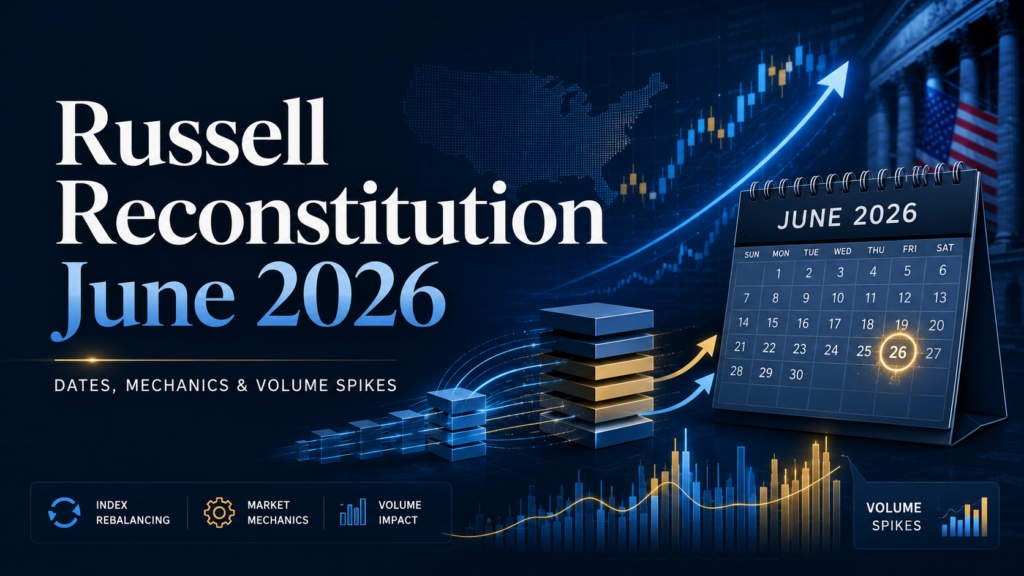
The June 2026 Russell Reconstitution becomes final after the U.S. market close on Friday, June 26, 2026, with the newly recalibrated indexes effective from the open on Monday, June 29, 2026. This is the annual (now semi-annual) rebalancing of the Russell US Indexes — including the Russell 3000, Russell 1000, and Russell 2000 — and it is one of the highest-volume trading sessions of the year as funds tracking these indexes adjust their holdings.
Sources checked
- FTSE Russell / LSEG — 2026 Russell Reconstitution schedule and preliminary results
- FTSE Russell methodology for the Russell US Indexes
- Public reporting on reconstitution mechanics and volume
2026 reconstitution timeline
| Step | Date | Note |
|---|---|---|
| Rank day | Thursday, April 30, 2026 | Companies ranked by market cap at close |
| Preliminary lists posted | Friday, May 22, 2026 | First additions/deletions published |
| List updates | May 29; June 5, 12, 18, 2026 | Updated after close (~6 PM ET) |
| Reconstitution final | Friday, June 26, 2026 | Final after U.S. market close |
| New indexes effective | Monday, June 29, 2026 | Trading begins on reconstituted indexes |
What’s new in 2026
FTSE Russell moved the Russell US Indexes back to a semi-annual reconstitution schedule starting in 2026, citing faster-moving markets and rising mega-cap concentration. That means a second, smaller rebalance is scheduled later in the year (effective in December 2026) in addition to the main June event. According to FTSE Russell’s preliminary 2026 results, the total market capitalization of the Russell 3000 rose about 29% from the prior rebalance, and the large-cap/small-cap breakpoint between the Russell 1000 and Russell 2000 increased to roughly $5.7 billion.
Why it matters
Trillions of dollars are benchmarked to the Russell US Indexes, so when membership changes, index funds and ETFs must buy newly added names and sell deletions to match the new composition. That mechanical rebalancing concentrates enormous volume into the final minutes of reconstitution day. Stocks moving between the Russell 1000 and Russell 2000, or entering/exiting the indexes entirely, can see unusual trading activity in the weeks leading up to and on the effective date.
How to read the event
- Additions/deletions: names joining or leaving an index face forced buying or selling by index funds.
- Up/down migrations: stocks moving between large- and small-cap indexes shift their fund ownership base.
- Volume spike: reconstitution day is typically among the year’s highest-volume sessions.
- Mechanical, not fundamental: the flows reflect index rules, not a view on company value.
Key signals table
| Signal | What it reflects | Caveat |
|---|---|---|
| Pre-recon speculation | Analysts guessing additions/deletions | Predictions can be wrong |
| Volume on June 26 | Index funds rebalancing | High volume is not direction |
| Small-cap breakpoint shift | Where large- vs small-cap is drawn | Changes each cycle |
Risks, uncertainty, and limits
- Preliminary membership lists can change before the final date.
- Reconstitution-driven moves are mechanical and can reverse afterward.
- Always confirm dates and lists with FTSE Russell directly.
- This article explains the event; it does not recommend any trade or predict price moves.
What to watch next
- Thursday, June 18, 2026: last preliminary list update.
- Friday, June 26, 2026: reconstitution final after the close.
- Monday, June 29, 2026: reconstituted indexes effective.
- December 2026: the new second (semi-annual) rebalance.
What this article does not conclude
This explainer states the schedule and mechanics of the reconstitution. It does not recommend any trade or predict how affected stocks will move.
When is the June 2026 Russell Reconstitution?
It becomes final after the U.S. market close on Friday, June 26, 2026, with the reconstituted indexes effective from the open on Monday, June 29, 2026.
What is the Russell Reconstitution?
It is the periodic rebalancing of the Russell US Indexes (Russell 3000, 1000, and 2000), updating membership to reflect changes in company size across the U.S. equity market.
Why is reconstitution day high volume?
Trillions of dollars track these indexes, so index funds must buy additions and sell deletions to match the new composition, concentrating volume into the close.
What changed about the schedule in 2026?
FTSE Russell returned to a semi-annual reconstitution in 2026, adding a second, smaller rebalance later in the year (effective December 2026) alongside the main June event.
Sources
- FTSE Russell / LSEG — 2026 Russell Reconstitution schedule and preliminary results.
- FTSE Russell — Russell US Indexes methodology.
- Public reporting on reconstitution mechanics and trading volume.