Last updated: June 14, 2026, 3:30 PM ET
Topic: market-structure basics (educational explainer).
This article is for informational and educational purposes only. It is not financial advice, investment advice, or a recommendation to buy, sell, or hold any security, cryptocurrency, or financial product. Always verify data with official sources before making financial decisions.
Short answer: what is quadruple witching?
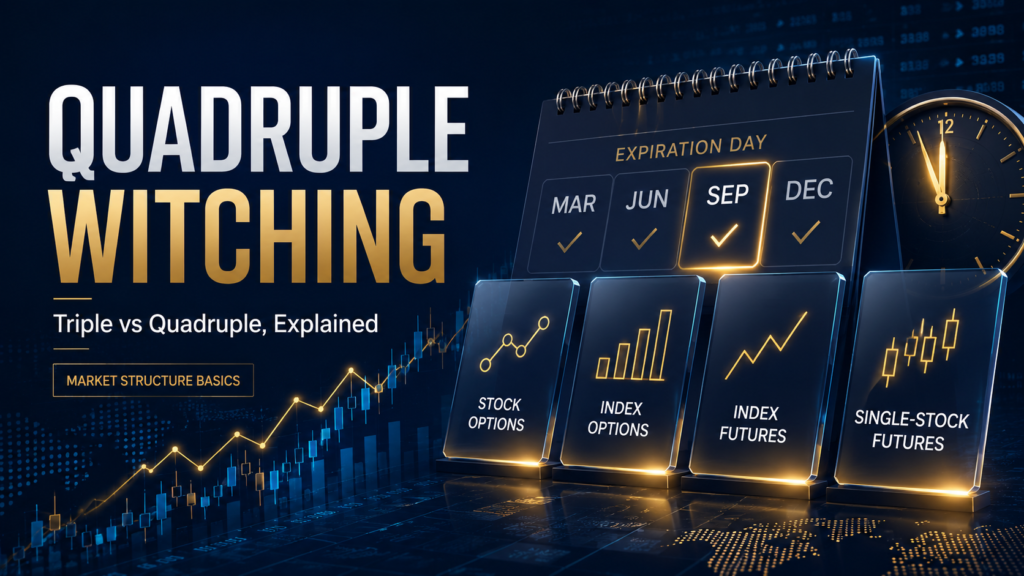
Quadruple witching is the quarterly date when four types of equity derivatives expire around the same session: stock options, stock index options, stock index futures, and single-stock futures. It happens on the third Friday of March, June, September, and December (shifted earlier when that Friday is a holiday). Because single-stock futures are a small product in the U.S., the same event is often called “triple witching.” The two terms describe the same calendar dates.
Triple vs quadruple witching
| Term | Contracts that expire | Notes |
|---|---|---|
| Triple witching | Stock options, index options, index futures | Most common U.S. usage today |
| Quadruple witching | The three above + single-stock futures | Single-stock futures are a minor U.S. product |
In practice, most U.S. market commentary uses “triple witching” because single-stock futures have minimal impact. The dates are identical either way.
A real-world example
Consider the third Friday of a quarter-ending month. An institution holding a large S&P 500 index options position must decide whether to let it expire, close it, or roll it to the next expiration. As that position is managed, the market makers on the other side adjust their hedges by buying or selling the underlying stocks or futures. Multiply that across many large positions and you get the elevated volume that characterizes these sessions, particularly in the final hour.
Why volume and volatility tend to rise
- Position rolling: traders move expiring exposure to a later date.
- Hedging flows: market makers rebalance to stay delta-neutral.
- Index rebalancing overlap: some quarters coincide with index reconstitution.
- The “witching hour”: the last trading hour often sees the most activity.
A key nuance: this activity is mechanical, not a directional forecast. High volume on a witching day does not tell you whether the market will close up or down.
Where it shows up on EskiSignal
- Triple Witching June 2026 — the specific upcoming date and mechanics.
- What Is Unusual Volume in Stocks? — reading volume signals in context.
- Stock Market Holidays 2026 — how holidays shift expiration dates.
Risks, uncertainty, and limits
- Witching has no reliable bullish or bearish bias.
- Effects differ quarter to quarter and can be overshadowed by news.
- In-the-money options may be automatically exercised at expiration — a mechanics point.
- This is an educational explainer, not trading guidance.
Mini glossary
| Term | Plain-English meaning |
|---|---|
| Expiration | The date a derivative contract ends |
| Roll | Closing an expiring contract and opening a later-dated one |
| Delta-neutral | A hedging stance that offsets directional exposure |
| Pin risk | Uncertainty when a stock sits near an option’s strike at expiration |
| Witching hour | The final trading hour on a witching day |
What this article does not conclude
This explainer defines the event and its mechanics. It does not recommend any strategy or predict how a witching session will trade.
What is the difference between triple and quadruple witching?
Triple witching covers stock options, index options, and index futures. Quadruple witching adds single-stock futures. Since single-stock futures are a minor U.S. product, the dates are the same and most commentary uses ‘triple witching.’
When does quadruple witching happen?
On the third Friday of March, June, September, and December, shifted earlier if that Friday is a market holiday.
Is quadruple witching bullish or bearish?
Neither reliably. It typically brings higher volume and can be more volatile, but the flows are mechanical and have no consistent directional bias.
Why is the last hour called the witching hour?
Trading activity tends to peak in the final hour as expiring positions are closed, offset, or rolled, and hedges are adjusted.
Sources
- Market-structure references on witching mechanics and contract types.
- Exchange options-calendar conventions for quarterly expirations.