The entire argument for raising rates into an energy shock rests on one claim: that without action, inflation expectations will drift higher and the shock will become permanent. There is a market price for that claim, published daily, and it is one of the few places where the central question in monetary policy right now has a number attached to it.
This article is for informational and educational purposes only. It is not financial advice, investment advice, or a recommendation to buy, sell, or hold any security, cryptocurrency, or financial product. Always verify data with official sources before making financial decisions.
Short answer: the difference between two Treasury yields
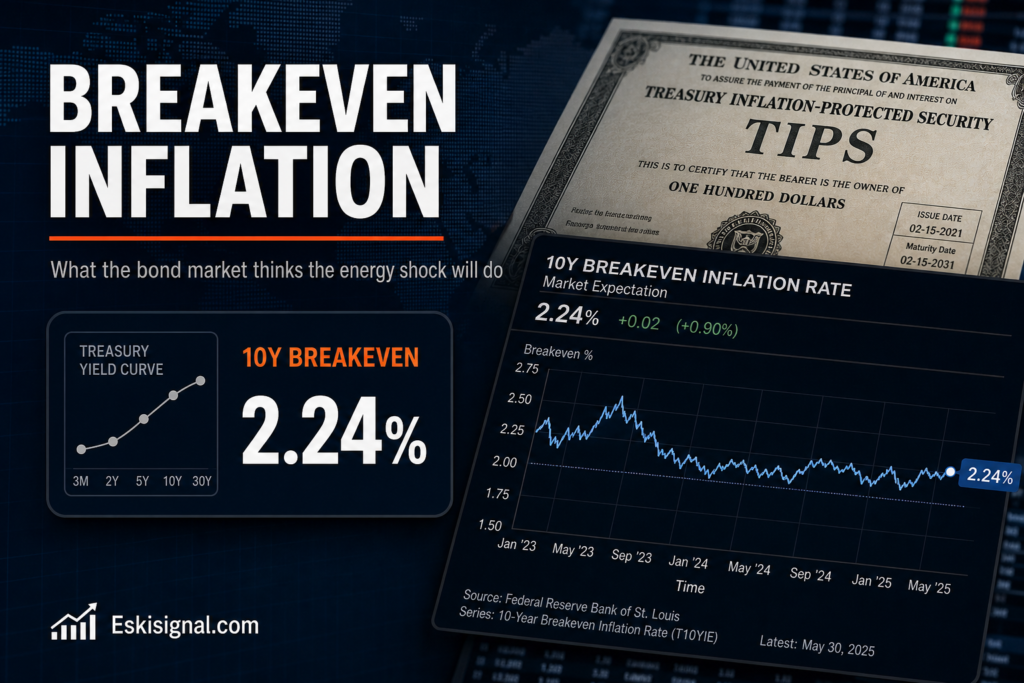
Short answer: The breakeven inflation rate is the nominal Treasury yield minus the inflation-protected (TIPS) yield at the same maturity. It is the average annual CPI inflation at which an investor would be indifferent between holding the two to maturity. The 10-year breakeven has sat in roughly a 2.2% to 2.4% range through mid-2026 — it was 2.24% on July 17, 2026 — which is close to the Federal Reserve’s target once the usual adjustments are made.
How the calculation works
A conventional Treasury pays a fixed nominal coupon. A TIPS adjusts its principal with the consumer price index, so its quoted yield is a real yield — a return above inflation, whatever inflation turns out to be.
If a 10-year nominal note yields 4.4% and the 10-year TIPS yields 2.1%, the breakeven is 2.3%. Realised inflation above that makes the TIPS the better holding; below it, the nominal note wins. The market sets the two prices independently, and the gap is what falls out.
| Instrument | What it pays | What its yield represents |
|---|---|---|
| Nominal Treasury | Fixed coupon | Real return plus expected inflation plus risk premia |
| TIPS | Coupon on CPI-adjusted principal | Real return |
| Difference | — | Breakeven inflation rate |
Why it is not purely an inflation forecast
This is the part that gets skipped, and it matters for how much weight the number can carry.
A breakeven contains three things, not one. There is the market’s central expectation for inflation. There is an inflation risk premium — extra compensation nominal bondholders demand for bearing uncertainty about inflation, which is positive and pushes breakevens above true expectations. And there is a TIPS liquidity premium, which is typically negative in its effect because the TIPS market is smaller and less liquid, pushing TIPS yields up and breakevens down.
The two premia work in opposite directions and neither is directly observable. Breakevens are therefore a good indicator of the direction of expectations and a noisy estimate of their level. A move from 2.2% to 2.6% is informative. A reading of 2.3% versus a 2% target does not mean the market expects a 0.3 point overshoot.
The CPI-versus-PCE adjustment
A further complication that changes the interpretation materially. TIPS are indexed to CPI. The Federal Reserve targets 2% on the PCE price index. CPI has historically run somewhat above PCE because of differences in weighting and formula.
That means a 10-year breakeven around 2.3% on CPI is broadly consistent with PCE inflation at or near the 2% target, not above it. Commentary that compares a CPI breakeven directly against the Fed’s PCE target is comparing two different indices and overstating the overshoot.
The five-year five-year forward
The measure central bankers actually watch is the five-year, five-year forward breakeven: expected inflation over the five years beginning five years from now.
The logic is that the near term is contaminated by things everyone can already see — a diesel shock, a tariff change, a gasoline spike. Pushing the window out past that leaves something closer to what the market believes about the central bank’s long-run commitment. If near-term breakevens rise on an energy shock while the forward measure stays flat, the market is saying the shock is real and temporary. If the forward measure rises, that is the unanchoring the Fed exists to prevent.
What this means for the current debate
The Fed raised rates in September specifically to defend expectations against an energy shock. Long-horizon breakevens sitting in a 2.2% to 2.4% range, on an index that runs above the targeted one, is not the signature of expectations coming loose.
There are two honest readings of that. One is that the hike was unnecessary insurance against a risk the market had already dismissed, paid for with a labour market that added 29,000 jobs in September. The other is that expectations stayed anchored precisely because the market expected the central bank to act, which makes the stable breakeven evidence that the policy worked rather than evidence it was pointless.
Those two interpretations are observationally identical. No amount of breakeven data distinguishes them, which is why this argument does not resolve.
Mini glossary
- Real yield. Return above inflation. What a TIPS quotes.
- Inflation risk premium. Extra compensation for bearing inflation uncertainty in a nominal bond.
- Liquidity premium. Extra yield demanded for holding a less liquid security, such as TIPS relative to nominal Treasuries.
- 5y5y forward. Expected inflation over the five years starting five years from today.
- Anchored expectations. Long-run inflation expectations that do not move much when actual inflation does.
Risks, uncertainty, and limits
The levels cited here reflect readings through mid-2026 and breakevens move daily. Current values for the 10-year breakeven and the 5y5y forward are published by the Federal Reserve Bank of St. Louis on FRED and should be checked directly rather than taken from any summary, including this one.
Breakevens also distort during liquidity stress, when TIPS sell off disproportionately and breakevens collapse for reasons that have nothing to do with inflation expectations. That happened in March 2020 and is the main reason to treat sudden moves with caution.