The Federal Open Market Committee meets on October 27 and 28, four weeks after raising interest rates for the first time in three years and three weeks after a jobs report that undercut the case for doing it again. There are no updated projections attached to this meeting, which means the only new information will be the statement and the press conference.
This article is for informational and educational purposes only. It is not financial advice, investment advice, or a recommendation to buy, sell, or hold any security, cryptocurrency, or financial product. Always verify data with official sources before making financial decisions.
Short answer: dates and what is released
Short answer: The FOMC meets October 27–28, 2026, with the decision and statement on the afternoon of the 28th followed by a press conference. This meeting does not include a Summary of Economic Projections — no dot plot, no updated forecasts. The committee will be working from data that has arrived since September without formally revising its published outlook, and markets will have only the statement language and the chair’s remarks to read.
Where September left policy
| Item | Detail |
|---|---|
| September 16 decision | Raised 25bp to 3.75–4.00%, effective September 17 |
| Vote | Unanimous, 12–0 |
| Significance | First increase since July 2023; reversed the December 2025 cut |
| SEP median, end-2026 | 4.1% |
| SEP median, end-2027 | 4.1% |
| SEP median, 2028 / 2029 | 3.9% / 3.6% |
| Participants expecting at least one more hike in 2026 | 16 of 18 |
A 12–0 vote is the part worth dwelling on. Unanimity on a first hike after three years of no increases indicates the committee was not narrowly persuaded. The projections reinforced it: a median implying one further increase this year and no cuts at all through 2027.
What has happened since
Two things, pulling in opposite directions.
The energy shock continued. Brent approached $99 in early October after attacks on Saudi energy facilities, US diesel reached a record, and middle distillate crack spreads moved above outright crude prices. That is the pressure that drove August headline CPI to 0.4% on the month with gasoline up 3.9%.
Then the labour market gave way. The September employment report on October 2 showed 29,000 payrolls against forecasts near 90,000, downward revisions of 60,000 across July and August, and unemployment rising to 4.2%. Average hourly earnings grew 0.1% on the month and 3.0% over the year — no sign of a wage-price spiral.
The split in expectations
Forecasters and markets have landed in different places, which is itself informative.
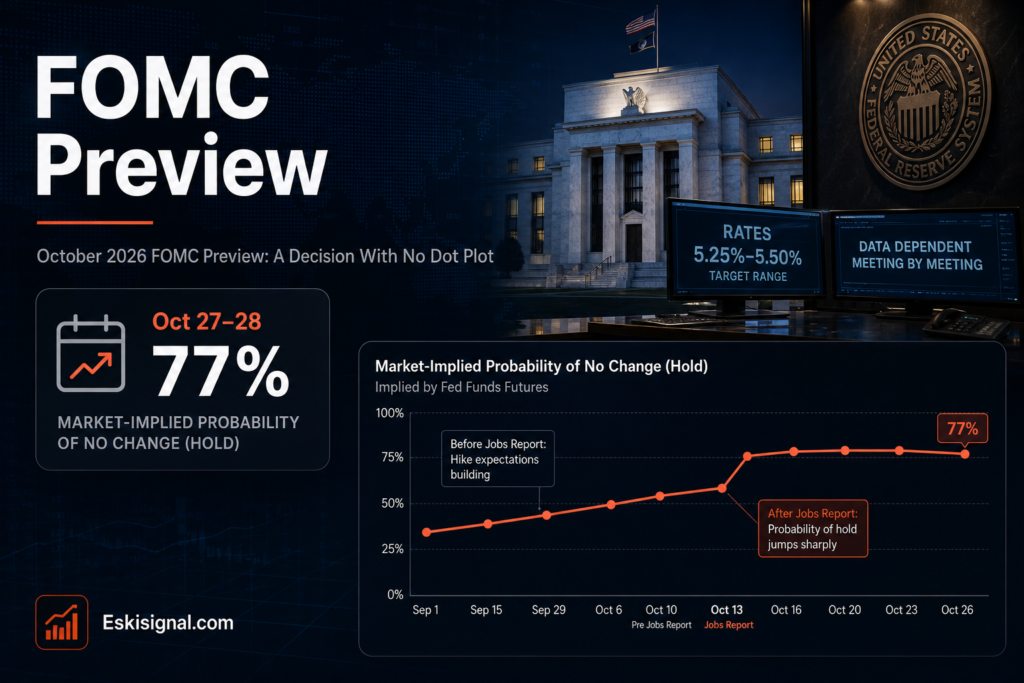
Goldman Sachs projected a 25 basis point increase at this meeting. Bank of America forecast hikes at both October and December. Rate futures in late September implied roughly 53% odds of an October move, up from about 42% a week earlier, with December fully priced.
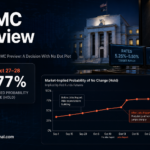
Then the jobs report arrived and the CME FedWatch tool showed roughly 77% odds of a hold. The gap between published forecaster views and market pricing is unusually wide, and it exists because the two are weighting the same two data points differently.
Why the absence of projections raises the stakes
At a meeting with a dot plot, the committee can hold rates while signalling intent through the projections. The decision and the message can be separated.
Without one, those collapse into a single choice. A hold with unchanged language reads as a pause. A hold with hawkish language reads as a delay. A hike reads as a committee that considers the September payroll figure noise. The statement wording, and whether any member dissents, will carry weight that in other months would be absorbed by a chart.
What to listen for
- How the September jobs report is characterised. Whether the statement treats it as a trend or as a single volatile print, given the revision history.
- Energy framing. Language distinguishing a relative price change from an inflation process would signal a committee preparing to look through the shock.
- “Removing accommodation.” Chair Warsh used this framing in September rather than calling the move tightening. If it persists, it positions further hikes as normalisation rather than restriction.
- Dissents. After a unanimous September vote, any dissent in either direction would be the most informative single detail of the meeting.
- Balance sheet. Runoff questions run alongside the rate decision and are sometimes addressed in this venue.
The data still to come
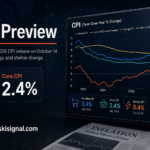
September CPI publishes on October 14, inside the window before the meeting and before the pre-meeting communications blackout closes. It is the last major inflation reading the committee receives, and given how far market pricing moved on one employment report, it has unusual leverage.
Risks, uncertainty, and limits
Meeting dates are published by the Federal Reserve and the no-projections status of this meeting follows the standard alternating schedule. Market-implied probabilities move continuously and the figures here reflect early October.
Nothing in this article forecasts the decision. The statement, any dissents and the press conference transcript are published by the Federal Reserve at the time of the decision, and the precise language is the thing that matters — not a summary of it.