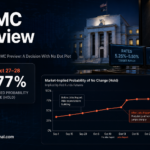
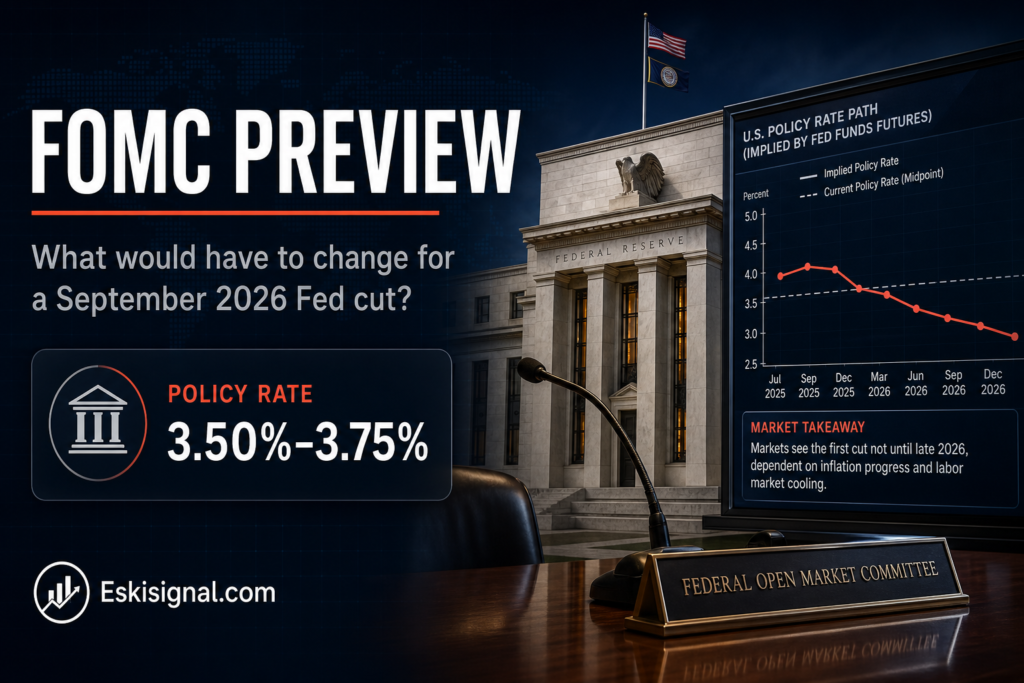
Outcome — 16 September 2026: The FOMC raised the target range by 25 basis points to 3.75%–4.00% in a unanimous 12–0 vote — the first increase since July 2023. Median projections put the funds rate at 4.1% at the end of both 2026 and 2027, with sixteen of eighteen participants expecting at least one further increase this year. The page below is the preview as published beforehand, left unchanged.
The Fed has held rates since the spring under a chair who took office in May, with a June dot plot that leaned hawkish and a July meeting that produced three dissents. September is the first decision with a fresh set of projections attached, which makes it the meeting where the committee has to write down what it actually thinks.
This article is for informational and educational purposes only. It is not financial advice, investment advice, or a recommendation to buy, sell, or hold any security, cryptocurrency, or financial product. Always verify data with official sources before making financial decisions.
Meeting dates and what is released
Short answer: The FOMC meets September 15–16, 2026, with the decision at 2:00 p.m. Eastern on the 16th. This meeting includes a Summary of Economic Projections — the dot plot — and a press conference. The July meeting had no projections, so September provides the first updated set since June and the first under the current chair with a full quarter of data behind it.
Starting point: the rate and the June dots
Policy sits at 3.50%–3.75%. The June dot plot was hawkish, with a meaningful share of participants projecting no easing over the remainder of the year and some projecting tightening. That plot is now two meetings old and predates the inflation and labour data that has arrived since.
The July meeting held rates with three officials dissenting — an unusually divided outcome that indicates the committee is not operating from a settled view. Chair Warsh said publicly that the Fed would not hesitate to act against inflation, while the bond market has priced a different path, and the long end has risen on term premium rather than on expectations of tightening.
What the labour data would need to show
The case for easing runs through employment, and the relevant threshold is deterioration that is broad rather than concentrated.
Announced job cuts fell to a two-year low in July at 33,429, and announced hiring plans were the strongest for the month since 2022. Against that, technology sector cuts are running well above last year and transportation has more than quadrupled. A labour market where the aggregate improves while the composition narrows is difficult to characterise, and the committee has to characterise it.
The specific things that would move the balance: a rising unemployment rate driven by job losses rather than by participation, downward revisions to prior payroll months, and a sustained fall in the hiring rate. Any one of those in the August or early September data would carry more weight than the level of the payroll print itself.
What the inflation data would need to show
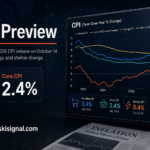
June CPI came in at 3.5% headline and 2.6% core, both well below consensus, with shelter posting its smallest monthly increase since January 2021. That is genuine progress and it arrived faster than expected.
The complication is that the headline decline was driven by energy — a 5.7% monthly fall including a near-10% drop in gasoline — which does not repeat and which mechanically reverses in the base as the months roll forward. For the committee, the relevant question is whether core services excluding housing continues to decelerate, since that component is closest to wage dynamics and least affected by commodity swings.
Two consecutive soft core prints with shelter continuing to cool would be a materially different picture than one soft print driven by energy.
Balance sheet questions running in parallel
The rate decision is not the only policy lever in play, and balance sheet questions have been running alongside it. The pace of runoff, the eventual size of reserves and the composition of holdings are all live, and they affect the long end independently of the policy rate.
This matters more than usual because the recent tightening in financial conditions has come through term premium rather than through policy expectations. A committee that wanted to ease financial conditions without cutting has balance sheet tools available, and the September communication may address them.
Dissent risk on a reshaped committee
Three dissents in July is a high number by recent standards and indicates genuine disagreement rather than procedural objection. A new chair has also brought organisational changes, including task forces on how the Fed communicates.
For markets the practical implication is that the dot plot may show wider dispersion than usual, and that the median dot — the number that gets reported — will represent a weaker consensus than in periods when the committee was aligned. A median that implies one cut, drawn from a distribution spanning tightening to multiple cuts, carries much less information than the same median from a tightly clustered set.
How markets are positioned
The gap between the June dot plot and market pricing has been the defining feature of this period. Markets have priced a more accommodative path than the committee projected, which is a familiar disagreement and one that has historically resolved in both directions.
Jackson Hole on August 27–29 sits between now and the meeting and is the most likely venue for any repricing. Between the symposium, the August jobs report and the August CPI print, there is a substantial amount of information still to arrive before the decision.
Risks, uncertainty, and limits
This describes the setup rather than forecasting the outcome. Data released between now and the meeting will matter more than anything in the current configuration.
The statement, projections and press conference transcript are published by the Federal Reserve at the time of the decision. Market-implied probabilities are available from futures pricing and change continuously.