
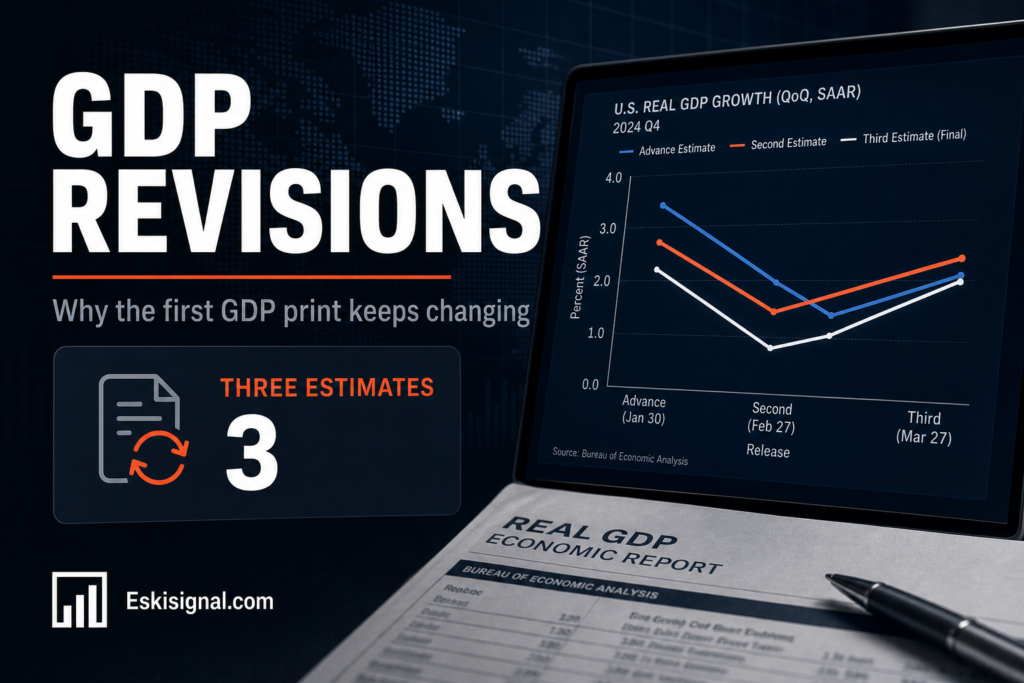
The GDP figure that leads the news is an estimate built from incomplete data, and it will be revised at least twice within three months and repeatedly for years afterward. Revisions have been large enough to change whether a quarter was recorded as growth or contraction — after the fact, after every market reaction had already happened.
This article is for informational and educational purposes only. It is not financial advice, investment advice, or a recommendation to buy, sell, or hold any security, cryptocurrency, or financial product. Always verify data with official sources before making financial decisions.
The three estimates
Short answer: The Bureau of Economic Analysis publishes GDP three times per quarter, roughly a month apart. The advance estimate arrives about a month after the quarter ends, followed by the second estimate and then the third. Each incorporates data that was unavailable for the previous one. The advance estimate is the one that moves markets and the one built on the least information.
| Estimate | Timing after quarter end | Basis |
|---|---|---|
| Advance | ~1 month | Substantial estimation for missing source data |
| Second | ~2 months | More complete trade, inventory and services data |
| Third | ~3 months | Near-complete quarterly source data |
| Annual revision | Following year | Incorporates annual survey and tax data |
What the BEA does not have on the first pass
The advance estimate is published before several major inputs exist. The third month of quarterly services data is typically incomplete. Trade data for the final month may be partial. Inventory figures — one of the most volatile GDP components — rely heavily on estimation. Construction and government spending detail arrives later.
For the missing pieces the BEA uses documented assumptions and trend extrapolation, and it says so explicitly in the release. This is not a flaw being concealed; it is a deliberate trade-off of accuracy for timeliness, made because a reasonably good number now is more useful to policymakers than a precise one much later.
Typical revision size
Revisions between the advance and third estimates have commonly run in the range of a few tenths of a percentage point on annualised growth, which sounds modest and is not. On a headline of 1.5%, a revision of half a point is a third of the reported figure.
Larger revisions cluster at turning points, which is exactly when accuracy matters most. Inventory and trade — the two components most heavily estimated in the advance figure — are also the two that swing hardest when conditions change. Several quarters have been revised from positive to negative growth or the reverse, well after the initial print shaped the narrative.
GDP vs GDI: two measures that rarely match
The economy can be measured by what was spent or by what was earned, and in principle the two are identical. Gross domestic product measures expenditure; gross domestic income measures income. They are compiled from different source data and they routinely disagree.
The gap is called the statistical discrepancy and it is published. It has occasionally been large enough that the two measures told materially different stories about whether the economy was expanding.
Research at the Federal Reserve has suggested that the average of the two — sometimes published as gross domestic output — may track the underlying economy better than either alone, and that GDI has occasionally been the more accurate early signal at turning points. Neither finding is settled, but the practical implication is clear enough: reading GDP without checking GDI discards half the available evidence.
The Q2 2026 second estimate
The second estimate for the second quarter is scheduled for the end of August. The components most likely to move are the ones that were most heavily estimated in the advance figure: inventories, net exports and services spending.
Given the tariff environment, trade is worth particular attention. Import and export flows have been unusually volatile as duty policy shifted, and the advance estimate’s assumptions about the final month of the quarter carry more uncertainty than usual. Net exports enter GDP with a negative sign for imports, which produces a counterintuitive result: a surge in imports subtracts from measured GDP even when it reflects strong domestic demand.
Annual and comprehensive revisions
Beyond the quarterly sequence, the BEA conducts annual revisions incorporating more complete source data, and periodic comprehensive revisions that update methodology, definitions and base years.
Comprehensive revisions can change the historical record substantially — altering the recorded depth of past recessions and the timing of turning points. Anyone comparing current conditions to a historical episode is comparing today’s preliminary estimates against figures that have been revised for decades, which systematically understates how uncertain the current reading is.
Mini glossary
- Annualised rate. The quarterly change expressed as if it continued for a full year. Amplifies quarterly noise by a factor of roughly four.
- Statistical discrepancy. The published gap between GDP and GDI.
- Real vs nominal. Real GDP is adjusted for price changes; nominal is not. Headline figures are real.
- Contribution to growth. How many percentage points each component added or subtracted. More informative than component growth rates.
What this article does not conclude
Nothing here forecasts the revision or its direction. Revisions can go either way and their size is not predictable from the advance estimate.
All three estimates, the statistical discrepancy and the full component detail are published by the BEA with documented methodology. The release itself states which components were estimated and on what basis.