
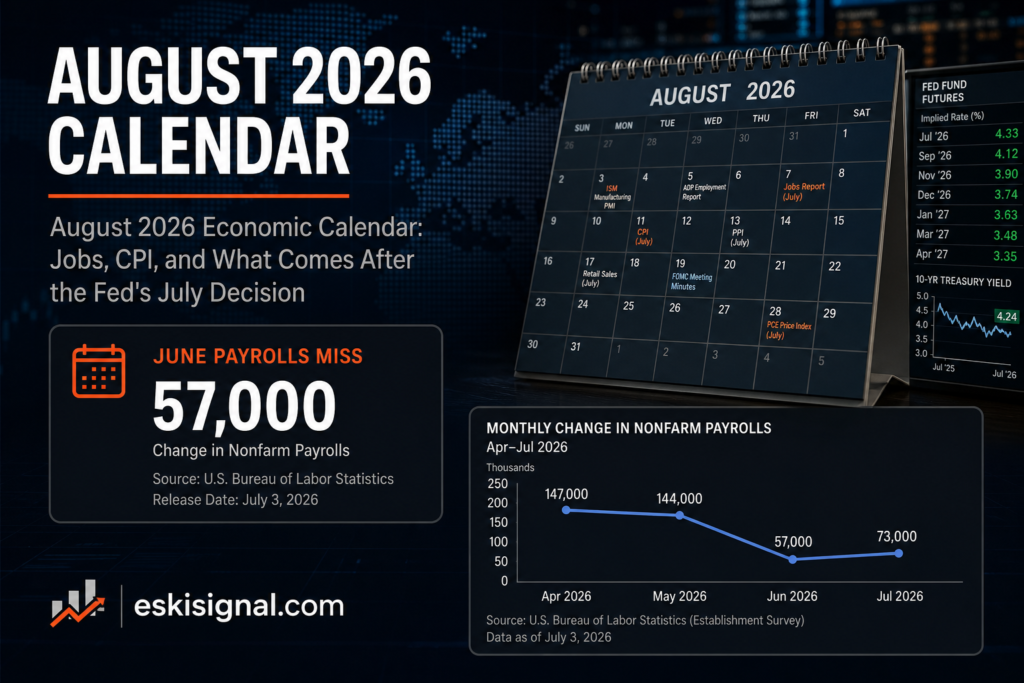
July closes with the Fed’s rate decision and four of the biggest earnings reports of the year landing in a 48-hour window. August opens with three separate data points — jobs, CPI, and PPI — that will determine whether the Fed’s hawkish June tilt survives contact with a labor market that’s already showing cracks. Here’s every date that matters.
This article is for informational and educational purposes only. It is not financial advice, investment advice, or a recommendation to buy, sell, or hold any security, cryptocurrency, or financial product. Always verify data with official sources before making financial decisions.
Quick answer: the key August 2026 dates
Quick answer: The two dates that matter most are Friday, August 7 (July jobs report) and Wednesday, August 12 (July CPI). The Producer Price Index follows on Thursday, August 13, and the July PCE price index — the Fed’s preferred inflation gauge — is expected in the final week of August, though the Bureau of Economic Analysis had not confirmed the exact date at publication time. There is no FOMC meeting in August; the next rate decision is September 15–16, 2026.
| Date | Release | Why it matters |
|---|---|---|
| Fri, Aug 7 | July jobs report (nonfarm payrolls, unemployment rate) | First read on whether June’s 57,000-job miss was a one-off or a trend |
| Wed, Aug 12 | July CPI | Key test of whether tariff-driven inflation pressure is showing up in consumer prices |
| Thu, Aug 13 | July PPI | Leading indicator for pipeline inflation, often foreshadows future CPI moves |
| Late August (date TBC) | July PCE price index | The Fed’s preferred inflation gauge, feeds directly into the September FOMC debate |
| Sept 15–16 | Next FOMC meeting | First rate decision after a full month of the data above |
The setup coming out of July
August’s data doesn’t arrive in a vacuum. The Fed held rates at 3.50%–3.75% on July 29 in a meeting with no fresh Summary of Economic Projections, meaning the June dot plot — nine of eighteen participants projecting at least one 2026 hike — is still the most recent official signal of the Committee’s thinking. Big Tech earnings from Microsoft, Meta, Apple, and Amazon landed the same week, and June’s PCE price index was due for release on July 30, giving the Fed one more inflation data point before August’s calendar even begins. Treasury yields had already climbed to 4.69% by July 24 on tariff-driven inflation expectations, and June’s jobs report showed real cracks — just 57,000 payrolls added against a 115,000 consensus, with April and May revised down a combined 74,000.
Why August is a genuine swing month
With no FOMC meeting until mid-September, August’s data essentially writes the script for that decision without the Fed able to respond to any single report in real time. That raises the stakes on each release: a weak August 7 jobs report following June’s miss would build a real case for a slowdown narrative, while a hot August 12 CPI print would reinforce the hawkish case built in June. The most consequential scenario for markets is if the two point in opposite directions — soft jobs alongside sticky inflation — which is exactly the stagflation-adjacent combination that leaves a central bank with no clean answer.
Risks and limits
- The PCE release date for July data had not been confirmed by the Bureau of Economic Analysis at the time of publication; check bea.gov for the finalized schedule.
- Government data release schedules can shift due to administrative changes; always confirm dates against the releasing agency directly.
- This is a calendar and context piece, not a forecast of what any individual report will show.
Is there a Fed meeting in August 2026?
No. The FOMC does not meet in August. The next scheduled meeting after July 28–29 is September 15–16, 2026.
What is the most important economic release in August 2026?
The July jobs report on August 7 and the July CPI report on August 12 are the two releases most likely to move markets, since both directly inform the Fed’s data-dependent stance heading into the September meeting.
Why does the PCE price index matter if CPI already came out?
PCE is the Fed’s explicitly preferred inflation gauge because it accounts for changes in consumer spending patterns differently than CPI, so it can tell a somewhat different story even when covering the same month.
Sources
- U.S. Bureau of Labor Statistics, Employment Situation and CPI/PPI release schedules, 2026.
- U.S. Bureau of Economic Analysis, Personal Income and Outlays release schedule, 2026.
- Federal Reserve, FOMC meeting calendar, 2026.
Leading porn websites offer secure and premium
content for adults. Discover reliable hubs for a quality experience.