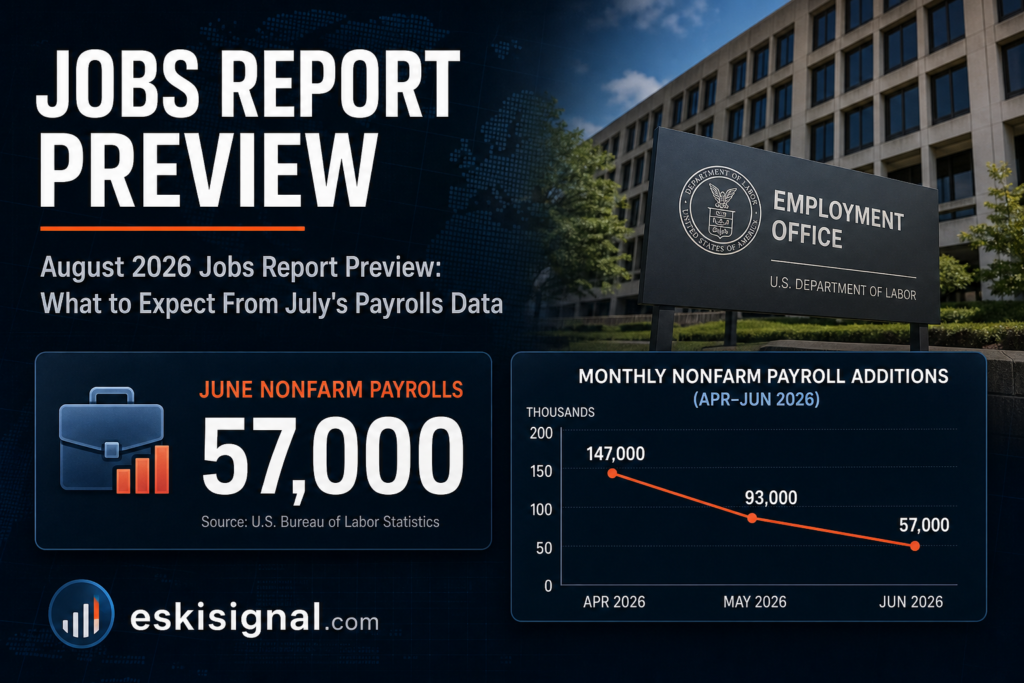
The last jobs report was not a good one. June payrolls rose just 57,000 against expectations for 115,000, and the unemployment rate’s dip to 4.2% came from people leaving the labor force, not from more people finding work. The August 7 report, covering July, is the next data point that will show whether that was a one-month wobble or the start of a real slowdown — and it lands eight days after the Fed’s July decision, at a moment when the Committee has already signaled it’s more worried about inflation than employment.
This article is for informational and educational purposes only. It is not financial advice, investment advice, or a recommendation to buy, sell, or hold any security, cryptocurrency, or financial product. Always verify data with official sources before making financial decisions.
Quick answer: when is the next jobs report?
Quick answer: The Bureau of Labor Statistics releases the July 2026 Employment Situation report — nonfarm payrolls and the unemployment rate — on Friday, August 7, 2026 at 8:30 a.m. ET. It follows a weak June report that showed only 57,000 jobs added against a 115,000 consensus, with April and May figures revised down by a combined 74,000. Economists will be watching whether July confirms a genuine slowdown or reflects one-off seasonal noise.
Why June’s report raised real questions
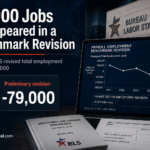
Three details in the June report matter more than the 57,000 headline number on its own. First, the miss was large relative to expectations — 57,000 against a Wall Street consensus of 115,000 is a wide gap, not a rounding error. Second, the unemployment rate’s move to 4.2% was driven by people leaving the labor force and lower participation, not by more people finding jobs, which is a weaker underlying signal than the headline rate suggests. Third, prior months got revised down by a combined 74,000 jobs, meaning the labor market was already softer earlier in the year than initially reported. Leisure and hospitality lost 61,000 jobs in June alone, reflecting unusually weak seasonal hiring, while professional and business services, social assistance, and healthcare were the only sectors adding meaningfully.
| June 2026 metric | Reading | What it signals |
|---|---|---|
| Nonfarm payrolls | +57,000 (vs. 115,000 expected) | Significant miss versus consensus |
| Unemployment rate | 4.2% (down from May) | Improvement driven by falling participation, not job growth |
| Prior-month revisions | -74,000 combined (April + May) | Labor market was weaker earlier in 2026 than first reported |
| Leisure & hospitality | -61,000 | Weak seasonal hiring, a sector-specific red flag |
Why this report matters more than usual for the Fed
The Fed’s July 28–29 meeting happens before this data is released, so Chair Warsh’s Committee will be flying partially blind on the labor side when it decides on rates. That makes the August 7 report the first real test of the Fed’s post-meeting posture: if July payrolls confirm a genuine slowdown, it complicates a Committee that leaned hawkish in June on inflation concerns, since a weakening labor market and above-target inflation pulling policy in opposite directions is exactly the scenario a central bank finds hardest to navigate. A strong rebound in July, by contrast, would support the case that June was noise and give the hawks more room to justify holding — or even hiking — rates.
What to watch beyond the headline number
- Revisions to June: another downward revision would reinforce the slowdown narrative; an upward revision would soften it.
- Labor force participation: whether July’s unemployment rate reflects real hiring or more people leaving the workforce, as in June.
- Sector detail: whether leisure and hospitality stabilizes after June’s sharp decline, or whether weakness broadens into other sectors.
- Wage growth: average hourly earnings data, which factors into the Fed’s inflation calculus alongside the headline jobs number.
Risks and limits
- This is a preview written ahead of the August 7 release and does not reflect the actual reported figures.
- BLS data is subject to revision in subsequent months, sometimes significantly, as seen with the April and May 2026 figures.
- This is educational content on how to read a jobs report, not investment advice or an economic forecast.
When is the August 2026 jobs report released?
The Bureau of Labor Statistics releases the Employment Situation report for July 2026 on Friday, August 7, 2026, at 8:30 a.m. ET.
Why was June’s unemployment rate drop considered a weak signal?
The unemployment rate fell to 4.2% mainly because fewer people were participating in the labor force, not because more people found jobs — a distinction that matters because it reflects discouraged workers leaving the workforce rather than genuine labor-market strength.
How much were April and May payrolls revised down?
Combined, April and May 2026 nonfarm payroll figures were revised down by 74,000 jobs from their initial estimates.
Sources
- U.S. Bureau of Labor Statistics, Employment Situation Summary, June 2026 (released July 2, 2026).
- U.S. Bureau of Labor Statistics, employment release schedule for 2026.