
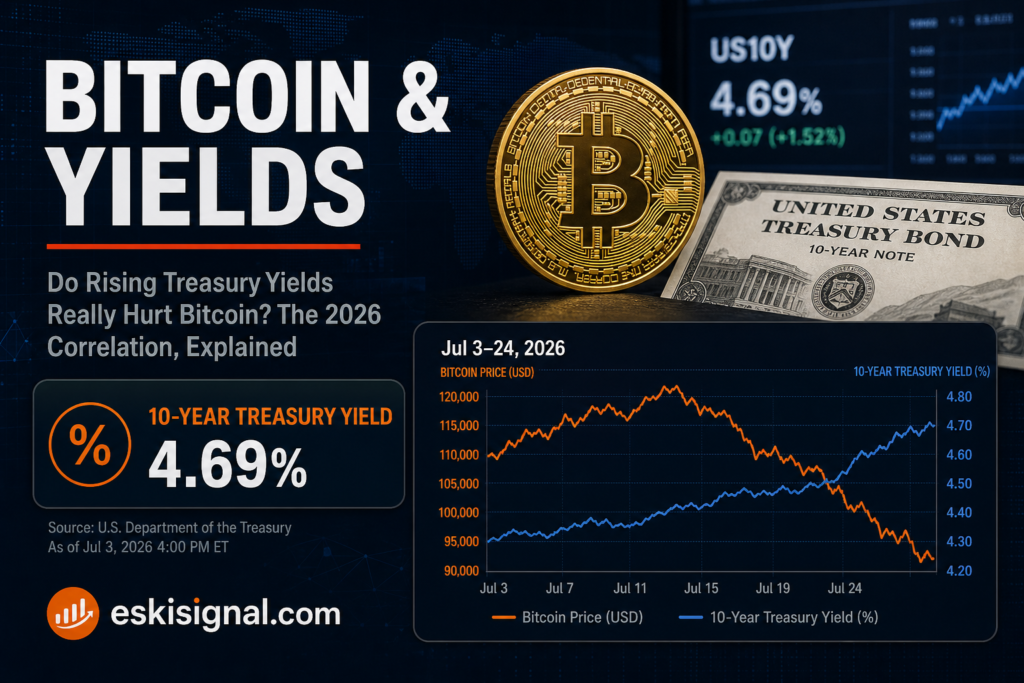
Bitcoin opened at $65,047.87 on Friday, July 24, 2026 — down 1.6% from the day before — while ethereum fell 2.9% to $1,876.92 over the same stretch. The proximate cause, according to market commentary that day, was higher Treasury yields pulling institutional money away from risk assets. It’s a clean, popular narrative. It’s also only partly true, and worth unpacking properly.
This article is for informational and educational purposes only. It is not financial advice, investment advice, or a recommendation to buy, sell, or hold any security, cryptocurrency, or financial product. Always verify data with official sources before making financial decisions.
Quick answer: do rising yields hurt Bitcoin?
Quick answer: Sometimes, and the mechanism is real but indirect. Bitcoin pays no yield, so when Treasury yields rise — as the 10-year did, climbing from roughly 4.58% in mid-July to 4.69% by July 24 — the opportunity cost of holding a non-yielding asset increases, which can push some institutional and leveraged capital toward bonds instead. But the correlation is inconsistent: Bitcoin and ethereum both rallied earlier in July on a softer-than-expected inflation report that also pushed yields down, meaning the same “yields down, risk assets up” relationship that held on July 15 partly reversed by July 24 without yields moving in a straight line the whole month.
A month that shows both sides of the correlation
July 2026 is a useful case study precisely because it doesn’t tell one clean story. Bitcoin opened July at $61,492.99 on the 3rd, then rallied through the month’s first two weeks as softer labor and inflation data reduced expectations of further Fed tightening. Both bitcoin and ethereum surged on July 15 specifically on a cooler-than-expected inflation print — the textbook version of the yields-down, crypto-up relationship. But that rally proved short-lived: escalating U.S. airstrikes against Iran dulled appetite for risk assets within days, showing that geopolitical risk can override the rates narrative entirely. By July 20, prices were already mixed as competing second-half-2026 outlooks pulled sentiment in different directions, and by July 24, rising yields — this time driven by tariff-linked inflation expectations rather than growth data — coincided with a fresh pullback.
| Date | What moved crypto | Direction |
|---|---|---|
| July 3 | Softer June jobs report reduced hike odds | Up |
| July 15 | Cooler-than-expected inflation report, yields fell | Up |
| July 17 | Escalating Iran conflict, risk-off | Down |
| July 24 | Tariff-driven yields rise, dollar strengthens | Down |
Where the correlation breaks down
The rates-crypto relationship works best as an explanation when it’s the dominant story of the day — a CPI print, a Fed decision, a clear yield move with no competing headline. It breaks down fastest when geopolitical risk, regulatory news, or crypto-specific catalysts (exchange flows, ETF inflows or outflows, leverage liquidations) are also in play, because those forces can swamp the more gradual opportunity-cost effect that rates changes create. July’s mid-month reversal — an inflation-driven rally interrupted within days by an escalating Middle East conflict — is a clean example of a bigger, faster-moving story overriding the rates narrative entirely.
Why institutional flows matter more than retail psychology here
The opportunity-cost mechanism is most relevant for institutional allocators comparing Bitcoin against yield-bearing alternatives as part of a portfolio decision — a pension fund or macro hedge fund weighing Bitcoin exposure against a 4.69%-yielding 10-year Treasury faces a different calculation than a retail trader reacting to headlines. That’s part of why the correlation tends to show up more reliably during periods dominated by macro, rates-focused institutional positioning, and less reliably during periods dominated by retail sentiment or crypto-specific news flow.
Risks and limits
- Correlation is not causation, and the relationship between yields and crypto prices shifts depending on what else is driving markets at a given time.
- Price figures cited reflect specific dates in July 2026 and will be outdated by the time you read this — always check a live source.
- This is educational content describing observed market patterns, not investment advice or a prediction of future Bitcoin or ethereum prices.
Why did Bitcoin fall on July 24, 2026?
Market commentary that day pointed to higher oil prices and new tariff policy raising inflation expectations, which pushed Treasury yields higher and drew some institutional capital away from risk assets including crypto.
Does Bitcoin always fall when Treasury yields rise?
No. The relationship is inconsistent — it tends to show up most clearly when rates are the dominant market story, and can be overridden by geopolitical events, regulatory news, or crypto-specific catalysts.
What is the “opportunity cost” argument against holding Bitcoin?
Because Bitcoin generates no yield, holding it means forgoing the interest income available from alternatives like Treasuries; when Treasury yields rise, that forgone income increases, which can make Bitcoin relatively less attractive to yield-sensitive institutional allocators.
Sources
- Daily bitcoin and ethereum price coverage, July 3–24, 2026.
- U.S. Treasury, Daily Treasury Par Yield Curve Rates, July 2026.