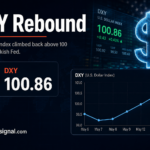
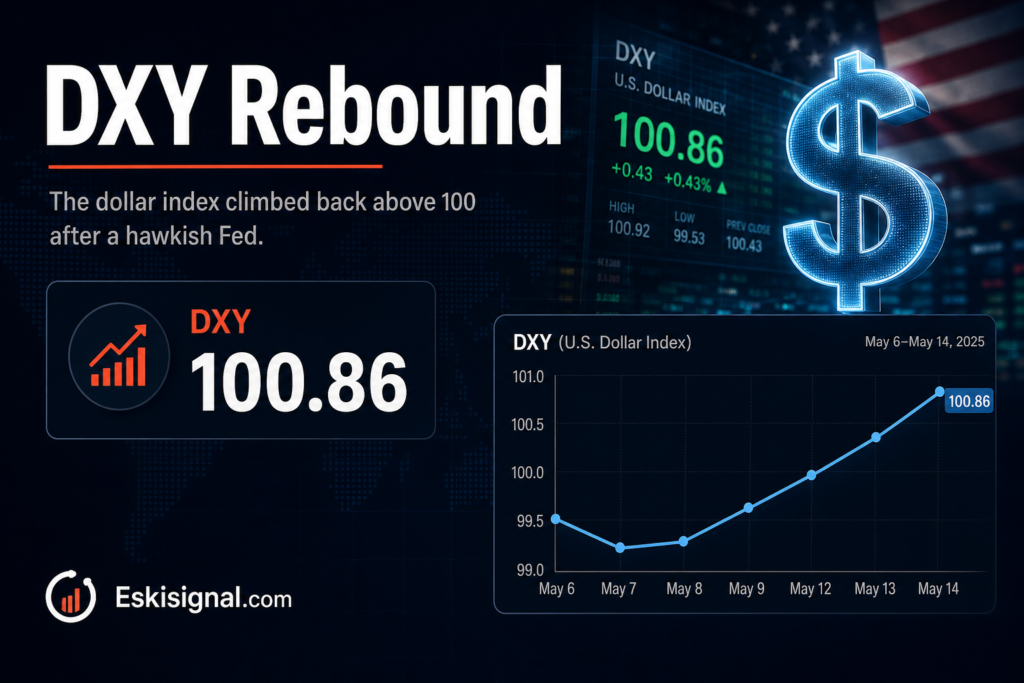
For most of 2026 the dollar was a one-way trade in the other direction, falling on expectations of Federal Reserve easing and a policy stance comfortable with a weaker currency. That reversed in September. The index pushed back above 100 and reached an eight-week high near 100.86, and the reason was almost entirely about interest rate expectations rather than anything else.
This article is for informational and educational purposes only. It is not financial advice, investment advice, or a recommendation to buy, sell, or hold any security, cryptocurrency, or financial product. Always verify data with official sources before making financial decisions.
Short answer: rate differentials took over
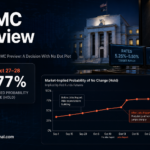
Short answer: The dollar index climbed above 100 to an eight-week high around 100.862 after the Federal Reserve raised rates in September and projected more tightening. Rate futures moved to imply better than even odds of another increase in October — around 53%, up from roughly 42% a week earlier — with a December hike fully priced. The move persisted even as Brent crude slipped back below $100, which indicates monetary policy divergence rather than commodity flows was doing the work.
What changed
Three things, in sequence. The August CPI report on September 11 showed core inflation above expectations on the month. The Fed raised rates 25 basis points to 3.75–4.00% on September 16 in a unanimous vote. And the accompanying projections put the median funds rate at 4.1% for both end-2026 and end-2027, implying one more increase this year and no cuts the following year.
That last point did most of the damage to the weak-dollar trade. Markets had been positioned for easing, and a projection showing no cuts through 2027 removes the entire premise rather than just delaying it.
Why rate differentials dominate currency moves
A currency pair is a relative price of two monetary policies. What matters is not whether the Fed is hiking but whether it is hiking relative to the central bank on the other side of the trade.
The mechanism runs through the return on holding short-term instruments in each currency. When the expected path of US rates rises relative to the eurozone or Japan, holding dollars pays more, capital flows accordingly, and forward markets reprice. This is why the dollar can strengthen on a hawkish surprise even when the US economic data is weak — the data matters only through what it implies for policy.
It is also why the dollar index is a narrower instrument than its name suggests. It is weighted heavily toward the euro, so a large share of what gets described as dollar strength is European policy expectations moving.
The energy wrinkle
Ordinarily a sustained energy shock would pressure the dollar’s traditional support from the US terms of trade less than it pressures net energy importers, so the dollar benefits twice — through rates and through relative energy exposure.
What makes this episode notable is the detail that dollar strength held while Brent fell back below $100. If the currency were trading on the energy story, it would have eased with crude. It did not, which is reasonably strong evidence that the rate channel was dominant and the commodity channel secondary.
What the October jobs report did to the trade
The September employment report on October 2 complicated it considerably. Payrolls rose 29,000 against forecasts near 90,000, prior months were revised down by a combined 60,000, and unemployment ticked up to 4.2%. Treasury yields fell and futures moved to roughly 77% odds of a hold at the October meeting.
That matters for the currency because the entire basis of the rally was the expected rate path. Remove the October hike from that path and a meaningful part of the support goes with it. Anyone reading the dollar chart without that context is looking at a move whose justification was partly withdrawn a week later.
What a stronger dollar reaches
- US multinational earnings. Roughly 40% of S&P 500 revenue is earned abroad and converts back at a worse rate. The constant-currency figure in company releases is the one to read.
- Commodities. Priced in dollars globally, so a stronger dollar is a headwind to prices for non-dollar buyers — working against the energy shock rather than with it.
- Emerging markets. The clearest channel. Dollar-denominated debt becomes harder to service, and central banks lose room to ease without pressuring their currencies.
- Unhedged international funds. A dollar-based investor holding foreign equities loses on translation, reversing the tailwind that flattered those returns earlier in the year.
What this article does not conclude
Price levels cited here reflect late September and early October 2026 and move continuously. The dollar index is a euro-heavy basket rather than a comprehensive measure, and broader trade-weighted measures frequently tell a different story.
Nothing above is a currency forecast. The rally was built on an expected rate path that the October jobs report partly removed, which is a description of what happened rather than a view on what comes next.