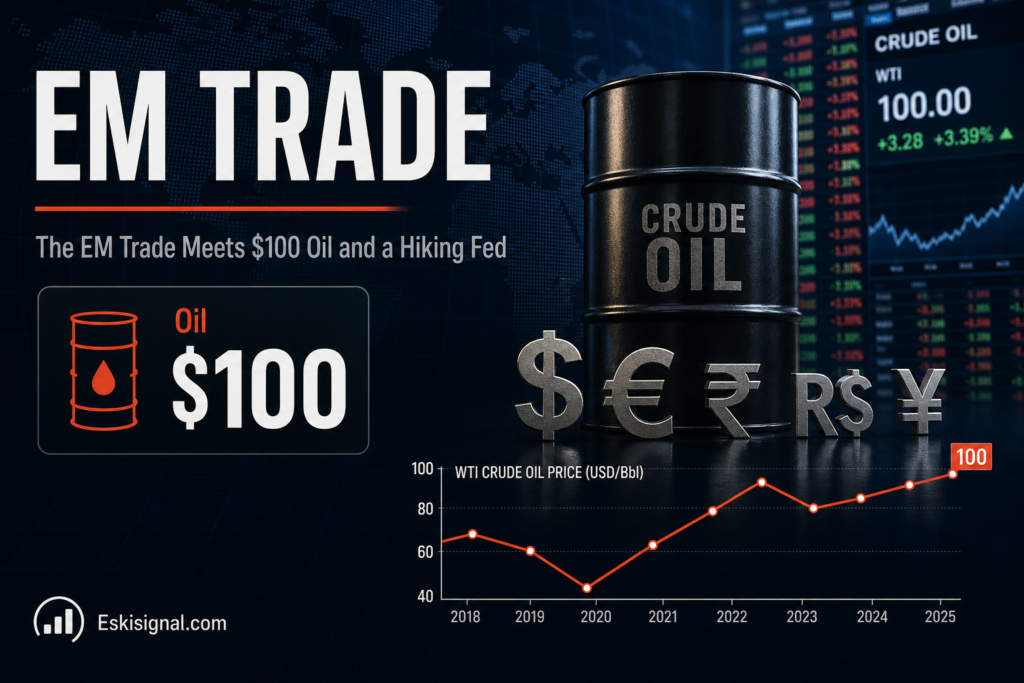
Emerging markets outperformed the S&P 500 through the first half of 2026, and the explanation offered at the time was straightforward: a weakening dollar and a Federal Reserve expected to ease. Both legs of that thesis have now reversed. The dollar has firmed, the Fed is being priced for an increase rather than a cut, and crude is above $100. The interesting part is that the asset class has not responded uniformly, and the reason is that “emerging markets” describes an index, not an economy.
This article is for informational and educational purposes only. It is not financial advice, investment advice, or a recommendation to buy, sell, or hold any security, cryptocurrency, or financial product. Always verify data with official sources before making financial decisions.
Short answer: one label, three unrelated trades
Short answer: A standard emerging market equity index is dominated by North Asian technology exporters, which trade on the global semiconductor and AI cycle rather than on anything usually described as emerging market risk. Sitting alongside them are commodity exporters, for whom $100 oil is a windfall, and energy importers, for whom it is a terms-of-trade shock. A stronger dollar and higher US yields hurt the third group most, help the second, and matter to the first mainly through global risk appetite. Aggregate index performance averages these together and conceals all of it.
Why the dollar matters so much more to some members than others
The classic transmission from a strong dollar to emerging market stress runs through debt. Where governments and companies have borrowed in dollars while earning revenue in local currency, a rising dollar raises the local-currency cost of servicing that debt without any change in the underlying business. Higher US yields compound it by raising refinancing costs and by pulling portfolio capital back toward Treasuries.
The important qualification is that this channel is much weaker than it was in 2013. A substantial share of emerging market sovereign borrowing has shifted to local currency over the past decade, and many of these central banks began tightening well before the Federal Reserve did in the last inflation episode, leaving them with real policy rate buffers rather than deficits. The countries that remain genuinely vulnerable are identifiable in advance by external debt composition and reserve adequacy, and they are a minority of the index by weight.
| Group | $100 oil | Stronger dollar / higher US yields |
|---|---|---|
| North Asian tech exporters | Modest input cost drag | Indirect, via global risk appetite |
| Energy importers | Terms-of-trade shock, current account pressure | Compounds the pressure |
| Energy and commodity exporters | Windfall | Partly offset by commodity revenue |
| High external-debt borrowers | Depends on trade balance | The most direct channel of stress |
The composition problem, stated plainly
Anyone holding a broad emerging market fund and forming a view on the dollar, or on Fed policy, or on commodity prices, should first establish what they actually own. In the major indices, a large share of the weight sits in a handful of North Asian technology names whose earnings are driven by global semiconductor demand and the artificial intelligence capital cycle.
The consequence is that a broad EM allocation has behaved, over recent years, substantially like a leveraged position on the same AI capital cycle that drives large-cap US technology — while being marketed and discussed as a diversifier away from it. That is not a criticism of the index construction, which simply reflects where market capitalisation sits. It is an observation that the label and the exposure have drifted apart, and that a correlation which looks like diversification in calm periods can disappear when the shared driver is what moves.
Oil at $100 is a transfer, not a shock
At the level of the asset class, an oil price rise is close to a redistribution. Gulf exporters, Brazil, Colombia and others receive it; India, Turkey, Korea, Taiwan and most of Central Europe pay it. The aggregate index effect is muddled, which is why oil shocks tend to produce large dispersion within emerging markets and unremarkable moves in the headline index.
The importers’ problem is not only the import bill. Energy is a large share of consumer price baskets in lower-income economies — considerably larger than in the United States — so an oil shock feeds into local inflation faster and more visibly, which constrains central banks that would otherwise be cutting to support growth. The currency then does additional work: a widening current account deficit weakens the exchange rate, which raises the local price of oil further in a loop that is familiar to anyone who followed emerging markets in 2013 or 2018.
The honest counterargument
The bearish EM case has been made repeatedly during this cycle and has repeatedly been wrong, which should count for something.
Valuations across the asset class have been substantially below developed market equivalents for years, meaning a great deal of bad news is already reflected in prices. Positioning has been light by most measures, so the marginal seller is scarcer than the headlines imply. Earnings growth in the Asian technology complex has been genuine rather than multiple-driven. And the strongest empirical objection is simply that a similar combination of a firm dollar and a hawkish Fed was in place for much of the past two years while emerging markets outperformed anyway — a relationship that fails to hold in the most recent period is a weak basis for a forecast.
What this article does not conclude
Nothing here recommends any market, fund or region, and nothing here forecasts the dollar, oil, or relative performance between emerging and developed equities. Country classifications differ between index providers — a market treated as emerging by one is frontier or developed to another, and index weights are revised on scheduled review dates.
The single most useful action for a holder is unglamorous: open the fund’s published holdings and country weightings and check what the exposure actually is. That document is free, current, and more informative about the position than any commentary written about the asset class in aggregate.