Private credit is a market of somewhere between $1.5 and $2 trillion that does not report daily prices, does not trade on an exchange, and marks its own holdings. That combination makes it very difficult to observe stress from outside — with one exception. Business development companies invest in the same loans and file quarterly with the SEC, listing every position, its cost, its fair value and whether it is still paying cash. The Federal Reserve Bank of Boston built an early-warning framework around exactly that disclosure this year.
This article is for informational and educational purposes only. It is not financial advice, investment advice, or a recommendation to buy, sell, or hold any security, cryptocurrency, or financial product. Always verify data with official sources before making financial decisions.
Short answer: the listed window into an unlisted market
Short answer: A business development company is a regulated fund that lends to mid-sized private businesses. Many are publicly traded, and all file a schedule of investments that names each borrower and states what the loan cost, what it is now valued at, and how the interest is being paid. Because BDCs and private credit funds lend to overlapping borrowers on similar terms, BDC filings function as a public sample of a private market. They are not a perfect proxy, but they are the only quarterly, position-level, audited disclosure available.
The four lines that carry the information
Most of the analytical value sits in a small number of disclosures, and three of the four are easy to miss because they are reported as components rather than headlines.
| Disclosure | Where it sits | What deterioration looks like |
|---|---|---|
| Non-accrual investments | Schedule of investments, footnoted | Rising share of portfolio at cost and at fair value |
| PIK income | Income statement detail | Rising share of total investment income |
| Fair value vs amortised cost | Schedule of investments | More positions marked materially below cost |
| Net asset value per share | Financial highlights | Declining while distributions are maintained |
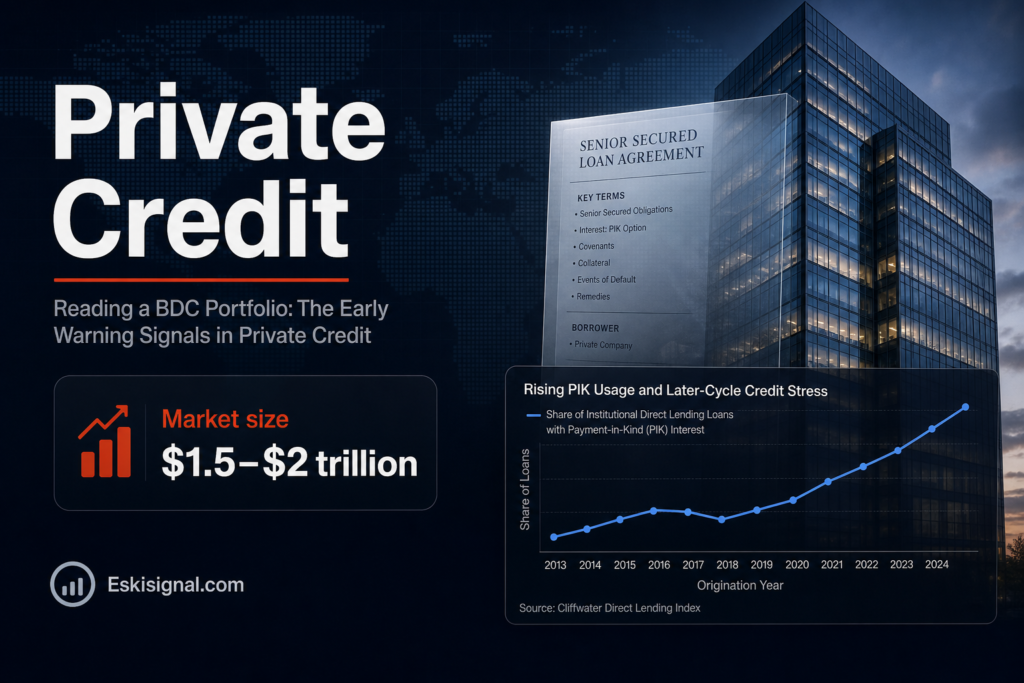
Payment-in-kind deserves particular attention because it is the one that flatters the reported numbers while describing a worsening situation. A PIK loan lets the borrower pay interest by adding it to the principal instead of paying cash. The lender books the income and reports it in earnings; no money has changed hands. A modest PIK component is a normal structuring choice for a growing company. A rising PIK share across a portfolio means an increasing number of borrowers are choosing not to — or cannot — pay in cash, and the lender’s reported income is increasingly an accounting entry rather than a receipt.
Regulators have noted rising PIK usage alongside a modest increase in defaults from very low levels. Both observations are consistent with a market moving into a later phase of its credit cycle rather than one in distress.
Why valuation is the structural weak point
The Financial Stability Board’s May report on private credit identified the recurring concern precisely: the absence of standardised, transparent data, combined with opaque valuation practices and complex funding structures.
The practical version of that concern is simple and checkable. Because these loans do not trade, their fair value is an estimate produced with input from the manager whose performance is measured by that estimate. When two different BDCs hold positions in the same borrower, they sometimes carry them at visibly different marks. Nothing improper need be involved — different models, different assumptions — but the dispersion is the point: it demonstrates that the number is a judgement, and judgements move more slowly than conditions.
Cross-referencing marks on shared borrowers across filings is tedious and is the single most informative exercise available to an outside analyst of this market.
Where the banking system connects to it
Private credit is frequently described as having moved risk outside the banking system. That framing is half right. Banks no longer hold most of these loans directly, but they lend to the funds that do, provide subscription lines and leverage facilities, and increasingly partner with private lenders to keep serving middle-market clients they can no longer finance on their own balance sheets.
Litigation between a regional lender and a large investment bank over loans tied to a bankrupt auto-parts manufacturer illustrated how entangled those relationships have become — and how much of the entanglement is invisible until something fails and the documents become public. Supervisory surveys have shown banks tightening terms to credit intermediaries and private equity funds across loan size, maturity, pricing, covenants and collateral, which is what lenders do when they are reassessing a counterparty type rather than an individual borrower.
The Boston Fed’s own assessment is worth stating plainly because it cuts against the alarmist reading: losses under a severe stress scenario applied to BDC portfolios would be substantial but not large enough to threaten bank solvency.
The honest counterargument
A serious defence of the asset class exists and rarely gets a fair hearing in coverage like this.
Private credit funds typically have locked-up capital, which means they cannot be forced to sell into a falling market — the mechanism that turns a credit problem into a financial crisis. There is no overnight funding, no mark-to-market margin spiral, and no depositor who can withdraw on demand. Slow marks look like obfuscation to an outside observer and like the absence of forced selling to a credit investor, and both descriptions are accurate. Direct lending also produced strong risk-adjusted returns through a period that included a rapid tightening cycle, which is evidence rather than marketing.
The unresolved question is whether that performance reflects genuine underwriting quality or the fact that losses in an unmarked market are recognised late, and the honest answer is that the asset class has not yet been through a full default cycle at its current size.
What this article does not conclude
Nothing here assesses any specific fund, lender or borrower, and nothing here forecasts default rates. BDCs are a sample of private credit, not a representative one — they skew toward certain deal sizes and structures, and inferring the whole market from them is an approximation whose error is unknown.
The primary sources are free. BDC 10-Q and 10-K filings are on EDGAR with the full schedule of investments; the Financial Stability Board’s private credit report and the Boston Fed’s BDC research are both published openly and are considerably more careful than most commentary written about them.