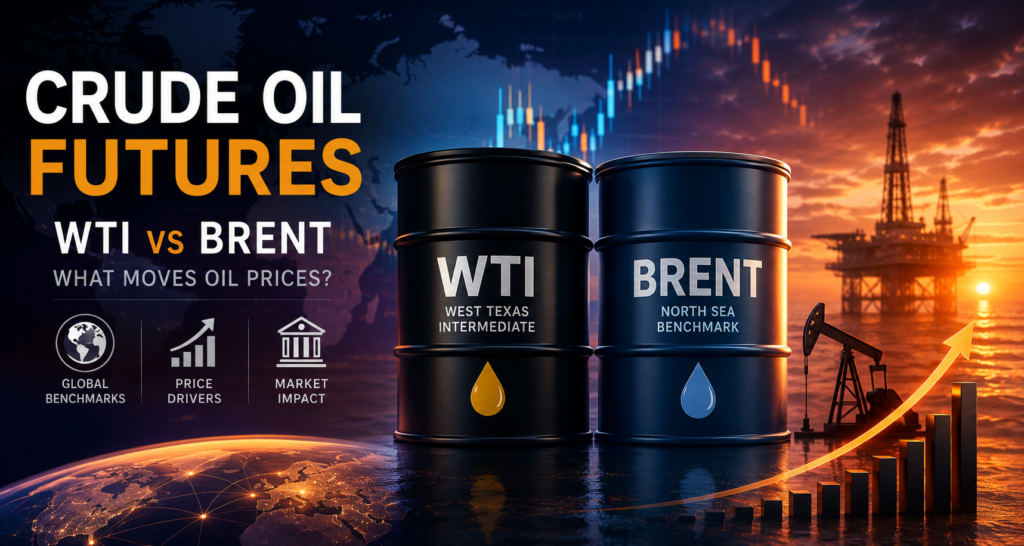
Quick answer: Crude oil futures are standardized contracts to buy or sell oil at a set price on a future date. The two global benchmarks are WTI (West Texas Intermediate, traded on NYMEX/CME) and Brent (traded on ICE). As of late May 2026, Brent was above $108/barrel and WTI above $103 — elevated due to the Iran conflict and Strait of Hormuz supply concerns. These prices feed directly into inflation data, making oil futures a leading indicator for CPI and Fed policy.
Last updated: June 11, 2026 · 8:00 a.m. ET
WTI vs Brent: Key Differences
| Feature | WTI (CL) | Brent (CO) |
|---|---|---|
| Exchange | NYMEX / CME Group | ICE Futures Europe |
| Delivery point | Cushing, Oklahoma | North Sea (offshore) |
| Ticker | CL (futures) / USO (ETF) | CO (futures) / BNO (ETF) |
| Global benchmark | US and Americas pricing | ~70% of global oil contracts |
| Typical spread | Usually $2–$5 below Brent | Usually $2–$5 above WTI |
| Price (late May 2026) | >$103/barrel | >$108/barrel |
How an Oil Futures Contract Works
One standard crude oil futures contract controls 1,000 barrels. At $103/barrel (WTI), one contract represents $103,000 in notional oil. Futures are marked to market daily — gains and losses settle each session, requiring margin maintenance.
Most participants (traders, hedge funds, airlines, refiners) close contracts before delivery rather than taking physical barrels. The settlement price becomes the benchmark that refineries and producers reference for physical deals.
🏦 How Oil Prices Affect the Fed Rate Decision →
🏠 How Elevated Oil Keeps Mortgage Rates High →
📅 CPI June 10 Preview — Energy Component Breakdown →
Why Oil Prices Are Elevated in 2026
Two primary drivers:
1. Iran conflict / Strait of Hormuz risk. Approximately 20% of global oil supply transits the Strait of Hormuz. Any threat to the strait — or actual disruption — raises a geopolitical premium on global oil prices. Iran-related tensions since early 2026 have kept that premium elevated.
2. OPEC+ supply management. OPEC+ has maintained production discipline through voluntary cuts, keeping global supply tighter than demand alone would dictate.
Oil’s Direct Path to Inflation and Fed Policy
Oil price → gasoline prices → headline CPI energy component → headline CPI YoY rate → Fed inflation assessment → rate decisions.
April 2026 CPI showed energy +3.8% MoM, accounting for over 40% of the monthly headline increase. This is the direct mechanism: sustained oil above $100 makes it harder for the Fed to declare inflation under control, delaying rate cuts — which in turn keeps mortgage rates and corporate borrowing costs elevated.
📅 June 2026 FOMC Meeting Preview — How Oil Affects the Decision →
📊 Stock Market Crash vs Correction — Geopolitical Context →
🌐 Commodities Hub — Oil, Gold & Energy →
FAQ
What is a crude oil futures contract?
A standardized agreement to buy or sell 1,000 barrels of crude oil at a specified price on a future date. Traded on NYMEX (WTI) and ICE (Brent). Most contracts are closed before physical delivery.
What is the difference between WTI and Brent?
WTI is the U.S. benchmark (delivery in Cushing, OK, traded on NYMEX). Brent is the global benchmark (North Sea origin, traded on ICE). Brent typically trades $2–$5 above WTI and is used to price ~70% of the world’s internationally traded oil.
Why does oil price affect the stock market?
Higher oil raises energy costs across the economy, feeds into CPI inflation, and complicates the Fed’s path to lower rates. Oil also directly hits airline, transportation, and energy-intensive sector margins. See the full chain: Fed rate cut conditions.
Sources
- CME Group — WTI Crude Oil Futures: cmegroup.com
- ICE — Brent Crude Futures: theice.com
- U.S. EIA — Oil market data: eia.gov/petroleum
- BLS — April 2026 CPI (energy component): bls.gov
Not financial advice. Written by Aybars Y. · EskiSignal Editorial · June 11, 2026