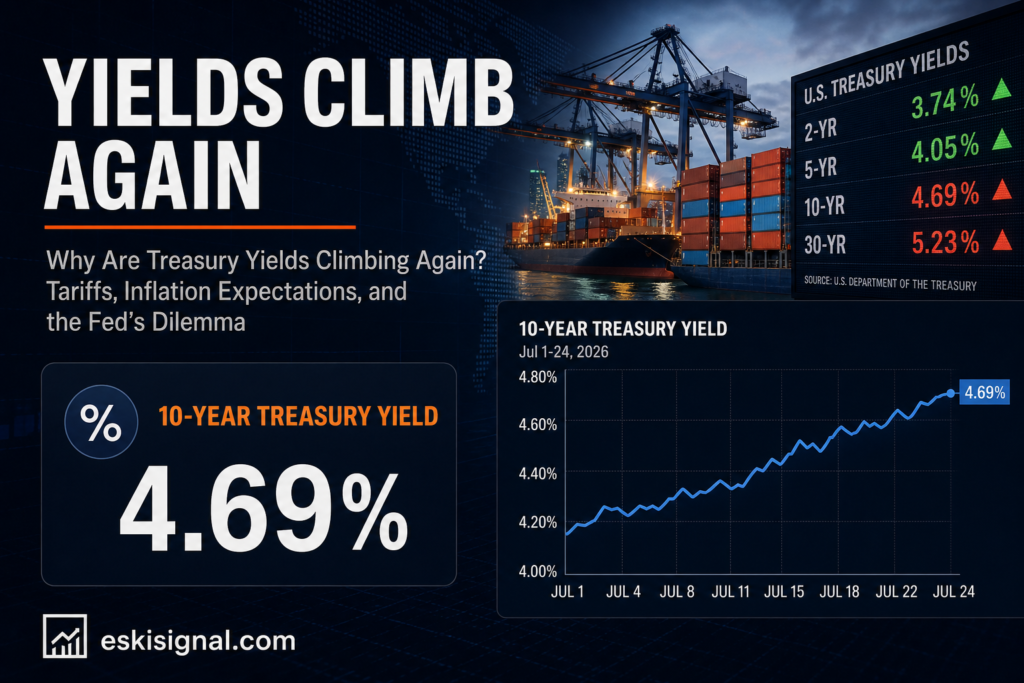
The 10-year Treasury yield closed at 4.69% on July 24, 2026 — up from a mid-July low near 4.58% reached right after a cooler-than-expected inflation print. That round trip in under two weeks captures the tug-of-war running through the bond market right now: disinflation signals pulling yields down, and a fresh wave of tariffs pulling them back up.
This article is for informational and educational purposes only. It is not financial advice, investment advice, or a recommendation to buy, sell, or hold any security, cryptocurrency, or financial product. Always verify data with official sources before making financial decisions.
Quick answer: why are yields rising?
Quick answer: Treasury yields climbed through the back half of July 2026 as new tariff actions — a 25% Section 301 tariff on Brazilian goods effective July 22, layered on top of April’s expanded Section 232 tariffs on steel, aluminum, and copper — revived inflation-expectations pressure just as the Fed prepares to meet on July 28–29. Higher expected inflation pushes bond buyers to demand higher yields to compensate, which is the basic mechanism behind the move; the 10-year yield rose from roughly 4.58% in mid-July to 4.69% by July 24.
The two tariff actions behind the move
Two separate tariff actions are doing most of the work. In April 2026, the administration expanded Section 232 tariffs on steel, aluminum, and copper, moving to a flat 50% rate on articles made almost entirely of those metals and 25% on derivative products, effective April 6. More recently, the U.S. Trade Representative imposed a 25% Section 301 tariff on most goods from Brazil, effective July 22 — just days before this yield move — with exemptions carved out for items like beef, orange juice, aircraft, and energy products. Tariffs function as a tax on imported goods, and businesses typically pass at least part of that cost through to consumer prices, which is why traders read fresh tariff actions as inflationary even before any actual price data confirms it.
| Tariff action | Effective date | Rate |
|---|---|---|
| Section 232 (steel, aluminum, copper) | April 6, 2026 | 50% on primary metal articles, 25% on derivatives |
| Section 301 (Brazil) | July 22, 2026 | 25% on most goods, with carve-outs for beef, OJ, aircraft, energy |
Why this puts the Fed in a bind
Tariff-driven inflation is a textbook awkward case for a central bank. It raises the price level, but it does so through a supply-side cost shock rather than excess demand — the kind of inflation that monetary policy is a blunt tool for addressing, since raising rates does nothing to offset a tariff, it just slows the rest of the economy down at the same time. That’s part of the backdrop for the Fed’s July 28–29 meeting: Chair Kevin Warsh’s Committee already flagged a hawkish tilt in June, with nine of eighteen participants projecting at least one hike in 2026, and fresh tariff-driven inflation pressure gives the hawks in the room another data point to point to, even though the case for treating tariff-driven price increases differently from demand-driven inflation is a live debate among economists.
Where rising yields ripple next
- Mortgages: 30-year mortgage rates track the 10-year Treasury yield closely, so a move from 4.58% to 4.69% flows through to home-loan pricing within days.
- Stocks: higher discount rates pressure the valuation of longer-duration growth stocks, including many AI-related names, more than value or defensive sectors.
- The dollar: higher U.S. yields tend to attract foreign capital into Treasuries, supporting the dollar — part of why the greenback has also strengthened through this period.
- Crypto and other risk assets: rising real yields raise the opportunity cost of holding non-yielding assets like Bitcoin, a headwind that showed up in late-July crypto price action.
Risks and limits
- Yield levels move daily; figures here reflect closing levels as of the dates cited and will be out of date by the time you read this.
- Tariff exemption lists and effective dates are subject to further legal and administrative changes.
- This is educational content on bond-market mechanics, not a forecast of future yield levels or investment advice.
What is the 10-year Treasury yield right now?
The 10-year closed at 4.69% on July 24, 2026, up from roughly 4.58% in mid-July. Treasury yields change daily, so check a live source like the Treasury Department or FRED for the current level.
Do tariffs always push bond yields higher?
Not automatically. Tariffs raise yields when markets interpret them as inflationary and expect the central bank to hold rates higher for longer as a result; the effect can be smaller or offset by other factors like weaker growth expectations.
How does a higher 10-year yield affect mortgage rates?
30-year fixed mortgage rates closely track the 10-year Treasury yield plus a spread, so when the 10-year rises, mortgage rates typically rise within days to weeks.
Sources
- U.S. Treasury, Daily Treasury Par Yield Curve Rates, July 2026.
- Office of the U.S. Trade Representative, Notice of Action on Section 301 Brazil tariffs, effective July 22, 2026.
- White House proclamation modifying Section 232 tariffs on steel, aluminum, and copper, effective April 6, 2026.