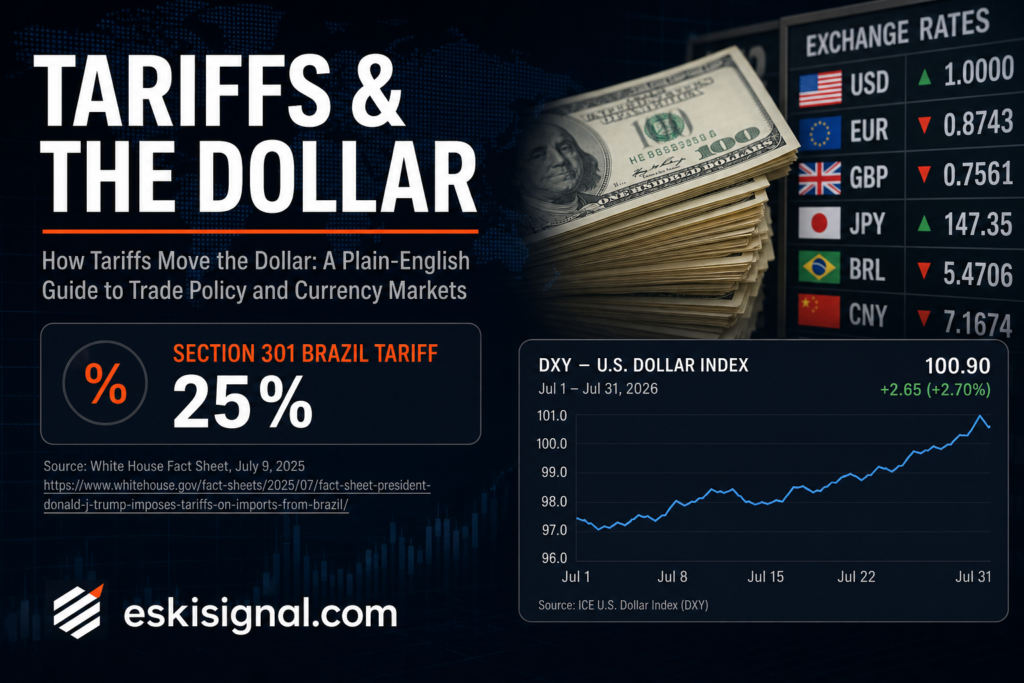
Tariffs get discussed as a trade-policy story, but for currency markets they’re just as much an interest-rate story wearing a different hat. The dollar’s climb through July 2026 — reaching its highest level against the Mexican peso since early April — is a case study in how a tariff announcement thousands of miles from a currency desk still moves exchange rates within hours.
This article is for informational and educational purposes only. It is not financial advice, investment advice, or a recommendation to buy, sell, or hold any security, cryptocurrency, or financial product. Always verify data with official sources before making financial decisions.
Quick answer: how do tariffs move currencies?
Quick answer: Tariffs move currencies mainly through two channels: they raise inflation expectations in the tariff-imposing country, which pushes bond yields up and makes that country’s currency more attractive to yield-seeking capital; and they shift trade-flow and growth expectations for both countries involved, which currency markets price in almost immediately. In 2026, new U.S. tariffs — including a 25% Section 301 levy on Brazilian goods and expanded Section 232 metals tariffs — combined with a hawkish Fed stance to push the dollar to its strongest level since early April against several currencies.
The rates channel: tariffs, inflation, and yield-seeking capital
The most direct link runs through interest rates. Tariffs on imported goods tend to raise consumer prices, at least temporarily, and higher expected inflation pushes bond yields higher as investors demand more compensation for holding fixed-rate debt — which is exactly what happened to the 10-year Treasury yield in the back half of July, rising to 4.69% from a mid-month low near 4.58%. Higher yields, in turn, make dollar-denominated assets more attractive to foreign investors chasing return, and that capital inflow strengthens the dollar. Layer on a Fed under Chair Kevin Warsh that has already signaled a hawkish tilt — nine of eighteen FOMC participants projected at least one 2026 hike after the June meeting — and the rates channel points firmly toward dollar strength.
The trade-flow channel: who actually pays a tariff
The second channel is more direct: tariffs change the price competitiveness of goods flowing between two countries, and currency markets often move to partly offset that shift. The Section 301 tariff on Brazil — a 25% levy on most Brazilian goods effective July 22, 2026, with exemptions for items including beef, orange juice, aircraft, and energy products — makes Brazilian exports to the U.S. more expensive at the border. One classic (though far from guaranteed) market response is for the exporting country’s currency to weaken, which would partially offset the tariff’s price impact for U.S. buyers by making Brazilian goods cheaper in local-currency terms even after the tariff. In practice, how much of this plays out depends heavily on capital flows, each country’s own monetary policy, and market positioning — it’s a tendency, not a rule.
| Channel | Mechanism | Typical dollar effect |
|---|---|---|
| Rates / inflation expectations | Tariffs raise expected inflation → yields rise → capital inflows | Dollar strengthens |
| Trade-flow repricing | Tariffs reduce exporting country’s competitiveness | Exporting country’s currency often weakens (not guaranteed) |
| Growth-risk repricing | Tariffs raise recession/slowdown risk for trade partners | Can cut both ways depending on which economy is seen as more exposed |
Why emerging-market currencies feel it most
A stronger dollar is rarely neutral for the rest of the world. Many emerging-market economies and companies borrow in dollars, so dollar strength effectively raises their debt-servicing costs in local-currency terms, even without a single new tariff aimed at them directly. Combine that with a country like Brazil facing a fresh 25% U.S. tariff on top of broader dollar strength, and the pressure on its currency can come from two directions at once — the direct trade hit and the indirect cost of dollar-denominated debt becoming more expensive to service.
Risks and limits
- Currency moves reflect many simultaneous inputs; attributing a specific move entirely to tariffs oversimplifies a multi-factor market.
- The trade-flow effect on a currency is a tendency observed in some historical episodes, not a rule that holds in every case.
- Exchange rates and tariff schedules change frequently — figures here reflect the dates cited and may be outdated by the time you read this.
- This is educational content on currency-market mechanics, not investment or trading advice.
Do tariffs always strengthen the dollar?
No. Tariffs tend to support the dollar when they raise U.S. inflation expectations and yields, but the net effect depends on how markets weigh that against growth risks and how other central banks respond — it’s a tendency observed in specific episodes, not a fixed rule.
Why do emerging-market currencies react more to dollar strength?
Many emerging-market governments and companies borrow in dollars, so a stronger dollar raises the local-currency cost of servicing that debt, adding pressure beyond any direct trade impact.
What currencies are exempt from the Brazil tariff?
The tariff itself applies to goods, not currencies. Certain Brazilian product categories — including beef, orange juice, aircraft and parts, and energy products — are exempted from the 25% Section 301 tariff, alongside more than 1,200 additional HTS-code exemptions.
Sources
- Office of the U.S. Trade Representative, Notice of Action on Section 301 Brazil tariffs, effective July 22, 2026.
- U.S. Treasury, Daily Treasury Par Yield Curve Rates, July 2026.
- Foreign-exchange market commentary on USD/MXN levels, July 2026.