
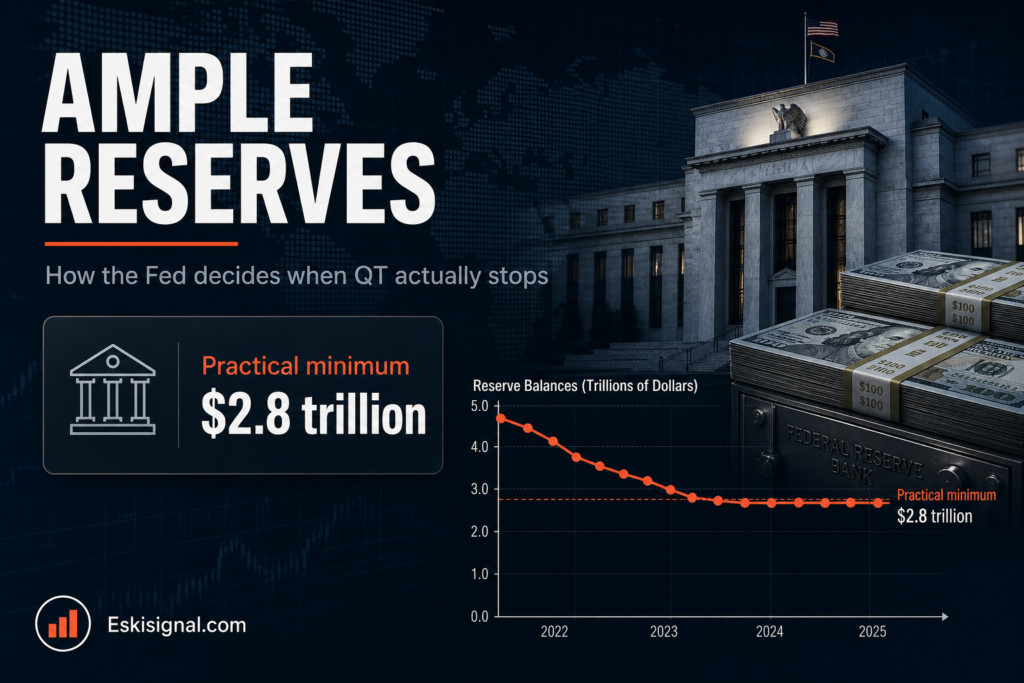
While the argument about whether the Fed raises rates this month occupies the front page, a quieter decision is being made in the same building about how much money should exist in the banking system. It has no announcement, no press conference and no dot plot. The Fed’s own answer is a word rather than a number — reserves should be “ample” — and the entire operating framework depends on identifying a level nobody can observe in advance.
This article is for informational and educational purposes only. It is not financial advice, investment advice, or a recommendation to buy, sell, or hold any security, cryptocurrency, or financial product. Always verify data with official sources before making financial decisions.
Short answer: enough reserves that the rate stays put on its own
Short answer: In an ample reserves regime the banking system holds so much cash at the Fed that the overnight rate is set administratively — by the interest the Fed pays on reserve balances — rather than by daily supply and demand for reserves. Quantitative tightening drains reserves. It is supposed to stop before the system moves from ample to scarce, because in a scarce regime the overnight rate starts moving on its own and the Fed loses precise control of the one rate it is supposed to set. The difficulty is that the boundary is only visible after it has been crossed.
Why the Fed cannot just pick a number
Reserve demand is not a fixed quantity. It depends on how banks are regulated, how they manage intraday payment flows, how much liquidity they choose to hold as a precaution and how unevenly reserves are distributed among them. Two banking systems holding identical aggregate reserves can behave completely differently if one institution holds most of them.
Estimates cluster around $2.8 trillion as the practical minimum for smooth functioning in the current system, but that figure is an inference from behaviour, not a target the Fed has adopted. It moves as regulation and bank practice move. Officials speak instead of the lowest comfortable level of reserves, which is honest phrasing for a threshold that is defined by the discomfort that appears when you reach it.
September 2019 is the reference episode. Reserves had been drained over two years, a corporate tax date and a large Treasury settlement coincided, and overnight repo rates spiked to several times the policy rate in a single morning. Nothing had signalled the boundary in the preceding weeks. It was located by hitting it.
| Ample reserves | Scarce reserves | |
|---|---|---|
| What sets the overnight rate | Administered rates (IORB) | Supply and demand for reserves |
| Day-to-day rate volatility | Minimal | Rises, spikes around settlement dates |
| Fed’s control | Precise | Requires active daily operations |
| Warning it is approaching | Repo rates drifting above IORB | Already there |
The two tools built after 2019, and what their usage says
The Standing Repo Facility exists so that the 2019 episode cannot repeat in the same form. Eligible institutions can borrow cash overnight from the Fed against Treasury and agency collateral, which puts a ceiling on how far repo rates can rise. It is designed as a backstop, not a funding source — a facility that is heavily used in normal conditions would indicate the system is already stressed rather than that the tool is working.
Its usage pattern is therefore a diagnostic. Balances reached roughly $75 billion around a recent year-end, then fell to zero once the turn passed — a clean example of a backstop doing exactly its job at the one moment of predictable stress. Watching whether that pattern stays confined to quarter-ends and tax dates is more informative than watching the aggregate reserve number.
The second tool is less discussed. Reserve Management Purchases restarted in December 2025, with the New York Fed buying roughly $40 billion of short-dated Treasuries through April 2026 to build a buffer ahead of the April tax drain, then tapering to $25 billion in May and $10 billion a month since. These are not quantitative easing. They are technical purchases intended to offset the growth of other liabilities on the Fed’s balance sheet so that reserves do not decline passively.
The distinction that gets lost in commentary
Balance sheet decisions and interest rate decisions are separate instruments aimed at separate objectives, and conflating them produces most of the confusion in coverage of this subject.
Ending quantitative tightening is not easing. It is the removal of a drain, made for operational reasons about the plumbing of the payments system, and it is entirely coherent for the Fed to stop shrinking the balance sheet in the same meeting it raises the policy rate. Markets nonetheless tend to read any balance sheet expansion as stimulus, which is why the Fed labels technical purchases carefully and why officials repeat the word “technical” until it sounds defensive.
The reverse conflation also appears: treating a large balance sheet as inherently inflationary. Reserves sit at the Fed earning interest. Whether they translate into credit creation depends on bank behaviour and loan demand, which is why a $6.6 trillion balance sheet has coexisted with wildly different inflation outcomes over the past fifteen years.
| Indicator | Where published | What a warning looks like |
|---|---|---|
| Reserve balances | Fed H.4.1, Thursdays | Sustained decline toward the estimated floor |
| SRF usage | New York Fed operations page, daily | Non-zero away from quarter-ends |
| EFFR vs IORB | New York Fed reference rates, daily | Effective rate drifting above the administered rate |
| SOFR percentiles | New York Fed, daily | Widening tail — some borrowers paying far above the median |
The honest counterargument
A serious body of opinion holds that the ample reserves framework is itself the problem, and that the Fed should return to a scarce reserves system with a much smaller balance sheet.
The argument is that a large balance sheet makes the central bank a permanent, dominant participant in the Treasury and mortgage markets, distorts the pricing of duration, pays substantial sums to banks in interest on reserves, and blurs the boundary with fiscal policy. Under the pre-2008 corridor system the Fed steered the overnight rate with open market operations measured in billions rather than trillions, and it worked for decades. This is the intellectual basis for the current Chair’s stated preference for a materially smaller footprint.
The objection is practical rather than theoretical: the banking system, the regulatory regime and the size of the Treasury market are all different now, and the transition from here to there runs directly through the boundary that nobody can locate in advance.
What this article does not conclude
Nothing here predicts when quantitative tightening ends, what reserve level the Committee will settle on, or whether the framework will be revised. The $2.8 trillion figure is an estimate produced by outside analysis of bank behaviour, not an official threshold, and estimates of it have been revised repeatedly.
All of the series referenced are published and free. The H.4.1 release, the New York Fed’s daily reference rates and its operations results are the primary record; commentary that does not reconcile to them, including this article, should be checked against them.