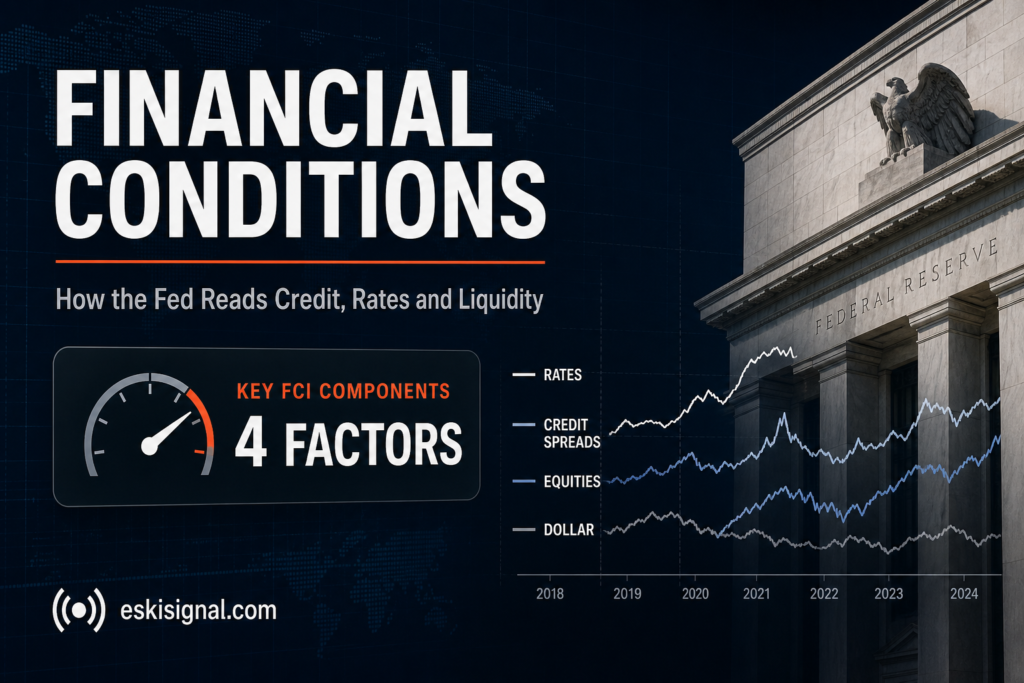
The Fed can hold its policy rate perfectly still for months and yet financial conditions can tighten or loosen underneath it anyway — because rates are only one lever among several. Credit spreads widening, stocks selling off, or the dollar surging can all do part of the Fed’s tightening work for it, without a single rate decision being made. That’s the entire point of the Financial Conditions Index.
This article is for informational and educational purposes only. It is not financial advice, investment advice, or a recommendation to buy, sell, or hold any security, cryptocurrency, or financial product. Always verify data with official sources before making financial decisions.
Quick answer: what is the Financial Conditions Index?
Quick answer: A Financial Conditions Index (FCI) is a composite gauge that blends multiple market variables — short-term interest rates, credit spreads, equity valuations, and currency strength, among others — into a single reading of how easy or difficult it currently is for households and businesses to borrow and raise capital. Several versions exist, published by the Federal Reserve Bank of Chicago, Goldman Sachs, and Bloomberg among others, each with slightly different components and weightings. A rising or “tightening” FCI signals that credit is getting harder or more expensive to access beyond what the Fed’s policy rate alone would suggest; a falling or “loosening” FCI signals the opposite.
Why the Fed cares about more than just its own rate
The Fed sets one number directly — the federal funds rate — but that rate doesn’t act alone on the economy. It works through a chain of market prices: mortgage rates, corporate bond yields, stock valuations, and the dollar’s exchange rate all respond to Fed policy, market expectations, and their own independent forces at the same time. An FCI attempts to capture the combined tightening or loosening effect of all of those channels at once, rather than looking at the policy rate in isolation.
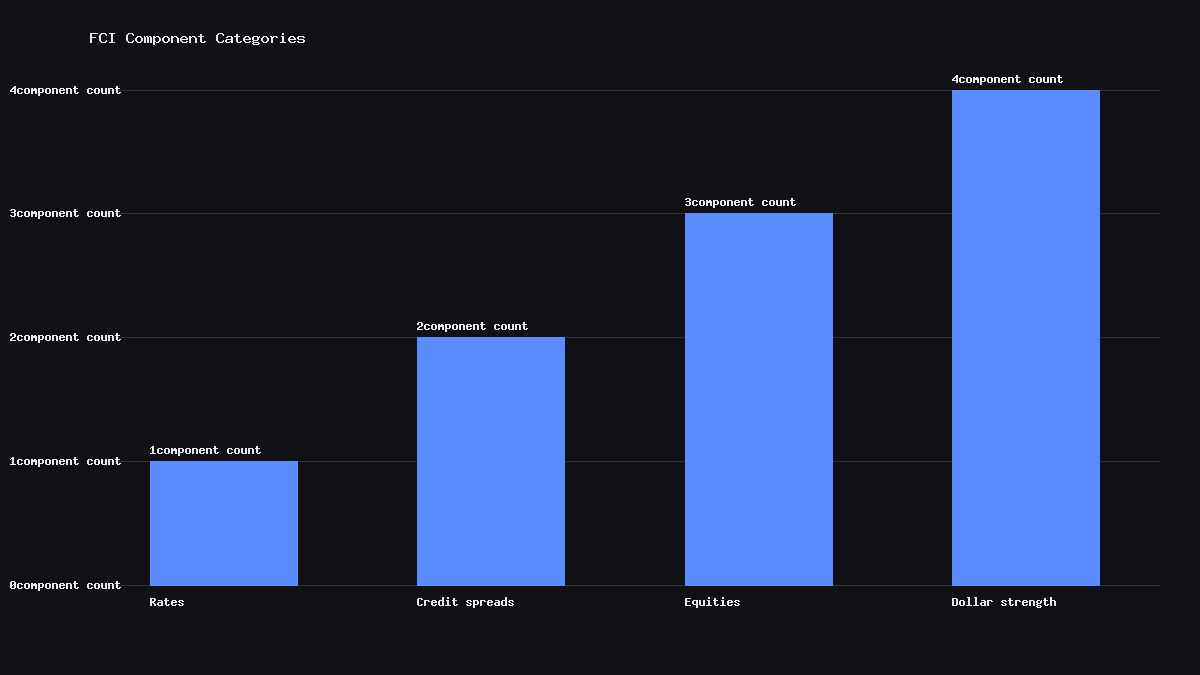
| Component category | What it captures | Effect when it worsens/widens |
|---|---|---|
| Short-term interest rates | Cost of short-term borrowing | Tightens conditions |
| Credit spreads | Extra yield investors demand to hold corporate debt over Treasuries | Widening spreads tighten conditions |
| Equity valuations | Stock market levels, a proxy for wealth and corporate funding access | Falling equities tighten conditions |
| Dollar strength (trade-weighted) | Cost of dollar-denominated debt and US export competitiveness | A stronger dollar can tighten conditions, especially for foreign borrowers |
Why FCIs matter for rate-cut and rate-hike expectations
An FCI is often described as capturing the market’s own “de facto” tightening or loosening, separate from anything the Fed has explicitly voted on. If financial conditions tighten sharply on their own — say, through a stock selloff and widening credit spreads — that can do part of the job a rate hike would otherwise do, giving the Fed more room to hold rates steady or even cut. Conversely, if conditions loosen significantly even while the Fed holds rates high (stocks rallying, spreads narrowing, credit flowing freely), some Fed officials have pointed to that loosening as a reason policy may need to stay tighter for longer, since easy financial conditions can work against the Fed’s own tightening efforts.
Comparing the major FCI versions
There’s no single official FCI — several institutions publish their own versions, and they don’t always move in lockstep because they weight components differently.
| Index | Publisher | Notable feature |
|---|---|---|
| National Financial Conditions Index (NFCI) | Federal Reserve Bank of Chicago | Weekly, broad set of over 100 financial indicators; publicly available |
| US Financial Conditions Index | Goldman Sachs | Widely cited by market commentators; proprietary weighting |
| Financial Conditions Index | Bloomberg | Combines money market, bond market, and equity market sub-indexes |
Risks and limits
- There is no single standardized FCI — different publishers weight components differently, and readings can diverge, especially during fast-moving market stress.
- An FCI is a snapshot of current market-based conditions, not a forecast of future Fed policy decisions.
- Because equities are typically a component, an FCI can partly reflect stock market sentiment rather than credit-market stress specifically.
- This is educational content describing how financial conditions indexes are constructed — it is not a signal or forecast of Fed policy.
Mini glossary
| Term | Plain-English meaning |
|---|---|
| Financial Conditions Index (FCI) | A composite gauge of how easy or hard it is to borrow and raise capital |
| Credit spread | The extra yield investors demand to hold corporate debt over comparable Treasuries |
| NFCI | The Chicago Fed’s National Financial Conditions Index, a widely cited public FCI |
| Tightening / loosening | Conditions becoming harder (tightening) or easier (loosening) for borrowing and raising capital |
What does a “tightening” Financial Conditions Index mean?
A tightening FCI means it’s becoming harder or more expensive for households and businesses to borrow or raise capital, based on a combination of rates, credit spreads, equity valuations, and currency strength — beyond what the Fed’s own policy rate alone would suggest.
Is there one official Financial Conditions Index?
No. Several institutions — including the Federal Reserve Bank of Chicago, Goldman Sachs, and Bloomberg — each publish their own version with different components and weightings, so readings can diverge from one publisher to another.
Why would the Fed care if financial conditions loosen without a rate cut?
If financial conditions loosen on their own — for example, through a stock market rally or narrowing credit spreads — while the Fed is trying to keep policy tight, that loosening can work against the Fed’s efforts to slow demand and inflation, which is one reason Fed officials sometimes reference financial conditions directly when discussing the outlook.
Sources
- Federal Reserve Bank of Chicago, National Financial Conditions Index (NFCI) methodology.
- Federal Reserve speeches and minutes referencing financial conditions in policy discussions.
- Goldman Sachs and Bloomberg published methodology notes on their respective Financial Conditions Indexes.