
The 10-year Treasury yield reached 4.85% this week, its highest level since October 2023. The conventional explanation is inflation: oil above $100, a diesel shortage, tariff passthrough still working through goods prices. That explanation is incomplete. In the same week, the President, the Vice President, the Treasury Secretary and a senior White House economic counsellor all publicly urged the Federal Reserve not to raise rates at its September meeting. Bond markets are pricing something in addition to inflation, and it has a name.
This article is for informational and educational purposes only. It is not financial advice, investment advice, or a recommendation to buy, sell, or hold any security, cryptocurrency, or financial product. Always verify data with official sources before making financial decisions.
Short answer: the compensation for policy that might not be independent
Short answer: An independence premium is the extra yield investors demand when they suspect a central bank’s decisions may be shaped by political pressure rather than by its mandate. It is not a published statistic. It shows up indirectly, in the gap between what inflation expectations justify and where long yields actually trade, and in the shape of the curve — specifically at the long end, where the credibility of policy twenty and thirty years out is what is being priced. The distinguishing feature is that it widens on political news rather than on economic data.
Why this is not just the term premium again
Term premium is the compensation for holding duration — for bearing the risk that rates move against you over a long holding period. It rises with uncertainty about the path of policy, with supply, and with inflation volatility. An independence premium is a component of that uncertainty, but it is a specific one, and separating it matters because it responds to different news.
The practical test is the reaction function. If long yields rise on a hot CPI print, that is inflation risk. If long yields rise on a headline about the Treasury Secretary commenting on the Fed’s balance sheet, the market is repricing something else. Over the past three weeks both types of news have moved the long end, which is why decomposing the move is harder than usual and why commentary describing the entire rise as an inflation story is doing less work than it appears to.
| What moved | Consistent with inflation risk | Consistent with credibility risk |
|---|---|---|
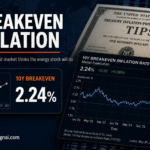
| Breakevens (nominal minus TIPS) | Rise | Rise, and by more at long maturities than short |
| Real yields | Can fall as breakevens rise | Rise alongside breakevens |
| Curve shape | Front end leads | Long end leads; 10s30s steepens |
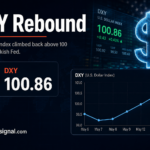
| Dollar | Firms on higher expected policy rates | Can weaken despite higher yields |
| Gold | Mixed | Rises with yields, breaking the usual inverse link |
That last row is the one worth sitting with. Gold trading near $4,395 while the 10-year prints its highest yield in nearly three years is not what the textbook relationship predicts. One reading is central bank reserve demand, which has been running at record levels. Another is that some buyers are hedging the credibility of the currency’s issuer rather than the level of real rates. The two readings are not mutually exclusive, and neither is provable from price data alone.
What the historical analogues actually show
The reference case American commentators reach for is the Nixon-Burns period, when a Fed chair widely believed to be accommodating a president presided over the beginning of the Great Inflation. It is a real analogue, but a slow one: the credibility loss took years to show up in long yields and roughly a decade and a double-digit policy rate to reverse.
The faster analogues are foreign. Emerging-market central banks that have been publicly overruled tend to see the currency move first, long yields second, and inflation expectations third — a sequence measured in weeks rather than years. The 2022 UK gilt episode is the closest developed-market example, and its lesson was narrower than it is usually described: the market punished a fiscal announcement that arrived without an accompanying independent forecast, and the mechanism that broke was leverage in pension funds, not credibility itself.
The useful generalisation from all three is that credibility is priced asymmetrically. It erodes faster than it rebuilds, and the rebuilding is expensive, because the only way to demonstrate independence convincingly is to do something unpopular and visible.
The September setup, and why a hike is the awkward case
Futures markets moved to roughly a 57% to 60% probability of a quarter-point increase after Chair Kevin Warsh’s Jackson Hole keynote in late August. That is not a confident market. It is a market that reads the Chair as willing to hike and is unsure whether the Committee will follow him — Governor Christopher Waller has said publicly he would be inclined to hold.
The awkwardness is that both outcomes are now readable as political. A hike, delivered days after an unusually direct White House lobbying campaign, will be read by some as the Fed proving a point. A hold will be read by others as capitulation. Warsh has addressed this directly, arguing that the Fed’s decision to hold rather than cut through the spring was itself evidence of independence. That is a reasonable defence, and it also illustrates the trap: once independence becomes the subject of commentary, every decision acquires a second interpretation that has nothing to do with the economy.
| Where to look | Source | What a credibility repricing looks like |
|---|---|---|
| 5y5y forward breakeven | FRED, derived from TIPS | Drifts up while near-term breakevens are flat |
| 10s30s spread | Treasury daily par yields | Steepens on political rather than data days |
| Auction tails and indirect bids | TreasuryDirect results | Weaker foreign participation at the long end |
| Dollar vs yields | DXY and 10-year together | Yields up, dollar down — an unusual combination |
The honest counterargument
There is a straightforward case that no independence premium exists here at all, and it deserves to be stated properly rather than waved away.
Oil moved from the mid-sixties to above $100 in a matter of weeks. Diesel cracks hit an all-time record. Distillate inventories are at their lowest seasonal level since the 1990s. Those are enormous, verifiable supply shocks, and they are individually sufficient to explain higher inflation expectations and higher nominal yields without invoking anything about politics. Long yields also rise when the market expects more issuance, and issuance is heavy. Attributing a residual to credibility is what analysts do when they cannot attribute it to anything else, and residuals are where wishful reasoning tends to live.
The counter-counterargument is the timing evidence — moves clustered on political headlines rather than data releases — and that evidence is suggestive rather than conclusive, because in a week this crowded almost every day contains both.
What this article does not conclude
Nothing here forecasts the September decision, the level of yields, or whether the Committee will follow its Chair. The independence premium is not measurable directly; every estimate of it is a residual from a model, and the two standard term-premium models already disagree with each other in normal conditions.
Yield levels cited here are as of 9 September 2026 and change daily. Probability estimates from futures pricing are a snapshot, not a forecast, and they have moved by twenty points or more inside a single week twice this year. The primary sources — Treasury par yield curves, TIPS breakevens, FOMC statements and auction results — are public, and reading them directly is more informative than reading anyone’s decomposition of them, including this one.