
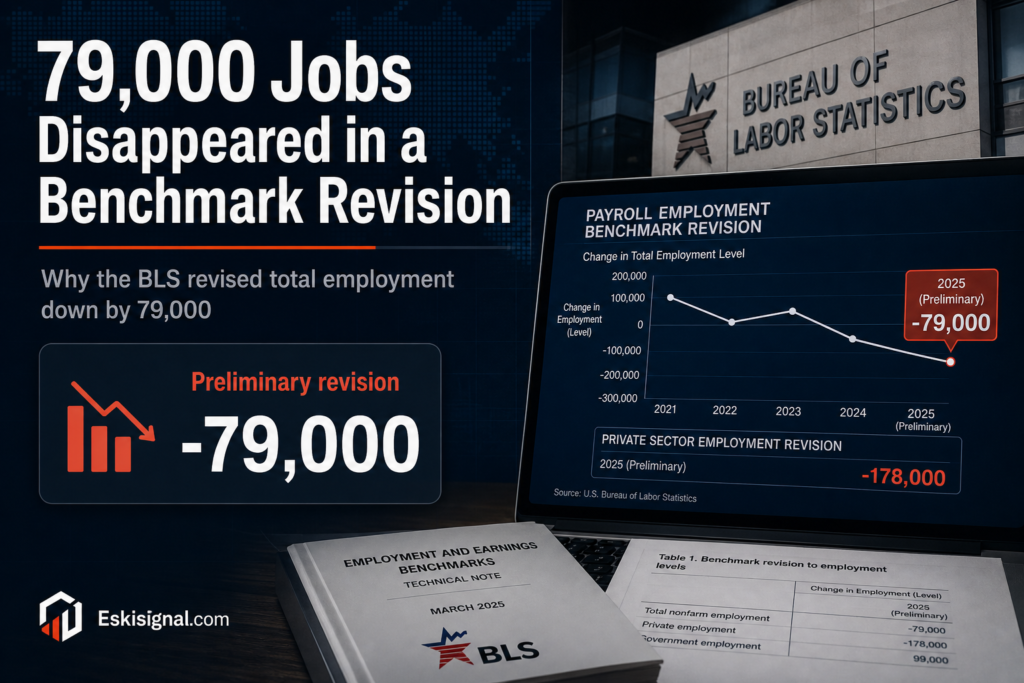
Every payroll number published between April 2025 and now was an estimate drawn from a survey. Once a year the Bureau of Labor Statistics checks those estimates against something closer to a census, and publishes the difference in a single line. This year the line read minus 79,000 for total employment as of March 2026, and minus 178,000 for private employment. After two years of far larger markdowns, that is the smallest preliminary benchmark revision since 2021.
This article is for informational and educational purposes only. It is not financial advice, investment advice, or a recommendation to buy, sell, or hold any security, cryptocurrency, or financial product. Always verify data with official sources before making financial decisions.
Short answer: the survey gets checked against the tax records
Short answer: The monthly jobs report comes from the Current Employment Statistics survey, a sample of employers. Once a year the level of that survey is realigned to the Quarterly Census of Employment and Wages, which is built from state unemployment insurance filings and covers the overwhelming majority of jobs rather than a sample of them. The benchmark revision is the size of the gap that accumulated since the last realignment. It restates history; it does not change the current month’s estimate directly, though it shifts the base every subsequent estimate is built on.
Why a gap opens at all
A sample survey can count jobs at firms it already knows about. It cannot count jobs at firms that did not exist when the sample frame was drawn, and it cannot know which firms in the frame have quietly ceased trading rather than simply failed to respond this month.
The BLS handles this with the net birth-death model, a statistical adjustment estimating employment from business formation and closure. It is a model, and it is calibrated on the recent past. That works well when the rate of business formation is stable and poorly when it turns — which is precisely what happens around inflection points in the economy, when the accuracy of the payroll number matters most. The model tends to overstate employment when firm deaths accelerate faster than the model expects, which is the mechanism behind the large downward revisions of the past two years.
| CES (monthly payrolls) | QCEW (benchmark source) | |
|---|---|---|
| Basis | Sample of employers | Unemployment insurance tax filings |
| Coverage | Sample, weighted up | Near-universe of covered employment |
| Timeliness | Three weeks after month end | Roughly two quarters in arrears |
| Handles new firms via | Birth-death model | Actual filings |
The trade-off is timeliness against accuracy, and it is not a flaw in the design. A near-census that arrives two quarters late cannot serve as a monthly indicator. A timely sample cannot be as accurate. The benchmark exists to reconcile the two rather than to choose between them.
Reading this year’s number properly
Minus 79,000 on a base of roughly 160 million jobs is about a tenth of a percent. In isolation that is a small statistical correction and considerably less dramatic than the coverage it received.
Two details complicate the reassuring reading. The first is that the private sector revision, at minus 178,000, is more than twice the total — which means government employment was revised up enough to offset more than half the private markdown. For anyone using payrolls as a read on private demand rather than on total headcount, the private line is the relevant one and it is the weaker of the two.
The second is composition. The downward pressure came from retail trade, education and health services, manufacturing and business services, while transportation and warehousing, information, financial activities and construction were revised up. That is not a uniform markdown; it is a reallocation, and reallocations carry information about which parts of the economy the monthly survey has been mis-measuring.
Preliminary is not final, and the gap between them has been large
The figure published now is a preliminary estimate. The final benchmark is incorporated into the official series with the January 2027 Employment Situation report, published in February 2027, and it is not unusual for the final to differ meaningfully from the preliminary.
This is worth holding on to, because the preliminary number generates the headlines and the final number rarely does. Anyone building a narrative about labour market strength on a preliminary benchmark is building it on a figure that will be restated in five months, from a survey measuring a month that is already half a year old.
| Stage | When | What it is |
|---|---|---|
| Monthly estimate | Three weeks after month end | CES sample plus birth-death model |
| Monthly revisions | Following two reports | Late survey responses incorporated |
| Preliminary benchmark | Around September | Estimate of the March realignment |
| Final benchmark | February the following year | Incorporated into the official series |
The honest counterargument
There is a reasonable position that benchmark revisions are over-interpreted in both directions, and that this year’s smaller number is the evidence for it.
When revisions were large, they were presented as proof that the labour market had been systematically weaker than reported and, in some accounts, that the data itself was untrustworthy. A tenth of a percent this year is a poor fit for that story. The more mundane reading is that the birth-death model performs badly around turning points in business formation and normally the rest of the time, which is what a statistical adjustment calibrated on the recent past should be expected to do. On this account the revision is a routine housekeeping entry that acquired a political audience.
The counter is that the QCEW itself has limitations — it misses workers outside the unemployment insurance system, and the coverage gap has grown alongside contract and platform work.
What this article does not conclude
Nothing here forecasts payrolls, the unemployment rate, or the Fed’s reading of either. The benchmark revision describes March 2026. It does not tell you what the labour market is doing now, and treating a restatement of a six-month-old level as current news is the most common error in coverage of this release.
The BLS publishes the preliminary benchmark release, the full CES technical documentation and the birth-death model adjustments openly. Anyone relying on the number for anything consequential should read the technical note rather than a summary of it.