
Last updated: June 17, 2026, 10:30 AM ET
Topic: U.S. stablecoin regulation (educational explainer).
This article is for informational and educational purposes only. It is not financial advice, investment advice, or a recommendation to buy, sell, or hold any security, cryptocurrency, or financial product. Always verify data with official sources before making financial decisions.
Short answer: what is the GENIUS Act and why does it matter for stablecoins?
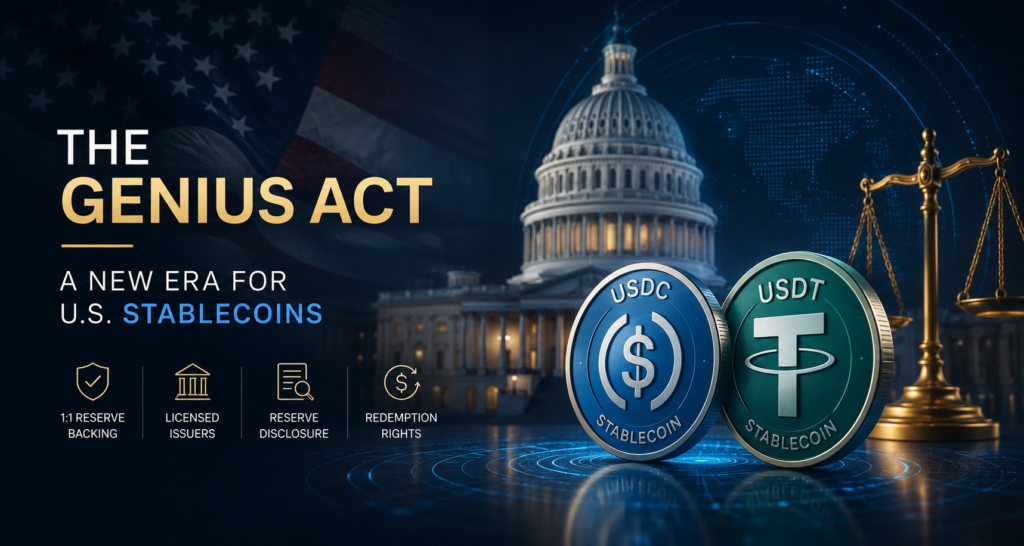
The GENIUS Act (Guiding and Establishing National Innovation for U.S. Stablecoins) is the first comprehensive U.S. federal framework for “payment stablecoins” — dollar-pegged digital tokens like USDC and USDT. Passed in 2025 and moving into implementation through 2026, it sets rules for who can issue stablecoins and how they must be backed. The headline requirements: full 1:1 reserve backing with high-quality liquid assets (U.S. Treasuries or cash equivalents), licensing for issuers, and regular public disclosure of reserves. This is an educational overview, not advice about any token or company.
Core requirements at a glance
| Requirement | What it means |
|---|---|
| 1:1 reserves | Every token backed by cash or short-term Treasuries; no fractional models |
| Licensed issuers | Only federally or state-approved entities can issue payment stablecoins |
| Reserve disclosure | Monthly attestations and transparency on backing |
| Redemption rights | Clearer rules for holders to redeem at par |
| Interest limits | Issuers face restrictions on paying yield directly to holders |
Why it matters
Stablecoins are the settlement layer for much of crypto trading and a growing piece of digital payments. A clear federal framework gives banks, fintechs, and enterprises more legal certainty to use them, while giving users stronger backing and transparency. Reporting has noted that USDC (issued by Circle) was already structured close to the new standard, while Tether’s global USDT product sits largely outside the framework, with a separate U.S.-compliant token launched for the U.S. market. The practical effect: compliant stablecoins may gain institutional adoption, while less-compliant ones could face limits on U.S. exchanges.
Implementation timeline (reported)
- July 2025: the GENIUS Act passed.
- Early–mid 2026: regulators (OCC and others) drafting implementing rules; comment periods ran into spring.
- Effective date: tied to the earlier of 18 months after enactment or 120 days after final rules.
- Enforcement: reported to begin no later than January 2027.
A real-world framing
The Act has reshaped competitive positioning among issuers. Because USDC was built around regulated issuance, institutional custody, and audited reserves, reporting describes it as well-positioned under the new rules, while other issuers have had to adapt. One debated detail is whether issuers can effectively pass reserve income to holders through third parties — a question regulators and courts may clarify.
Key points table
| Point | Why it matters | Caveat |
|---|---|---|
| Federal clarity | Reduces legal uncertainty for businesses | Rules still being finalized |
| 1:1 backing | Stronger holder protection | Attestations are not the same as full audits in all cases |
| Issuer divergence | USDC vs USDT face different paths | Strategies are evolving |
| Yield restrictions | Affects the appeal vs bank deposits | Legal interpretation is contested |
Risks, uncertainty, and limits
- Implementing rules and effective dates were still being finalized at the time of writing.
- Regulatory details can change; confirm with primary sources.
- A regulated stablecoin is not risk-free; backing and redemption still depend on the issuer.
- This is educational content, not advice about any token, coin, or company.
What to watch next
- Final implementing regulations from U.S. regulators.
- Which issuers obtain approved status under the framework.
- How the yield/interest question is resolved.
- Adoption by banks, fintechs, and payment platforms.
What this article does not conclude
This explainer summarizes the GENIUS Act framework. It does not recommend any stablecoin, token, or company, and it does not predict regulatory outcomes.
What is the GENIUS Act?
It is the first comprehensive U.S. federal law for payment stablecoins, setting rules on 1:1 reserve backing, issuer licensing, and reserve disclosure. It passed in 2025 and is being implemented through 2026.
What does the GENIUS Act require of stablecoins?
Full 1:1 backing with cash or short-term Treasuries, issuance only by approved entities, monthly reserve attestations, clearer redemption rights, and limits on paying interest directly to holders.
How does it affect USDC and USDT?
Reporting describes USDC (Circle) as already close to the standard, while Tether’s global USDT sits largely outside the framework, with a separate U.S.-compliant token for the U.S. market.
When does the GENIUS Act take effect?
The effective date is tied to the earlier of 18 months after enactment or 120 days after final rules, with enforcement reported to begin no later than January 2027. Confirm with primary sources.
Sources
- Congress.gov — GENIUS Act (S.394) text.
- Federal Register / OCC — implementing rule proposals.
- Public reporting on issuer positioning (Circle/USDC, Tether/USDT).