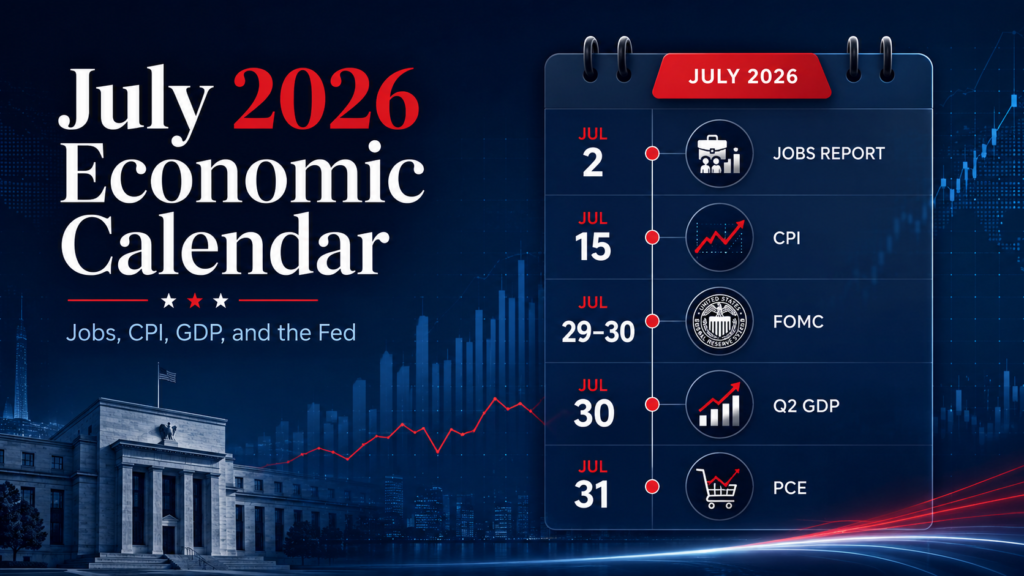
July is one of the busier stretches on the U.S. data calendar. The month opens with the June jobs report, runs through a CPI print that lands while the Fed is in its pre-meeting quiet period, and closes with the second-quarter GDP estimate and the Fed’s preferred inflation gauge. Below is what to watch, with the times in Eastern and the reason each release tends to move markets. Dates follow the standard agency schedules; always confirm against the official source, since timing can shift.
Informational and educational content only. Nothing here is financial or investment advice, or a recommendation to buy, sell, or hold anything. Verify figures against official sources before acting on them.
The headline releases
| Date (2026) | Release | Time (ET) | Why it matters |
|---|---|---|---|
| Thu, Jul 2 | June Jobs Report (Employment Situation) | 8:30 a.m. | Payrolls, unemployment, wages — the month’s biggest data point |
| Wed, Jul 15 | June CPI | 8:30 a.m. | Headline inflation read after the spring energy spike |
| Thu, Jul 16 | June PPI / Retail Sales | 8:30 a.m. | Wholesale prices and consumer spending |
| Wed, Jul 29–30 | FOMC meeting | 2:00 p.m. (Jul 30) | No new dot plot; statement and Warsh presser in focus |
| Wed, Jul 30 | Q2 Advance GDP | 8:30 a.m. | First read on second-quarter growth |
| Thu, Jul 31 | June PCE (core) | 8:30 a.m. | The Fed’s preferred inflation gauge |
Note the jobs report timing. Because Friday, July 3 is the observed Independence Day holiday with markets closed, the June employment report is expected to land on Thursday, July 2 rather than its usual first-Friday slot. That compresses the data into a short pre-holiday week.
How July sets up after June’s Fed meeting
The backdrop is a Fed that just turned more hawkish. June’s dot plot erased the 2026 rate cut and lifted the median year-end rate toward 3.8%, with roughly half the committee now expecting a hike. That makes every July inflation and labor reading higher-stakes than usual: a hot CPI or a strong jobs number feeds the hike case, while soft prints support the view that the spring energy-driven inflation is fading.
The late-July FOMC meeting is not a projection meeting, so there is no fresh dot plot. The action will be in the statement language and Warsh’s press conference — especially after he spent his June debut stripping the statement down and standing up five internal task forces.
Reading the calendar without overreacting
A practical way to use a data calendar is to separate the releases that reset the macro narrative from the ones that mostly confirm it. Jobs, CPI, and PCE are narrative-setters. Secondary releases — regional Fed surveys, sentiment indexes, weekly claims — fill in texture but rarely move the broad market on their own. Knowing which is which keeps you from treating every number as a turning point.
- First, the jobs report (Jul 2) frames whether the labor market is still tight enough to keep the Fed leaning hawkish.
- Then CPI (Jul 15) tests whether energy-driven inflation is rolling over now that oil has pulled back.
- Finally, GDP and PCE (Jul 30–31) close the month with growth and the Fed’s favored inflation measure.
A note on holidays and timing
Markets are closed Friday, July 3, 2026 in observance of Independence Day (July 4 falls on a Saturday), and many releases shift around it. The Treasury market typically takes an early close on July 3 as well. Beyond that, the late-month clustering of GDP, PCE, and the FOMC meeting into the same few days makes the final week the densest of the month.
What are the most important economic releases in July 2026?
The June jobs report (expected July 2), June CPI (around July 15), the late-July FOMC meeting (July 29–30), and the Q2 GDP and June PCE readings at month-end are the highest-impact items.
Why is the July jobs report on a Thursday?
Friday, July 3, 2026 is the observed Independence Day market holiday, so the June Employment Situation report is expected to be released Thursday, July 2 instead of the usual first Friday. Confirm with the BLS schedule.
Is there a Fed dot plot in July 2026?
No. The July 29–30 FOMC meeting is not a projection meeting, so there is no new Summary of Economic Projections. Focus shifts to the statement and the press conference.
Are U.S. markets closed for July 4, 2026?
July 4 falls on a Saturday in 2026, so the market holiday is observed Friday, July 3, with U.S. stock markets closed and an early bond-market close.
Sources
- U.S. Bureau of Labor Statistics — CPI and Employment Situation release schedules.
- U.S. Bureau of Economic Analysis — GDP and PCE release schedule.
- Federal Reserve — 2026 FOMC meeting calendar.