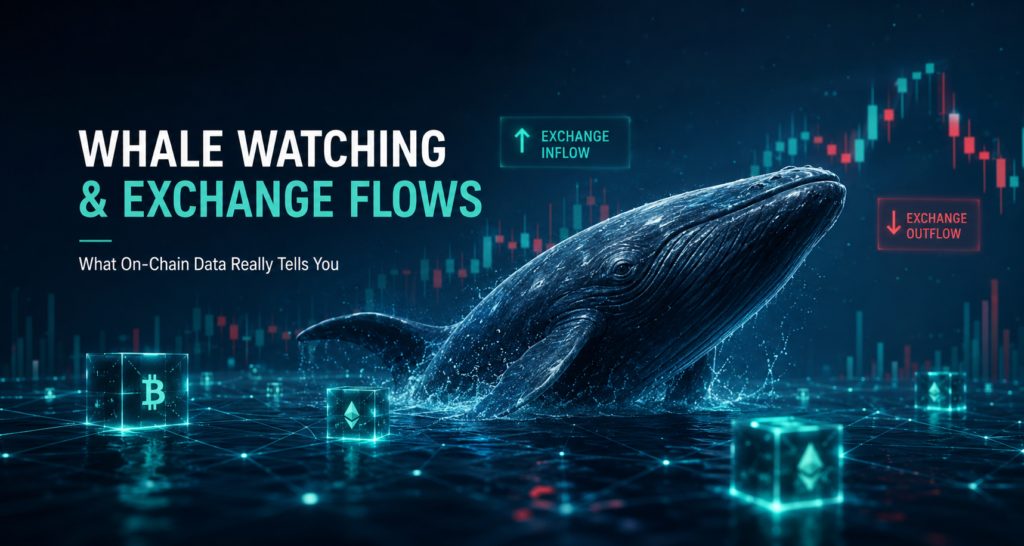
Imagine being able to watch, in real time, every time a major bank moved money between its own vaults. That is roughly what crypto analysts get to do every day — except the “banks” are wallets, and anyone with an internet connection can look. In crypto, a handful of very large holders, nicknamed “whales,” can move a market that millions of smaller participants trade in, and because every transaction on a public blockchain is visible, analysts spend a lot of time watching what they do, especially when coins move on and off exchanges.
Informational and educational content only. Nothing here is financial or investment advice, or a recommendation to buy, sell, or hold anything. Verify figures against official sources before acting on them.
Who counts as a whale, and why attribution is messy
There is no official cutoff for what makes a wallet a “whale.” Generally it means holding enough of an asset to move the market when it trades — think large institutions, early adopters, funds, or exchanges themselves. Because blockchains are transparent, on-chain analysts can track these large wallets and flag when they accumulate, distribute, or shift funds. The catch, and it is a big one, is that one entity can control many wallets, and exchange wallets pool the holdings of thousands of individual users. A single “whale address” moving coins is not always what a screenshot on social media makes it look like.
The flow everyone watches: coins moving to and from exchanges
The transfer that draws the most attention is movement between private wallets and exchanges, and the logic behind it is intuitive. You generally have to move a coin onto an exchange before you can sell it there, so a large inflow is sometimes read as potential selling pressure. An outflow, in turn, is read as a sign that holders are moving coins into long-term, self-custodied storage — conviction rather than an intent to sell. Stablecoin inflows get their own reading too: fresh dollars arriving on-exchange are sometimes described as “dry powder” waiting to buy.
None of these are hard rules. Plenty of transfers happen for custody, security, or internal accounting reasons that have nothing to do with an intent to trade. An exchange reshuffling funds between hot and cold wallets can look, on a dashboard, identical to a whale making a decisive move.
Why this data is so popular in the first place
Exchange flows and whale moves are popular precisely because they are among the few genuinely public datasets in any market. In equities, you cannot see a large holder walk an order to the exchange floor in real time; on a blockchain, you can see the transfer, the amount, and the destination address. That transparency is what makes the data compelling, and during periods of stress it can add real context — heavy stablecoin inflows alongside falling prices, for instance, or large outflows during a rally. It works best as one more lens, used alongside price, volume, and derivatives signals like funding rates and open interest, rather than as a standalone verdict.
Where the reading breaks down
- Attribution is hard: one entity can run many wallets; exchange wallets pool many users.
- Intent is unknown: a transfer to an exchange is not proof of an intent to sell.
- Internal moves distort the data: exchanges shuffle funds between hot and cold wallets constantly.
- It lags and gets revised: labeling wallets correctly takes time and is imperfect.
- Narratives outrun the data: a single large transfer can spawn a story the numbers don’t actually support.
The analyst’s takeaway
Treat on-chain flow commentary the way you would any single indicator: as a piece of context, not a verdict. The most disciplined analysts pair it with other data and resist building an entire thesis on one whale transaction. When a big transfer makes headlines, the useful question is not “what does this mean for price,” but “what do we actually know, and what are we assuming to fill in the rest.” Whale-watching is genuinely one of crypto’s more interesting quirks — a market where you can watch the largest players move in daylight — but the transparency of the data does not make the interpretation of it any less uncertain.
Sources
- On-chain analytics references on exchange flows and wallet labeling.
- Educational explainers on whale tracking and its limitations.
- General market commentary on interpreting on-chain data.