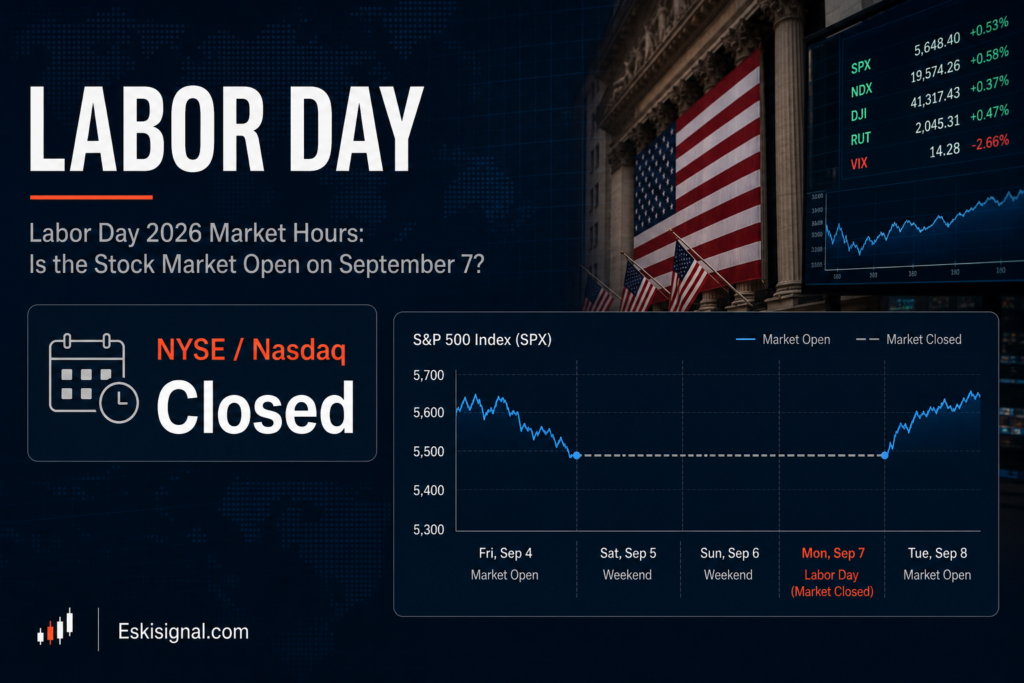
The first Monday in September closes US equity markets entirely, and the week around it has a distinct volume and liquidity profile that matters more than the closure itself. Here is what shuts, what stays open, and what the settlement calendar does to trades placed beforehand.
This article is for informational and educational purposes only. It is not financial advice, investment advice, or a recommendation to buy, sell, or hold any security, cryptocurrency, or financial product. Always verify data with official sources before making financial decisions.
Short answer: markets are closed Monday, September 7
Short answer: US stock markets are closed for Labor Day on Monday, September 7, 2026. This is a full closure — the New York Stock Exchange and Nasdaq do not open, and there is no shortened session. Trading resumes on normal hours Tuesday, September 8. Labor Day is one of the nine full-day exchange holidays in the US calendar.
| Market | Monday, September 7 | Notes |
|---|---|---|
| NYSE / Nasdaq | Closed | Full closure, no half day |
| US bond market | Closed | Per SIFMA recommendation |
| CME equity index futures | Limited holiday session | Reduced hours |
| Forex | Effectively continuous | Thin US liquidity |
| Crypto | Open | Trades continuously |
NYSE and Nasdaq: full closure, no half day
Some US market holidays carry an early close at 1:00 p.m. Eastern — the day after Thanksgiving and Christmas Eve when it falls on a weekday are the usual examples. Labor Day is not one of them. Both exchanges are closed for the full session, and so are the options markets.
The preceding Friday, September 4, is a normal full trading day, though volume typically runs light through the afternoon as participants leave early.
Bond market hours under SIFMA’s recommendation
The US bond market does not have an exchange setting its hours. The Securities Industry and Financial Markets Association publishes a recommended holiday schedule that dealers follow by convention, and it recommends a full close for Labor Day.
SIFMA’s calendar does not always match the equity calendar. There are days when bond markets close early or fully while equities trade normally — Good Friday and Columbus Day being the recurring examples. For Labor Day the two align.
Futures, forex, and crypto over the long weekend
Equity index futures on the CME trade a limited holiday session on Labor Day, typically with an early close, and volume is thin. Thin conditions mean wider spreads and larger price moves per unit of order flow, so a headline arriving during the holiday session can produce a move that partially reverses when full liquidity returns Tuesday.
Foreign exchange trades essentially continuously since it is decentralised, though US dollar liquidity is materially reduced. Crypto markets trade without interruption, which occasionally makes them the only visible price for risk sentiment over a US holiday weekend — a role they fill imperfectly given their own liquidity conditions.
Friday September 4 settlement and the T+1 effect
US equities settle one business day after the trade under T+1. A trade executed Friday, September 4 settles Tuesday, September 8, because Monday is not a business day.
This matters in a few practical situations: proceeds from a Friday sale are not available for withdrawal until Tuesday, and anyone needing settled cash for a specific date should count business days rather than calendar days across the holiday. The same logic applies to dividend record dates falling near the holiday, where the ex-dividend timing shifts with the settlement calendar.
Volume patterns around the unofficial end of summer
Labor Day marks the informal end of the summer trading period, and the pattern around it is consistent enough to be worth expecting.
The week before typically runs light, with many desks understaffed. The week after usually sees a sharp increase in volume as participants return and institutional activity resumes — September is also a heavy month for corporate bond issuance, which brings a wave of hedging flow into rates markets.
The related folk claim — that September is a weak month for equities — rests on the same small-sample problem that affects every calendar effect. It is a real pattern in the historical average and not one with enough observations behind it to act on.
Remaining 2026 market holidays
After Labor Day, the remaining US market holidays for 2026 are Thanksgiving in late November, with a shortened session the following day, and Christmas Day in December. The full schedule, including early closes, is published by the exchanges in advance.
Related notes
Holiday schedules are confirmed by the NYSE, Nasdaq and SIFMA and occasionally amended. Where a specific date matters for settlement or a corporate action, confirm against the exchange calendar rather than a summary.