Last updated: June 17, 2026, 10:30 AM ET
Market context: crude oil, gasoline, and the U.S.–Iran deal.
This article is for informational and educational purposes only. It is not financial advice, investment advice, or a recommendation to buy, sell, or hold any security, cryptocurrency, or financial product. Always verify data with official sources before making financial decisions.
Short answer: why did oil prices drop, and will gas prices follow?
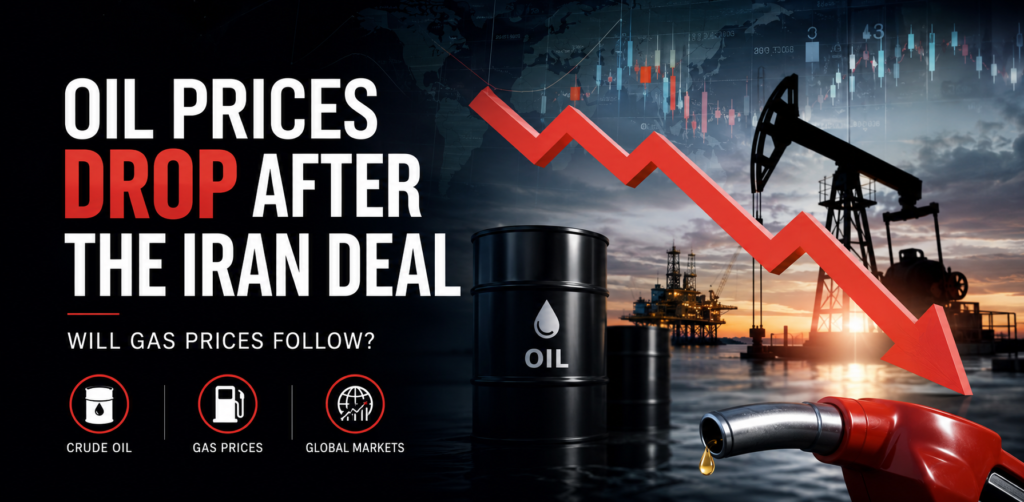
Oil prices fell sharply after the U.S. and Iran announced a framework deal on June 14–15, 2026 to end the war and reopen the Strait of Hormuz. Reporting showed crude dropping more than 4.5% toward roughly $80 per barrel, its lowest in weeks, as the war-risk premium that had built up began to unwind. Gasoline and other refined-product prices often follow crude lower, but with a lag: retail pump prices typically take days to weeks to reflect a drop in futures. This article explains the link and the timing, without predicting where prices settle.
Sources checked
- OilPrice.com, NBC News — reporting on the deal and oil reaction
- Trading Economics — gasoline and heating-oil moves on prior reopening news
- Public reporting on Brent/WTI benchmarks (June 2026)
What happened to energy prices
| Product | Reaction to the deal | Note |
|---|---|---|
| Crude (Brent/WTI) | Fell more than 4.5% toward ~$80 | Lowest in weeks |
| Gasoline futures | Tend to follow crude lower | Retail prices lag |
| Heating oil/diesel | Tend to track crude | Also follows with a lag |
| Natural gas | Less directly tied to the strait | Own supply/demand drivers |
Why crude fell
During the conflict, the effectively closed Strait of Hormuz removed a large share of global oil from reliable transit, adding a “war premium” to prices. The framework deal to reopen the strait and lift blockades signaled that supply could return to normal flows, so traders began pricing out that premium. President Trump’s call to reopen the strait and “let the oil flow” was part of the news that drove the move.
Why gas prices lag crude
Retail gasoline prices reflect more than just crude: refining margins, distribution, taxes, seasonal demand, and local competition all play a role. When crude falls, stations generally pass the savings through over days to weeks, not instantly. The rule of thumb is that pump prices “rise like a rocket and fall like a feather” — a description of the lag, not a precise rule. Watching crude gives an early read on the likely direction for gas.
Key signals table
| Signal | What it can indicate | Caveat |
|---|---|---|
| Crude falling | Lower input cost for fuels | Retail lag of days to weeks |
| Strait reopening | Supply returning to normal flows | Logistics take time to normalize |
| Refining margins | How much of the drop reaches the pump | Vary by region and season |
| Demand/season | Summer demand can offset some declines | Holiday travel adds demand |
What changed versus prior context
For months, the story was rising energy costs feeding inflation — energy drove over 60% of the May CPI increase. The deal flips that toward potential energy relief. If lower crude sticks and feeds through to the pump, it could ease one of 2026’s main inflation pressures. But this depends on the deal holding and on the lag between futures and retail prices.
Risks, uncertainty, and limits
- A framework deal is not final; oil can reverse on new headlines.
- Pump prices lag crude and depend on local factors.
- Summer demand and refining issues can offset some declines.
- This article explains the link; it does not predict oil or gas prices.
What to watch next
- June 19, 2026: the formal Geneva signing of the deal.
- Whether crude holds below recent highs or rebounds.
- National average retail gasoline trends over the following weeks.
- Upcoming inflation data (PCE, next CPI) for energy pass-through.
What this article does not conclude
This explainer describes why oil fell and how gas prices relate. It does not predict oil or gasoline prices or recommend any action.
Why did oil prices drop in June 2026?
Oil fell more than 4.5% toward roughly $80 after the U.S. and Iran announced a framework deal to end the war and reopen the Strait of Hormuz, unwinding the war-risk premium.
Will gas prices go down after oil dropped?
Gasoline tends to follow crude lower, but with a lag of days to weeks, and retail prices also depend on refining margins, taxes, and local demand. This article does not predict pump prices.
Why do gas prices fall slower than oil?
Retail prices reflect refining, distribution, taxes, and competition, so savings pass through gradually — often described as prices rising fast and falling slowly.
Is the oil price drop permanent?
Unknown. The move followed a framework deal that is not yet final, and oil can reverse on new developments. This article does not forecast prices.
Sources
- OilPrice.com and NBC News — deal and oil-market reaction.
- Trading Economics — gasoline and heating-oil moves on reopening news.
- Public reporting on Brent/WTI benchmarks, June 2026.