Last updated: June 17, 2026, 10:30 AM ET
Topic: energy markets and geography (educational explainer).
This article is for informational and educational purposes only. It is not financial advice, investment advice, or a recommendation to buy, sell, or hold any security, cryptocurrency, or financial product. Always verify data with official sources before making financial decisions.
Short answer: what is the Strait of Hormuz and why is it so important?
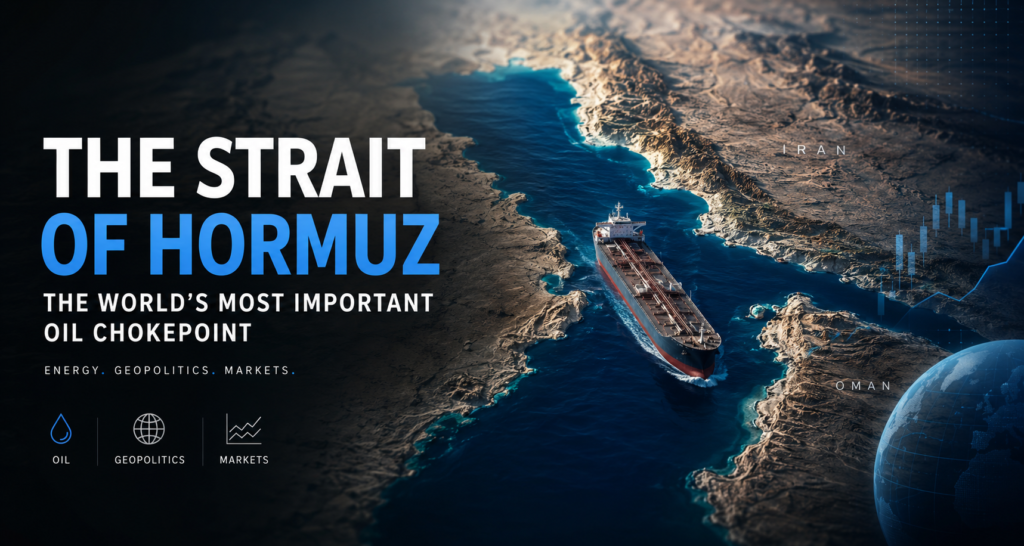
The Strait of Hormuz is a narrow waterway between Iran and the Arabian Peninsula that connects the Persian Gulf to the open ocean. It is the world’s most important oil chokepoint: roughly 20% of global oil supply — and a large share of liquefied natural gas — passes through it. Because so much energy moves through such a narrow passage with no easy full substitute, any threat to transit there can move global oil prices, inflation expectations, and risk sentiment in markets far away. The 2026 Iran conflict, which effectively closed the strait for months before a framework deal to reopen it, is a vivid example.
The strait by the numbers
| Feature | Detail |
|---|---|
| Location | Between Iran and Oman/UAE, linking the Persian Gulf to the Gulf of Oman |
| Share of global oil flow | Roughly 20% of the world’s oil |
| Narrowest point | About 21 nautical miles wide; shipping lanes are narrower |
| Key exporters that rely on it | Saudi Arabia, Iraq, UAE, Kuwait, Qatar, Iran |
| Substitutability | Limited; few pipelines can bypass it at scale |
Why a chokepoint matters for markets
When transit through a chokepoint is threatened, traders price in a “risk premium” — extra cost to reflect the chance of disruption. That shows up first in oil benchmarks like Brent and WTI, then flows into gasoline, inflation data, and even central-bank discussions. Because energy is a major input across the economy, a Hormuz disruption can raise costs well beyond the oil market itself. The reverse is also true: news that the strait will reopen can send oil sharply lower, as happened around the June 2026 framework deal.
How disruptions happen
- Direct threats: attacks on vessels or mining of shipping lanes.
- Insurance: when war-risk insurance becomes unavailable or too costly, ships stop sailing.
- Blockades: military action restricting passage in either direction.
- Knock-on costs: rerouting and higher freight ripple through supply chains.
A real-world framing
After conflict began on February 28, 2026, the strait was effectively closed, oil benchmarks spiked, and energy became the main driver of the May CPI surge to 4.2%. In mid-June 2026, a U.S.–Iran framework deal to reopen the strait sent oil down more than 4.5% toward $80. That round trip — close, spike, reopen, fall — is a textbook illustration of why this single waterway matters so much to global markets.
Where this shows up on EskiSignal
- Strait of Hormuz and the Stock Market — the markets link in depth.
- Crude Oil Futures: WTI vs Brent — how oil benchmarks work.
- Crude Oil Futures: WTI vs Brent — how oil benchmarks work.
Risks, uncertainty, and limits
- Open/closed status during conflicts can be contested day to day.
- Spare capacity elsewhere can partly offset disruptions over time.
- This is educational content, not a forecast of oil prices or events.
What this article does not conclude
This explainer defines the strait and why it matters to markets. It does not predict oil prices or geopolitical outcomes.
What is the Strait of Hormuz?
It is a narrow waterway between Iran and the Arabian Peninsula linking the Persian Gulf to the open ocean. Roughly 20% of the world’s oil passes through it, making it the most important oil chokepoint.
Why does the Strait of Hormuz affect oil prices?
Because so much oil moves through such a narrow passage with limited alternatives, any threat to transit adds a risk premium to oil prices, which can ripple into inflation and markets.
How wide is the Strait of Hormuz?
At its narrowest, the strait is about 21 nautical miles wide, with shipping lanes narrower than that.
What happened to the strait in 2026?
It was effectively closed after conflict began on February 28, 2026, spiking oil prices. A U.S.–Iran framework deal in mid-June 2026 aimed to reopen it, sending oil sharply lower.
Sources
- U.S. Energy Information Administration — world oil chokepoints.
- Congressional Research Service — Strait of Hormuz background.
- Public reporting on the 2026 closure and reopening.