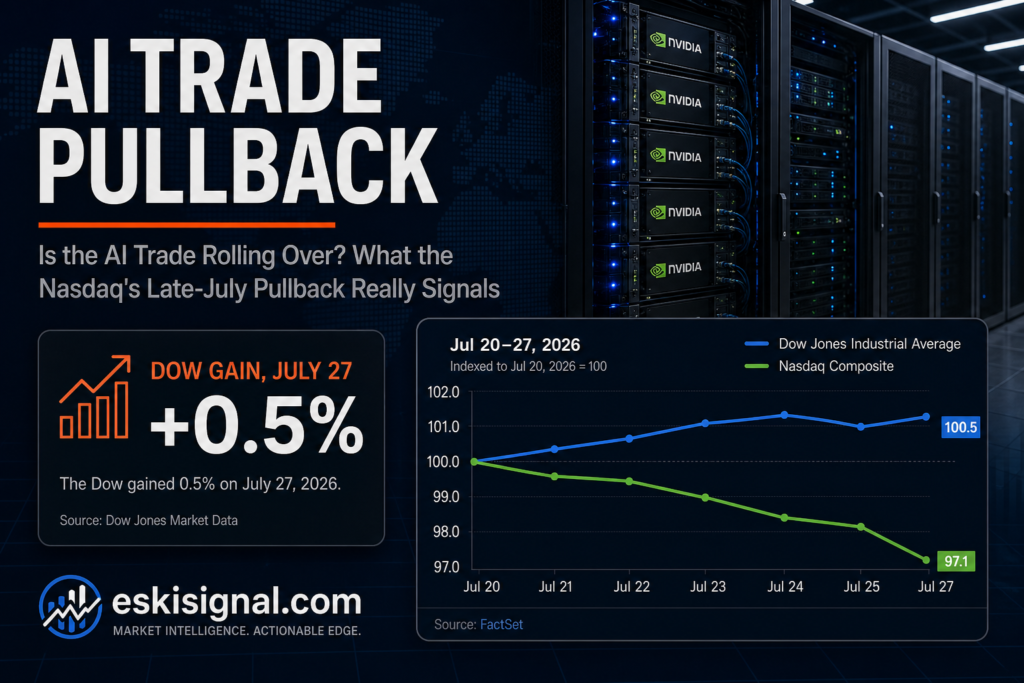
The Dow gained 0.5% on July 27 while the Nasdaq closed in the red — Nvidia dragging the index lower as investors once again questioned whether the money being poured into AI infrastructure is showing up in revenue fast enough to justify it. That split isn’t a one-day fluke. It’s the clearest sign yet of a rotation question the market has been circling for weeks: is this a healthy pause in an intact AI trade, or the early stage of something bigger?
This article is for informational and educational purposes only. It is not financial advice, investment advice, or a recommendation to buy, sell, or hold any security, cryptocurrency, or financial product. Always verify data with official sources before making financial decisions.
Quick answer: is the AI trade rolling over?
Quick answer: Not definitively — but the signals worth watching have shifted. The late-July pullback in AI-related names, including Nvidia, reflects growing investor scrutiny of capital-expenditure spending relative to the revenue growth it’s producing, following capex-heavy reports from Alphabet and ahead of similar scrutiny for Microsoft, Meta, Apple, and Amazon this same week. A genuine regime change would show up as broad, sustained underperformance across the AI trade alongside deteriorating fundamentals; a healthy rotation looks more like sector-specific profit-taking and rebalancing while underlying demand data stays intact.
What “rotation” means versus “regime change”
Rotation describes money moving between sectors or styles within a market that’s still functioning normally — capital flowing from richly valued growth names into cheaper defensive or value names, for example, without the broader market breaking down. A regime change is a more fundamental shift: a multi-quarter or multi-year trend running out of road, where the prior leadership doesn’t just pause but structurally underperforms going forward. The July 27 session had rotation characteristics — communications and consumer-defensive stocks led while tech and energy lagged — but a single session, or even a single week, isn’t enough data to distinguish a rotation from the start of a regime change. That distinction typically only becomes clear in hindsight, over a longer stretch of price action and fundamentals.
| Signal | Consistent with healthy rotation | Consistent with regime change |
|---|---|---|
| Capex vs. revenue growth | Capex growth moderates while cloud/ad revenue accelerates | Capex keeps rising with no matching revenue acceleration, quarter after quarter |
| Breadth | Selloff concentrated in a handful of most-crowded AI names | Broad underperformance across semiconductors, cloud, and AI-adjacent sectors |
| Guidance tone | Management reaffirms demand visibility despite spending scrutiny | Management itself flags slowing demand or pulls back guidance |
Why this week’s earnings are the real test
The market doesn’t have to guess for long. Microsoft and Meta report July 29, with Apple and Amazon following July 30 — and all four are effectively being asked the same question the market has been asking since Alphabet’s own capex-heavy print drew scrutiny days earlier: is AI infrastructure spending translating into revenue growth, or is it just weighing on margins and free cash flow while investors wait for a payoff that hasn’t shown up yet? Guidance on capital expenditure plans for the back half of the year will likely matter more to the stock reactions than the headline earnings beats or misses themselves.
What a genuine regime shift would look like
- Sustained underperformance of AI/semiconductor names relative to the broader index across multiple quarters, not just weeks.
- Deteriorating fundamentals — decelerating cloud revenue growth, order cancellations, or capex guidance cuts — rather than just multiple compression.
- Broadening weakness beyond the most crowded names into the wider supply chain (memory, networking, power infrastructure).
- A shift in how sell-side analysts frame the sector, from “how fast is this growing” to “is this spending justified.”
Risks and limits
- Distinguishing a rotation from a regime change is inherently easier in hindsight than in real time; this article describes a framework, not a prediction.
- Single-day and single-week price action is a limited sample and can reverse quickly.
- This is educational content, not a recommendation to buy, sell, or hold any specific stock or sector.
Why did Nvidia stock fall on July 27, 2026?
Nvidia was among the AI-related names pulling the Nasdaq lower that day as investors grew more cautious about the scale of AI capital spending relative to the revenue growth it has generated so far, a concern amplified by Alphabet’s capex-heavy report the week before.
What’s the difference between sector rotation and a market regime change?
Rotation is capital shifting between sectors within an otherwise normal market; a regime change is a more durable, multi-quarter shift where prior market leadership structurally underperforms going forward. The two can look similar in their first days or weeks.
What should investors watch this earnings season for AI-spending clues?
Capital expenditure guidance for the back half of the year, cloud/ad revenue growth rates relative to prior quarters, and management commentary on demand visibility are the details analysts are focused on most closely this earnings season.
Sources
- Market wrap coverage of the July 27, 2026 Nasdaq selloff and sector performance.
- Earnings preview coverage for Microsoft, Meta, Apple, and Amazon, week of July 27, 2026.