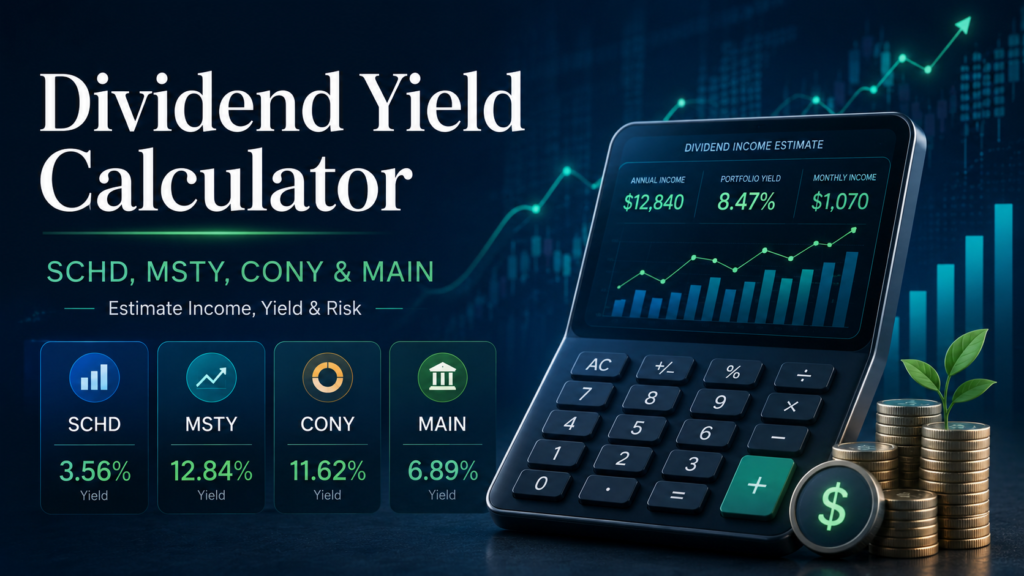
Quick answer: Dividend yield = (annual dividend per share ÷ current share price) × 100. To calculate expected annual income, multiply yield by your dollar investment. This page walks through the math for SCHD, MSTY, CONY, and MAIN — four widely-searched dividend payers with very different structures and risks.
Last updated: June 8, 2026 · 8:00 a.m. ET
Dividend Yield Formula
| Term | Formula | Example (SCHD) |
|---|---|---|
| Annual dividend per share | Sum of all distributions in 12 months | ~$1.05 |
| Dividend yield | (Annual div ÷ Price) × 100 | $1.05 ÷ $31.50 × 100 = 3.33% |
| Annual income on $10,000 | $10,000 × yield% | $10,000 × 3.33% = $333 |
| Shares needed for $1,000/yr | $1,000 ÷ annual div per share | $1,000 ÷ $1.05 = ~952 shares |
Side-by-Side: SCHD vs MSTY vs CONY vs MAIN
| Ticker | Type | Frequency | Recent Div/Share | TTM Yield (approx.) | Risk Level |
|---|---|---|---|---|---|
| SCHD | Dividend equity ETF | Quarterly | $0.26/quarter | ~3.3% | Lower |
| MAIN | BDC (monthly payer) | Monthly | $0.26/month | ~7.9% – 8.7% | Medium |
| CONY | YieldMax options ETF | Weekly | ~$0.42 – $0.56/wk | ~79% – 184% | High |
| MSTY | YieldMax options ETF | Weekly | ~$0.52 – $0.56/wk | ~184% – 306% | Very High |
Yields sourced from: Schwab AM (SCHD), SEC 8-K filings (MAIN), YieldMax official site (MSTY/CONY). Yields change daily with price movement.
The Key Difference: Stable Yield vs. Headline Yield
SCHD and MAIN pay from real earnings — dividends from underlying stocks (SCHD) and net investment income from loans (MAIN). Their yields are lower but reflect actual business income generation. MAIN has never cut its monthly dividend since its 2007 IPO.
MSTY and CONY pay from option premium income and in some cases return of capital. The headline yield (100%–300%) is mathematically real but includes NAV erosion and return of your own capital. Total return (distributions minus NAV decline) is the number that matters — not yield alone.
📅 SCHD Dividend Schedule 2026: Ex-Dates, Pay Dates, Yield →
📊 SCHD Dividend History: Every Annual Payment Since 2011 →
💰 MSTY Dividend History: How YieldMax MSTR Pays Weekly →
Income Calculator: $10,000 Invested
| Ticker | $10,000 Invested | Expected Annual Income | Caveat |
|---|---|---|---|
| SCHD | $10,000 | ~$333 | Stable; grows with dividends |
| MAIN | $10,000 | ~$870 | Monthly; supplemental dividends extra |
| CONY | $10,000 | ~$7,900 – $18,400 | Includes NAV erosion; not “safe” income |
| MSTY | $10,000 | ~$18,400 – $30,600 | Includes NAV erosion; very high risk |
CONY and MSTY income figures are illustrative of the math at current yield rates — they do not account for NAV decline, which reduces the value of the underlying investment.
📅 CONY Dividend History: How YieldMax COIN Pays Weekly →
📅 MSTY Ex-Dividend Dates 2026: Weekly Schedule →
🏦 Interest Rates — How Fed Rate Affects Dividend Stocks →
FAQ
How do I calculate dividend yield?
Divide the annual dividend per share by the current share price, then multiply by 100. Example: $1.05 annual dividend ÷ $31.50 price = 3.33% yield.
Is a higher dividend yield always better?
No. Very high yields (above 10–15%) often signal elevated risk, NAV erosion (options ETFs), or financial stress in the underlying company or fund. Yield should always be evaluated alongside total return and distribution sustainability.
What is the difference between yield and total return?
Yield measures income only (distributions). Total return includes income plus or minus share price change. A fund yielding 200% that loses 70% of its NAV has a negative total return.
Want to run your own numbers instead of just SCHD/MSTY/CONY/MAIN examples? Use our Dividend & DRIP Calculator to estimate income for any share count and dividend rate, and project reinvestment growth over time.
Sources
- Schwab AM — SCHD: schwabassetmanagement.com
- SEC EDGAR — MAIN 8-K (Feb 24, 2026): sec.gov/edgar
- YieldMax — MSTY & CONY: yieldmaxetfs.com
Not financial advice. Written by Aybars Y. · EskiSignal Editorial · June 8, 2026