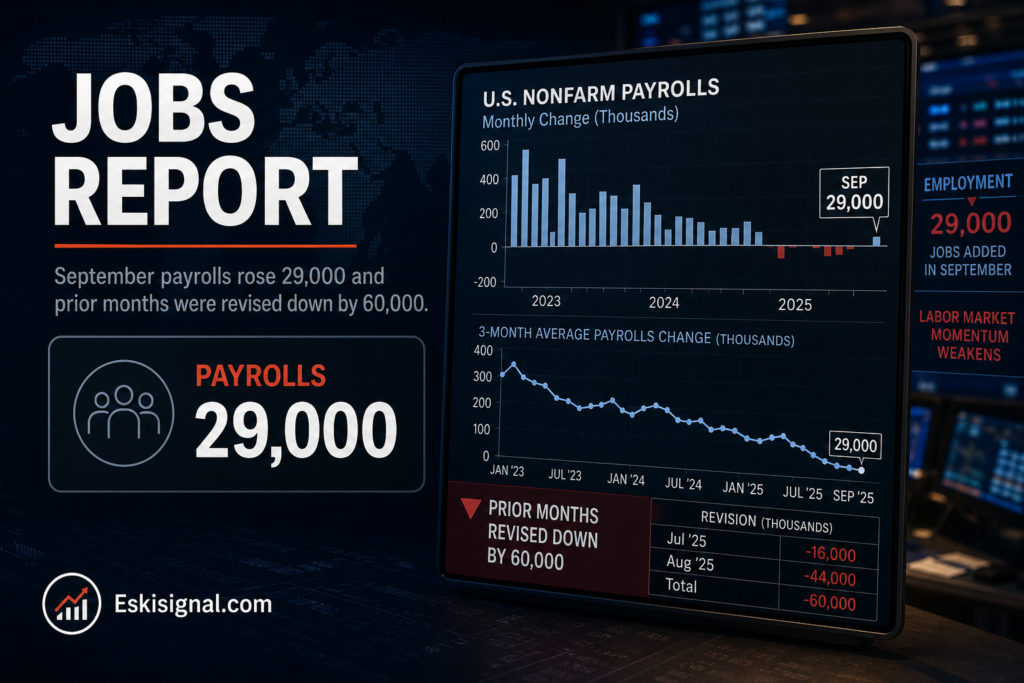
The September employment report landed on October 2 with a number small enough to change the policy conversation. Payrolls rose 29,000 against forecasts clustered between 84,000 and 95,000, the unemployment rate ticked up, and revisions removed 60,000 jobs from the two months before it. Two weeks earlier the Federal Reserve had raised interest rates.
This article is for informational and educational purposes only. It is not financial advice, investment advice, or a recommendation to buy, sell, or hold any security, cryptocurrency, or financial product. Always verify data with official sources before making financial decisions.
Short answer: a soft print that landed in an awkward place
Short answer: US employers added 29,000 jobs in September, missing consensus by a wide margin. The unemployment rate rose to 4.2% from 4.1%, against expectations it would hold. July and August were revised down by a combined 60,000. Average hourly earnings rose 0.1% on the month to $37.81, up 3.0% over twelve months. Stock futures rose and Treasury yields fell on the release, because a weak labour market lowers the odds of further rate increases.
| Measure | September 2026 | Context |
|---|---|---|
| Nonfarm payrolls | +29,000 | Consensus ranged 84,000–95,000 |
| Revisions, July and August | −60,000 combined | Removes most of two months of reported gains |
| Unemployment rate | 4.2% | Up from 4.1%; consensus 4.1% |
| Average hourly earnings, m/m | +0.1% | To $37.81 |
| Average hourly earnings, y/y | +3.0% |
Why the revisions matter more than the headline
A 29,000 print is weak. A 29,000 print accompanied by 60,000 of downward revisions is weaker than weak, because it changes the recent history rather than just the current month.
The establishment survey is revised twice after its first publication as more employers report. When revisions run consistently negative, it indicates the initial estimates have been systematically too high — which is the documented behaviour of the birth-death model around turning points, where it tends to overstate job creation as a downturn begins by assuming business formation continues at its prior pace.
The practical consequence is that the three-month average, the figure most analysts actually use, now sits far below where it appeared to be a month ago. Anyone who built a view on the August report was working from numbers that no longer exist.
The unemployment rate rose for the wrong reason
An unemployment rate can rise two ways. More people can enter the labour force and search for work without immediately finding it, which is a sign of confidence. Or people can lose jobs, which is not.
The distinction is read through the participation rate alongside the household survey’s own employment count. A rate rising on growing participation with household employment also rising describes an expanding workforce. A rate rising while household employment is flat or falling describes something closer to job loss. With payroll growth this weak and prior months revised lower, the benign reading requires more supporting evidence than the headline provides.
Wages at 3.0% are the part the Fed will like
The one component that cuts in the Fed’s favour is earnings. A 0.1% monthly increase and a 3.0% annual rate is soft enough to be consistent with inflation returning to target, given trend productivity.
This matters because the committee’s stated concern has been that an energy-driven price shock could pass into wages and become self-sustaining. Earnings growth at 3.0% is evidence that has not happened. It is also a lagging series, and a single month at 0.1% is within the noise band of a measure that bounces around on composition effects — when lower-paid workers lose jobs disproportionately, average earnings mechanically rise, and the reverse is also true.
What it did to October rate expectations
Futures repriced immediately. Following the release, the CME FedWatch tool showed roughly 77% odds that the Fed holds at its October meeting — a substantial move away from the hike that had been gaining probability through late September, when rate futures had implied better than even odds of another increase.
That repricing is the clearest read on how markets interpreted the report: not as a signal that cuts are coming, but as enough labour market weakness to make a second consecutive hike harder to justify in four weeks.
What this report does not settle
One month does not establish a trend, and this is a series with wide confidence intervals and a revision history that has repeatedly embarrassed confident readings. The BLS publishes standard errors precisely because monthly changes frequently fail to reach statistical significance.
It also does not resolve the central tension. Inflation has been running above target on energy costs while the labour market softens, and a weak jobs report does nothing to lower the price of diesel. The committee is weighing two problems that point to opposite decisions, and this report made one of them louder without making the other quieter.
The full release, including revisions, participation and the household survey detail, is published by the Bureau of Labor Statistics. Where the detail matters, read it rather than a summary.