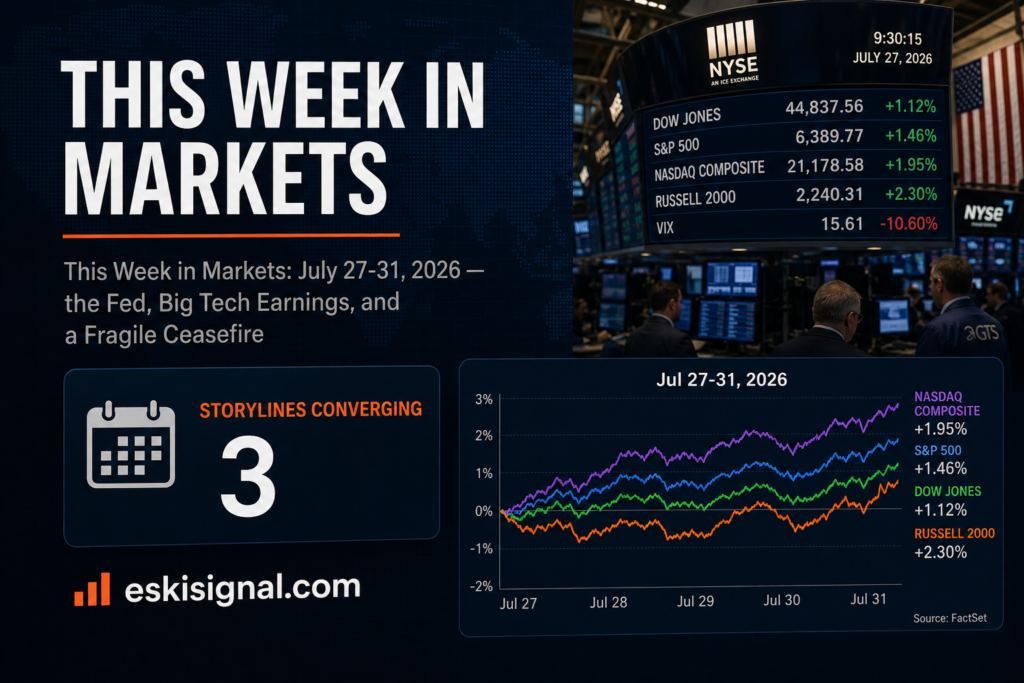
Three separate storylines are converging on the same five trading days. The Fed hands down a rate decision Wednesday with no dot plot to soften the read. Four of the most valuable companies on the planet report earnings within 24 hours of that decision. And all of it is playing out against a backdrop of fresh tariffs, a firmer dollar, and a fragile pause in Middle East hostilities that’s already whipsawed oil, gold, and stocks once this month. Here’s how the week is shaping up.
This article is for informational and educational purposes only. It is not financial advice, investment advice, or a recommendation to buy, sell, or hold any security, cryptocurrency, or financial product. Always verify data with official sources before making financial decisions.
Quick answer: what’s on the calendar this week?
Quick answer: The FOMC meets Tuesday and Wednesday, July 28–29, with the rate decision at 2:00 p.m. ET Wednesday. Microsoft and Meta report earnings after the close that same Wednesday; Apple and Amazon follow Thursday, July 30. There’s no fresh dot plot at this meeting, so the statement language and Chair Warsh’s press conference tone carry extra weight. All of it lands on top of a market already digesting a stronger dollar, a 10-year Treasury yield near 4.69%, and a fragile relief rally tied to a pause in U.S.-Iran hostilities.
| Day | Key event |
|---|---|
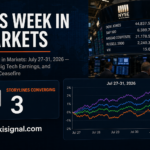
| Monday, July 27 | Nasdaq selloff on AI-capex concerns; Dow gains on defensive rotation and an oil-driven relief rally |
| Tuesday, July 28 | FOMC meeting begins (day 1 of 2) |
| Wednesday, July 29 | FOMC rate decision, 2:00 p.m. ET; Microsoft & Meta earnings after close |
| Thursday, July 30 | Apple & Amazon earnings after close |
| Friday, July 31 | Month-end; markets digest the week’s full set of data |
Storyline one: the Fed, without a dot plot
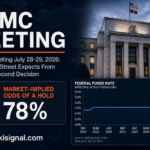
Markets are overwhelmingly pricing a hold at 3.50%–3.75% — CME FedWatch put the odds near 61% as of July 25, with prediction markets showing an even more lopsided read near 78%. But because this isn’t a Summary of Economic Projections meeting, there’s no updated dot plot to react to, which puts unusual weight on the statement language and how Chair Kevin Warsh frames the inflation-versus-growth tradeoff in his press conference — especially with June’s jobs report showing real cracks (just 57,000 payrolls added) even as tariff-driven inflation keeps pressure on prices.
Storyline two: Big Tech’s AI-spending reckoning
Microsoft, Meta, Apple, and Amazon report within a 24-hour window, and all four face some version of the same question that hit the Nasdaq on Monday: is AI infrastructure spending converting into revenue growth, or just weighing on margins? Meta enters the print near record highs on strong ad metrics; Amazon’s setup hinges almost entirely on AWS growth; Apple’s on iPhone demand and margin pressure from memory costs. Whatever tone these four set is likely to determine whether Monday’s tech selloff was noise or the start of something bigger.
Storyline three: tariffs, yields, and a fragile ceasefire
Underneath both of the above sits a third story: new tariffs — a 25% Section 301 levy on Brazil effective July 22, on top of April’s expanded Section 232 metals tariffs — have pushed the 10-year Treasury yield up to 4.69% and strengthened the dollar to its firmest level since April. At the same time, a pause in U.S.-Iran strikes triggered a classic relief rally across oil, gold, bonds, and stocks in tandem. Both threads are more fragile than they look: tariff schedules and geopolitical pauses can both reverse quickly, and either one reversing would ripple through the Fed and earnings stories above it.
What would make this a good week versus a bad one
- Good week: a Fed statement that doesn’t escalate the hawkish tone further, Big Tech guidance that pairs capex with matching revenue growth, and the Iran pause holding.
- Bad week: a hawkish surprise from the Fed, capex guidance with no revenue payoff from Big Tech, or a resumption of hostilities that reverses the relief rally.
- Wildcard: the Fed decision and Microsoft/Meta earnings land within hours of each other on Wednesday, so cross-currents between rate-path repricing and earnings reactions could amplify moves in either direction.
Risks and limits
- This article was written ahead of Wednesday’s Fed decision and Wednesday/Thursday’s earnings reports and does not reflect their actual outcomes.
- Market conditions, probabilities, and prices referenced here reflect the dates cited and change continuously.
- This is educational content summarizing scheduled events and known context, not a prediction of market direction.
What is the single most important event this week?
The Fed’s July 29 rate decision and Microsoft/Meta’s earnings the same evening are arguably tied for the most market-moving events, since they land within hours of each other and could compound one another’s market reaction.
Is there a risk of the market reacting to the Fed and earnings at the same time?
Yes. Because the Fed’s decision (2:00 p.m. ET) and Microsoft/Meta’s earnings (after the 4:00 p.m. ET close) both land on Wednesday, July 29, cross-currents between rate-path repricing and earnings reactions are a real possibility that could amplify volatility in either direction.
What happens after this week?
The next major scheduled catalyst is the July jobs report on August 7, followed by July CPI on August 12 — both landing before the Fed’s next meeting on September 15–16.
Sources
- Federal Reserve, FOMC meeting calendar, 2026.
- Company earnings-date announcements for Microsoft, Meta Platforms, Apple, and Amazon, July 2026.
- Market wrap coverage of U.S. equity, oil, gold, bond, and currency moves, week of July 27, 2026.