
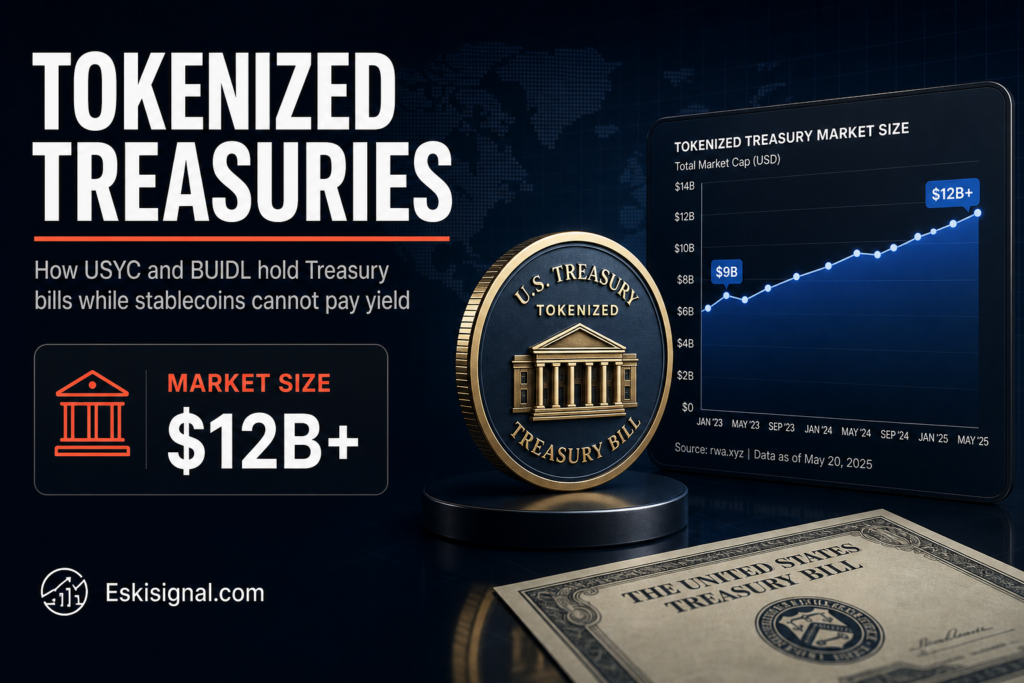
The GENIUS Act contains a provision that reads like a technical footnote and has turned out to be the most consequential sentence in the law: a payment stablecoin issuer may not pay interest or yield to holders. Since it was written, the on-chain market has done exactly what you would expect capital to do when one product is barred from paying a return and an adjacent one is not. Tokenized Treasury funds have grown from roughly $9 billion at the start of the year to somewhere between $12 and $15 billion.
This article is for informational and educational purposes only. It is not financial advice, investment advice, or a recommendation to buy, sell, or hold any security, cryptocurrency, or financial product. Always verify data with official sources before making financial decisions.
Short answer: a money market fund with a token as the share register
Short answer: A tokenized Treasury fund holds short-dated US government debt — bills and repo collateralised by them — in a conventional fund structure, and records ownership of the fund’s shares on a blockchain instead of in a transfer agent’s database. The token is the share register, not the asset. Legally these are securities, which is precisely why they may pay yield when a payment stablecoin may not. The two largest, Circle’s USYC and BlackRock’s BUIDL, each sit in the region of $2.4 to $3 billion.
The regulatory boundary that created the category
The GENIUS Act’s reserve rules are strict and narrow. A permitted payment stablecoin must be backed by cash, balances at the Federal Reserve, insured demand deposits, short-dated Treasury bills, repo collateralised by Treasuries, or shares in government money market funds — with monthly composition disclosure and auditor attestation. The intent is that a token claiming to be worth a dollar is backed by things that are reliably worth a dollar.
Then comes the yield ban. Those reserves earn interest — that is what short-dated Treasuries do — but the issuer may not pass it to the holder. The economic consequence is unavoidable: the issuer keeps the carry, and the holder of a large stablecoin balance is lending at zero in an environment where the front end pays several percent.
For retail balances used for payments, that is a reasonable trade for convenience. For treasury operations holding meaningful sums, it is an expensive one, and the obvious response is to hold the yield-bearing instrument instead and convert to a stablecoin only at the moment a payment is made. That rotation is the single best explanation for why stablecoin growth has flattened around the $314 to $320 billion range while tokenized Treasury funds have grown quickly from a much smaller base.
| Payment stablecoin | Tokenized Treasury fund | |
|---|---|---|
| Legal character | Payment instrument under GENIUS | Security / fund share |
| Can pay yield to holder | No | Yes |
| Typical holder | Anyone | Qualified or whitelisted investors |
| Transfer | Permissionless in most cases | Restricted to approved addresses |
| Redemption | At par, on demand | Subject to fund terms and cut-off times |
What the tokenization actually buys the holder
The underlying portfolio is unremarkable. A short-dated government fund has existed for fifty years and is available from every major asset manager without a blockchain anywhere near it. The case for the token wrapper is operational rather than financial.
Settlement runs continuously rather than on business days, which matters for counterparties operating across time zones and for markets that do not close. Transfers settle in minutes rather than through a chain of intermediaries. Most significantly, a tokenized fund share can be posted directly as collateral in venues that accept it, meaning an institution can earn a yield on cash that would otherwise sit idle as margin. That last use case — collateral mobility — is what institutional adopters cite most consistently, and it is a genuine improvement rather than a marketing point.
The risks are in the wrapper, not the bills
Treasury bills held to maturity carry minimal credit risk. Every meaningful risk in these products sits in the layers built around them, and they are worth separating.
Redemption is the first. A token trades continuously; the underlying fund does not. Bills settle on conventional market hours and conventional cycles, so a token holder wanting cash outside those windows depends either on a secondary market or on a liquidity provider standing between the two. In stressed conditions that intermediary is the point of failure, and the token can trade below the value of the assets behind it while nothing at all is wrong with the assets.
The second is that these are permissioned instruments. Transfers are restricted to whitelisted addresses, which is what makes them compliant and also means the composability that makes on-chain assets useful is deliberately limited. A tokenized fund share is not freely usable across the ecosystem in the way a stablecoin is, and any description of it as “on-chain cash” glosses over exactly the constraint that makes it legal.
The honest counterargument
Fifteen billion dollars is a rounding error. The US Treasury bill market is measured in trillions, and money market funds hold several trillion more. Framing this as a transformation of the Treasury market is not supportable at the current scale.
The sceptical reading is that this is a distribution channel rather than a new asset class — the same instrument, sold to holders who happen to keep their balances on a blockchain, with a fee structure attached. Growth from $9 billion to $15 billion in nine months is impressive in percentage terms and modest in dollars, and percentage growth from small bases is the least informative statistic in finance. The counter is that collateral use is a genuinely new capability rather than a repackaging, and that adoption of settlement infrastructure tends to be slow and then abrupt.
What this article does not conclude
Nothing here recommends any fund, token or issuer, and nothing here forecasts the growth of the category. Market size figures for tokenized assets vary substantially between trackers depending on what is counted — some include private credit and commodity tokens, some count only public-chain issuance — and the $12 to $15 billion range reflects that disagreement rather than measurement precision.
The GENIUS Act’s implementation timetable runs to January 2027, and rules published are not the same as rules enforced. Anyone acting on the distinction between a payment stablecoin and a tokenized security should read the fund’s own offering documents, which state the redemption terms, the transfer restrictions and the fees that summaries like this one omit.