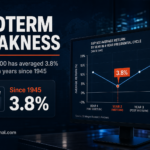

Corporate buybacks are one of the largest sources of demand for US equities. For roughly five weeks around every earnings report, that demand voluntarily switches itself off — and because the schedule is unwritten and unannounced, it is one of the few large flows in the market that nobody publishes.
This article is for informational and educational purposes only. It is not financial advice, investment advice, or a recommendation to buy, sell, or hold any security, cryptocurrency, or financial product. Always verify data with official sources before making financial decisions.
Short answer: when companies stop repurchasing
Short answer: A buyback blackout is a self-imposed period during which a company suspends open-market repurchases of its own stock, typically running from a few weeks before quarter end until a couple of days after results are published. It is not a legal requirement. It is a compliance practice adopted because executing buybacks while holding unreleased results creates insider trading exposure.
The unwritten calendar
There is no statutory blackout period for repurchases. Companies set their own windows through internal insider trading policies, and while the policies differ, the resulting pattern is fairly consistent.
The common shape starts two to four weeks before quarter end — when internal results become reasonably knowable — and lifts one to two business days after the earnings release. That produces roughly four to six weeks per quarter, or somewhere near a third of the trading year, during which a large share of the corporate bid is absent.
Because earnings dates cluster, so do blackouts. The aggregate corporate bid weakens and returns in a broadly synchronised way across the market, which is the basis for the seasonal claims attached to it.
Rule 10b-18 safe harbour and the daily volume cap
Rule 10b-18 provides a safe harbour from market manipulation claims for issuers repurchasing their own stock, provided four conditions are met.
- Single broker. All bids and purchases on a given day routed through one broker.
- Timing. No purchases at the open, and restrictions near the close depending on the security’s liquidity.
- Price. Purchases at or below the higher of the last independent transaction price and the highest independent bid.
- Volume. No more than 25% of the security’s average daily trading volume, with a limited block exception.
The volume cap is the operationally significant one. It means a company cannot support its stock aggressively during a sharp decline — the faster the price falls on light volume, the smaller the permitted repurchase. Buyback capacity is largest exactly when it is least needed.
The safe harbour is voluntary. A company can trade outside it and lose the protection rather than break a rule, but few do.
Accelerated share repurchases and how they sidestep the window
An accelerated share repurchase is a contract with an investment bank: the company pays a lump sum upfront and immediately receives most of the shares, with the bank borrowing stock to deliver and buying it back over the following months. Final settlement adjusts based on the average price over the period.
The mechanism matters here because it moves the execution risk and the trading activity to the bank. The company has committed its capital and received its share count reduction; the bank is doing the buying, and it is not subject to the issuer’s blackout. This is one reason aggregate repurchase activity does not fall to zero during blackout periods.
Estimating the size of the corporate bid
Estimates of daily buyback demand circulate widely and vary enormously, for a straightforward reason: companies disclose repurchases quarterly, in aggregate, in their filings. There is no daily reporting.
Analysts therefore infer the daily figure by taking quarterly disclosed totals, dividing by trading days and adjusting for assumed blackout timing. Every step involves assumptions — particularly about which companies are in blackout when, since earnings dates are known but individual policies are not. Two credible desks can produce estimates differing by a wide margin from the same underlying disclosures.
Treat any precise daily buyback figure as a model output. The direction of the seasonal pattern is better established than its magnitude.
What the seasonality data actually supports
The claim is that equity returns are weaker during blackout periods because a large, price-insensitive buyer steps aside. The mechanism is plausible and the evidence is mixed.
Blackout windows coincide with earnings season, which brings its own volatility and repricing, so isolating the buyback effect from the earnings effect is genuinely difficult. Studies attempting the separation have produced small effects with wide confidence intervals. And the pattern is widely known — if it were reliable and large, it would be arbitraged.
The more defensible version of the claim is narrow: during blackout periods a source of price-insensitive demand is reduced, which plausibly means less cushioning during declines. That is a statement about market depth, not a predictable return pattern.
What this article does not conclude
Blackout timing varies by company and is not publicly disclosed. Aggregate estimates are inferences, not measurements, and the seasonal return effect attributed to them is weakly supported.
Actual repurchase activity is disclosed in quarterly filings with a monthly breakdown, which is the only authoritative source for what a specific company actually bought.