Last updated: June 17, 2026, 11:00 AM ET
Topic: extended-hours trading (educational explainer).
This article is for informational and educational purposes only. It is not financial advice, investment advice, or a recommendation to buy, sell, or hold any security, cryptocurrency, or financial product. Always verify data with official sources before making financial decisions.
Short answer: what are premarket and after-hours trading?
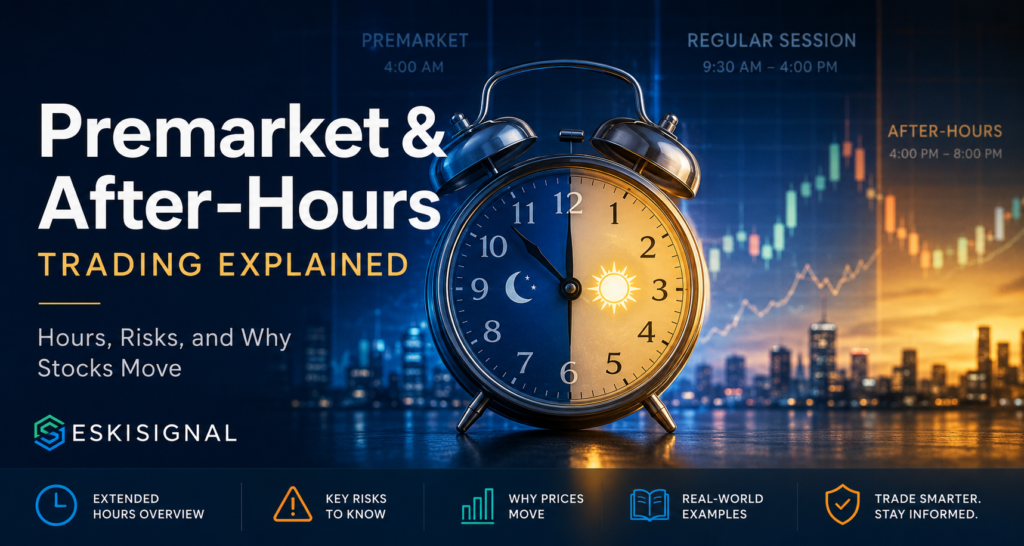
Premarket and after-hours trading — together called “extended-hours” trading — let investors buy and sell certain stocks outside the regular U.S. session of 9:30 a.m. to 4:00 p.m. ET. Premarket runs before the open (commonly from around 4:00 a.m. ET, though access varies by broker), and after-hours runs after the close (commonly until about 8:00 p.m. ET). Trades happen on electronic networks rather than the main exchange floor. Extended hours are where stocks often react first to earnings reports and overnight news — but they come with lower liquidity and wider price swings. This is an educational overview, not trading advice.
Trading sessions at a glance (U.S. Eastern Time)
| Session | Typical hours (ET) | Note |
|---|---|---|
| Premarket | ~4:00 a.m. – 9:30 a.m. | Access and hours vary by broker |
| Regular session | 9:30 a.m. – 4:00 p.m. | Highest liquidity |
| After-hours | 4:00 p.m. – ~8:00 p.m. | Reacts to earnings/news |
| Overnight | Varies / limited | Some brokers offer extended overnight |
Why prices move in extended hours
A lot of market-moving information lands outside regular hours. Most companies report earnings either before the open or after the close, and macro headlines can hit overnight. That is why you often see a stock “up 8% after-hours” following an earnings release — traders are reacting before the next regular session. However, those early moves do not always hold once the full market opens and more participants weigh in.
The key risks of extended-hours trading
- Lower liquidity: fewer buyers and sellers, so orders can be harder to fill.
- Wider spreads: the gap between bid and ask prices is often larger.
- More volatility: small orders can move prices more sharply.
- Limited order types: many brokers only allow limit orders in extended hours.
- Gaps: a price after-hours may differ sharply from the next day’s open.
Premarket vs after-hours: what each is known for
| Session | Common catalysts | What traders watch |
|---|---|---|
| Premarket | Pre-open earnings, overnight news, economic data (8:30 a.m. ET) | Direction into the open |
| After-hours | Post-close earnings, late filings, guidance | First reaction to results |
A real-world framing
Suppose a company reports earnings at 4:15 p.m. ET, just after the close. The stock may swing immediately in after-hours trading as traders react to the numbers and guidance. By the next morning’s premarket, analysts and more investors have weighed in, and the move can extend, fade, or reverse. Watching both sessions shows how a story develops — but the thinner the trading, the less reliable the price signal.
Where this shows up on EskiSignal
- What Time Does the Stock Market Open? — the full session schedule.
- What Is Unusual Volume in Stocks? — reading volume signals.
- Earnings Calendar — when reports tend to move stocks.
Mini glossary
| Term | Plain-English meaning |
|---|---|
| Extended hours | Trading before/after the regular session |
| Liquidity | How easily shares can be bought or sold |
| Bid-ask spread | The gap between buy and sell prices |
| Limit order | An order to trade at a set price or better |
| Gap | A jump between one session’s price and the next open |
Risks, uncertainty, and limits
- Extended-hours hours and access vary by broker; confirm with yours.
- Thin trading can make prices less reliable as signals.
- After-hours moves do not always hold into the next session.
- This is educational content, not trading advice.
What this article does not conclude
This explainer defines premarket and after-hours trading. It does not recommend any trade or predict how a stock will move between sessions.
What time does premarket trading start?
Premarket trading commonly begins around 4:00 a.m. ET, though the exact start time and access depend on your broker. The regular session opens at 9:30 a.m. ET.
How late does after-hours trading go?
After-hours trading commonly runs until about 8:00 p.m. ET, following the 4:00 p.m. close. Some brokers also offer extended overnight sessions.
Why do stocks move so much after hours?
Most earnings reports and a lot of news land outside regular hours, so traders react immediately. But lower liquidity means those moves can be exaggerated and may not hold.
Is extended-hours trading riskier?
It can be. Lower liquidity, wider bid-ask spreads, more volatility, and limited order types make extended hours riskier than the regular session. This article does not give trading advice.
Sources
- U.S. Securities and Exchange Commission — investor education on after-hours trading.
- Exchange and broker references on extended-hours sessions.