Editorial note: This article is for informational and educational purposes only. It is not financial advice or a recommendation to buy, sell, or hold Nvidia (NVDA) stock. Always verify data with official sources. Last updated: May 13, 2026.
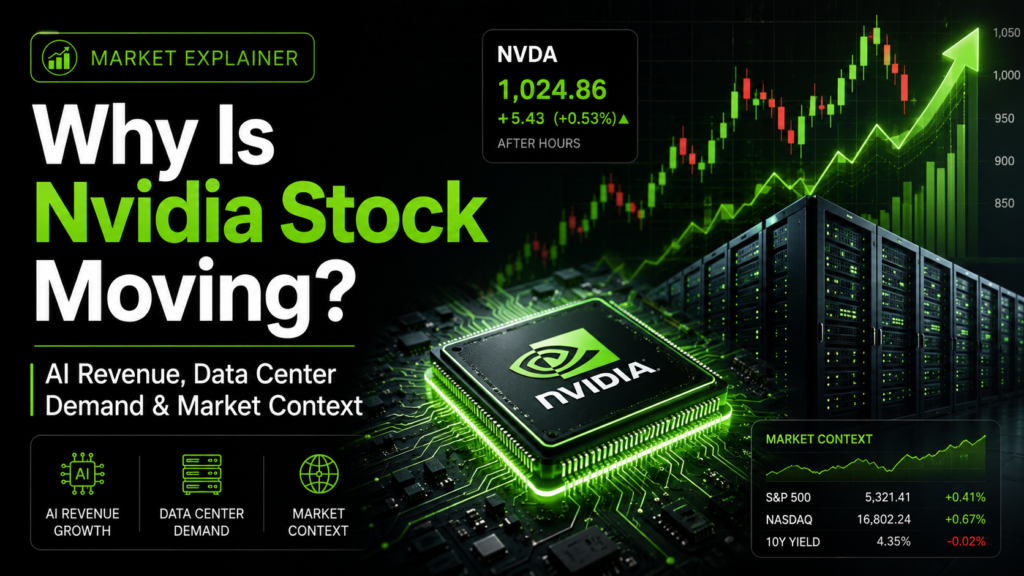
Nvidia (NVDA) is one of the most closely watched stocks in global markets because its revenue and guidance function as a leading indicator for AI infrastructure spending. When Nvidia stock moves significantly, the move is typically linked to one or more recurring drivers. This explainer breaks them down using source-first context.
Top 3 Drivers Behind Nvidia Stock Moves
| Driver | What to Track | Source to Verify |
|---|---|---|
| AI chip demand | Data center revenue segment, GPU order commentary, hyperscaler capex | Nvidia IR (investor.nvidia.com), hyperscaler 10-Q/10-K |
| Earnings and guidance | Revenue vs. consensus, gross margin, next-quarter guidance | Nvidia IR, SEC EDGAR 10-Q filings |
| Sector and macro sentiment | Nasdaq Composite, Philadelphia Semiconductor Index (SOX), bond yields | Market data providers, Federal Reserve |
1. Earnings Reports and Guidance
Nvidia reports quarterly earnings four times per year. Each report includes revenue, EPS, gross margin, and forward guidance. The single most market-moving item is typically the next-quarter revenue guidance. Because Nvidia operates in a fast-moving AI infrastructure market, guidance above or below analyst consensus can trigger outsized stock reactions.
Verify the most recent earnings figures at the official Nvidia investor relations page (investor.nvidia.com) and SEC EDGAR (sec.gov).
2. AI and Data Center Revenue
Nvidia’s data center segment generates the largest share of its revenue. Demand for AI accelerators from hyperscalers (Microsoft, Amazon, Google, Meta) drives this segment. When major cloud providers signal increased AI infrastructure spending in their own earnings calls, markets often interpret this positively for Nvidia’s forward revenue. The reverse is also true.
3. Sector Sentiment and Macro Context
Nvidia is a large-cap technology stock. Broad moves in the Nasdaq or the Philadelphia Semiconductor Index (SOX) can lift or weigh on NVDA even when there is no Nvidia-specific news. Rising bond yields, risk-off sentiment, or broad tech sector rotation can cause Nvidia stock to move without company-specific catalysts.
Key Signals Table
| Signal | What to Look For | Confidence in Move Explanation |
|---|---|---|
| Data center revenue growth | YoY and sequential growth rates | High — primary revenue driver |
| Gross margin trend | Expanding or contracting; supply chain commentary | Medium — affects profitability narrative |
| Hyperscaler capex signals | Cloud company capex commentary in their earnings calls | Medium — indirect but influential |
| Export restriction news | U.S. Commerce Department chip export policy | Medium-High — can affect revenue directly |
| SOX / Nasdaq trend | Broad semiconductor and tech sector direction | Low-Medium — systematic factor |
Risks and Uncertainty
- Stock prices can move for multiple overlapping reasons simultaneously.
- Export control policy changes can affect Nvidia’s revenue without immediate public disclosure.
- Market data may be delayed depending on the source.
- Analyst price target changes are opinion, not fact.
- This article does not predict future price movement.
What to Watch Next
- Nvidia’s next earnings date (check investor.nvidia.com)
- Next major hyperscaler earnings call for AI capex commentary
- Any U.S. Commerce Department chip export policy announcements
- Philadelphia Semiconductor Index (SOX) direction for sector context
Related EskiSignal Guides
- Stock Movers Today: Premarket, After-Hours, Gainers and Losers
- Earnings Reports: How to Read Results, Guidance and Reactions
- Sectors and Rotation: Where Market Strength Is Appearing
FAQ
Why does Nvidia move so much on earnings days?
Nvidia’s data center segment is the primary proxy for AI infrastructure investment. Guidance that changes AI spending expectations can move not just Nvidia but the entire semiconductor sector.
Is this a recommendation to buy or sell Nvidia?
No. This is an educational explainer only. EskiSignal does not give financial advice.
Sources checked: Nvidia Investor Relations (investor.nvidia.com), SEC EDGAR (sec.gov), Philadelphia Semiconductor Index (SOX) methodology, U.S. Bureau of Labor Statistics for macro context.