The Fed meets for two days this week, and for once the suspense isn’t really about the rate decision. Markets have priced a hold at the July 28–29 meeting for weeks. The real questions are what Chair Kevin Warsh says about the rest of the year, and whether the hawkish tilt he introduced at his June debut hardens or softens under pressure from tariff-driven inflation data.
This article is for informational and educational purposes only. It is not financial advice, investment advice, or a recommendation to buy, sell, or hold any security, cryptocurrency, or financial product. Always verify data with official sources before making financial decisions.
Quick answer: what’s happening July 28–29?
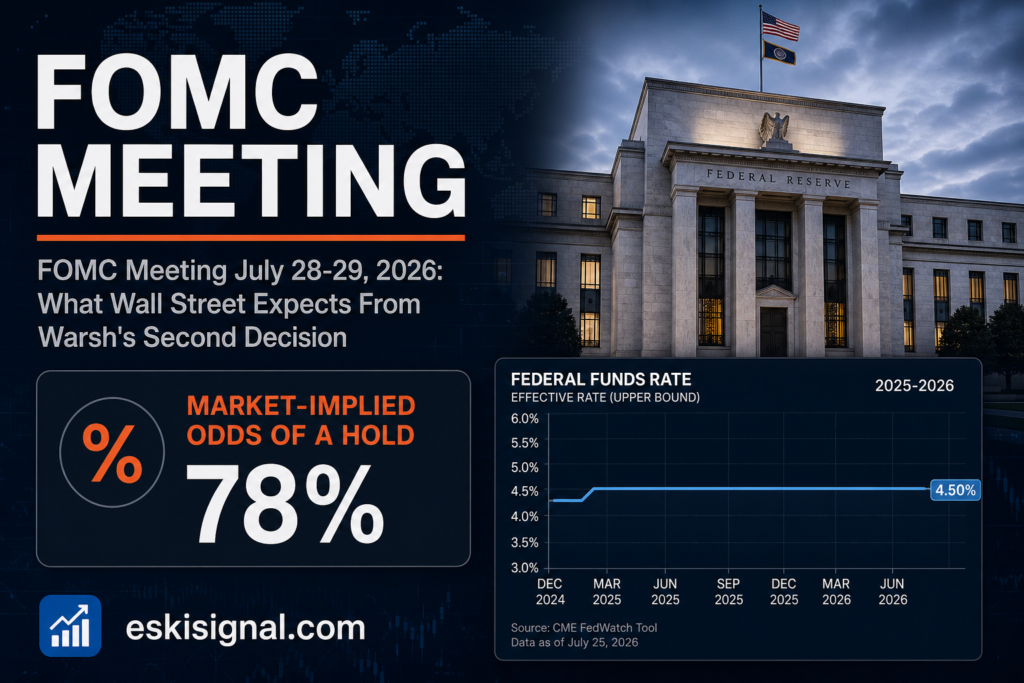
Quick answer: The Federal Open Market Committee holds a two-day meeting on Tuesday, July 28 and Wednesday, July 29, 2026, with the rate decision released at 2:00 p.m. ET on the 29th, followed by Chair Warsh’s press conference at 2:30 p.m. This is not a Summary of Economic Projections meeting — no updated dot plot — so the statement language and the press conference carry more weight than usual. Markets are overwhelmingly pricing a hold at the current 3.50%–3.75% target range, with rate cuts effectively off the table for this meeting.
Where rates stand after Warsh’s first meeting
Kevin Warsh was confirmed by the Senate on May 13, 2026 and sworn in as the 17th Fed Chair on May 22. His debut meeting on June 17 held the federal funds rate at 3.50%–3.75%, but the dot plot that came with it surprised a market that had been leaning toward cuts: nine of eighteen FOMC participants penciled in at least one hike before year-end, six of them multiple hikes. Warsh himself declined to submit a personal dot, saying only that he had “refrained from offering any projections of my own, consistent with my long-held views.” The committee also dropped its previous reference to “additional rate adjustments,” moving to language the Fed describes as purely data-dependent.
That hawkish signal landed against a backdrop of inflation running near 4.2% year-over-year — well above target — which is the tension this meeting has to resolve. Since June, two forces have pulled in opposite directions: energy prices and new tariffs have kept price pressure elevated, while a softer-than-expected June CPI print briefly pulled Treasury yields lower in mid-July before tariff-driven inflation expectations pushed the 10-year back up to 4.69% by July 24.
What markets are pricing for July 29
Pricing has been remarkably one-sided. As of July 25, the CME FedWatch Tool showed roughly a 61% probability of a hold, with most of the remaining probability split between a small hike risk and a residual chance of a cut — itself under 1%. Prediction-market pricing on Polymarket has shown an even more lopsided read, putting the odds of no change near 78%, with roughly a one-in-five chance assigned to a 25-basis-point hike and cuts barely registering. The two sources disagree on the exact split, which is normal given different methodologies and update timing, but they agree on the direction: a hold is by far the most likely outcome, and a hike is a more live possibility than a cut for the first time in this cycle.
| Scenario | Approx. market-implied odds (late July) | Market reaction if it happens |
|---|---|---|
| Hold at 3.50%–3.75% | 61%–78% depending on source | Likely muted; focus shifts to statement language and press conference tone |
| 25bp hike | ~20% | Sharp move higher in yields and the dollar; likely equity selloff |
| 25bp+ cut | <1% | Would be a major surprise; risk-asset rally likely |
Why the missing dot plot matters
Because July isn’t a Summary of Economic Projections meeting, there’s no fresh dot plot to react to — the June dots are still the most recent official signal of where individual officials see rates heading. That puts unusual weight on the statement’s wording and on how Warsh characterizes the inflation-versus-growth tradeoff in his press conference. Traders will be listening for whether he leans into the hawkish framing from June or tempers it given that tariff-driven price pressure, not demand-side overheating, is doing most of the work on inflation this time — a distinction that matters because tariff-driven inflation is generally viewed as more of a one-time price-level shift than something that calls for sustained tightening.
What to watch beyond the rate decision
- Statement language on tariffs: whether the Committee explicitly links recent Section 232 and Section 301 tariff actions to the inflation outlook.
- Vote count: any dissents would signal how contested the hawkish shift is within the Committee.
- Press conference tone: Warsh’s characterization of the labor market ahead of the August 7 jobs report.
- Balance sheet commentary: any update on the pace of quantitative tightening.
Risks and limits
- Probabilities from CME FedWatch and prediction markets are estimates based on current pricing, not guarantees, and can move sharply between now and the decision.
- This is a preview written ahead of the meeting — it does not and cannot describe the actual outcome.
- This is educational content about how markets are pricing a Fed meeting, not investment advice or a rate forecast.
Is the Fed expected to cut rates on July 29, 2026?
No. As of late July, both CME FedWatch and prediction-market pricing put the odds of a rate cut at under 1%. A hold is the overwhelming base case, with a hike viewed as more likely than a cut for the first time this cycle.
Will there be a new dot plot at the July meeting?
No. The Summary of Economic Projections, which includes the dot plot, is only released at the March, June, September, and December meetings. The most recent dots are from Warsh’s June 17 debut.
Why did nine FOMC members project a hike after cuts looked likely?
The shift followed inflation holding near 4.2% year-over-year alongside new tariff actions that raised near-term price expectations, prompting several officials to see less room to cut — or even a case for further tightening — despite earlier expectations for cuts later in 2026.
Sources
- Federal Reserve, FOMC meeting calendar and July 29, 2026 policy statement release schedule.
- CME Group FedWatch Tool, rate-probability data as of July 25, 2026.
- Federal Reserve press conference transcript, June 17, 2026 (Warsh’s debut meeting).