
Update — 7 October 2026: This preview was published before the 27–29 August symposium. Three weeks later, on 16 September, the FOMC raised the target range to 3.75%–4.00% in a unanimous vote — the first increase since July 2023.
The Kansas City Fed’s annual symposium has produced more market-moving central bank communication than any scheduled meeting outside the FOMC itself. This year it convenes with a reshaped committee, rates on hold, and a chair delivering his first keynote in the role.
This article is for informational and educational purposes only. It is not financial advice, investment advice, or a recommendation to buy, sell, or hold any security, cryptocurrency, or financial product. Always verify data with official sources before making financial decisions.
Dates, venue, and when the keynote lands
Short answer: The 2026 Jackson Hole Economic Policy Symposium runs Thursday, August 27 to Saturday, August 29 at Jackson Lake Lodge in Wyoming. The chair’s address traditionally opens Friday morning, and it is the single event markets position around. The next FOMC decision follows on September 16, giving roughly three weeks between the speech and the meeting it is read as signalling.
Why the theme is itself a signal
The Kansas City Fed selects a theme months in advance and commissions academic papers around it. This year’s programme centres on financial innovation and payments.
That choice is worth noting precisely because it is not a monetary policy theme. In years when the symposium has focused on labour markets, inflation dynamics or policy frameworks, the academic programme foreshadowed a shift in how the Fed thought about its mandate. A payments-focused agenda points toward structural questions — settlement infrastructure, digital payment rails, the boundary between banks and non-banks — rather than toward the rate path.
The practical implication is that the substantive content of the symposium may have little to do with what markets want to hear, which raises rather than lowers the weight placed on the chair’s opening remarks.
What markets will listen for
Three things, in descending order of likely market impact.
- The bar for cutting. Not a promise of timing, but the conditions described as necessary. Language about the balance of risks between inflation and employment carries more information than any calendar reference.
- Balance sheet. Questions about the pace and endpoint of runoff have run in parallel with the rate debate and are frequently addressed at this venue rather than at a meeting.
- Framework language. Any indication of how the committee is thinking about its longer-run strategy, which is periodically reviewed and which a payments-themed symposium might touch obliquely.
The setup going in
The Fed held at 3.50%–3.75% at the July meeting, which came without a fresh Summary of Economic Projections. That leaves the June dot plot as the most recent formal signal, and it was hawkish — a meaningful share of participants projected no easing or further tightening.
Since then the data has pulled in two directions. July CPI showed inflation decelerating, with headline at 3.5% in June and shelter posting its smallest monthly increase in over five years. The labour market has softened, with announced job cuts falling but sector concentration increasing. Long yields have risen on term premium rather than on policy expectations, tightening financial conditions without a Fed move.
That combination — disinflation alongside labour softening and a steepening curve — is the configuration in which communication matters most, because the committee has genuine optionality and markets have limited information about how it will be used.
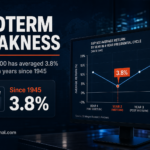
Jackson Hole’s record of moving markets — the honest version
The symposium has produced genuinely consequential communication. It has also produced many years of speeches that markets ignored within a session.
The pattern is that Jackson Hole matters when the committee has something to signal that does not fit into a policy statement — a framework change, a shift in reaction function, an acknowledgment that conditions have changed. It does not matter when policy is on a clear path, because there is nothing to communicate that the statement has not already said.
The corollary is that positioning ahead of the speech is a bet on the existence of news rather than on its direction. Implied volatility typically rises into the event and collapses afterward regardless of content, which is a more reliable pattern than anything about the speech itself.
What this article does not conclude
Nothing here forecasts what will be said or how markets will respond. The symposium agenda is published by the Kansas City Fed in advance, and the chair’s remarks are released in full at the time of delivery.
Readings of central bank communication are inherently interpretive. Where the precise language matters, the transcript is the source — not the summary of it.