
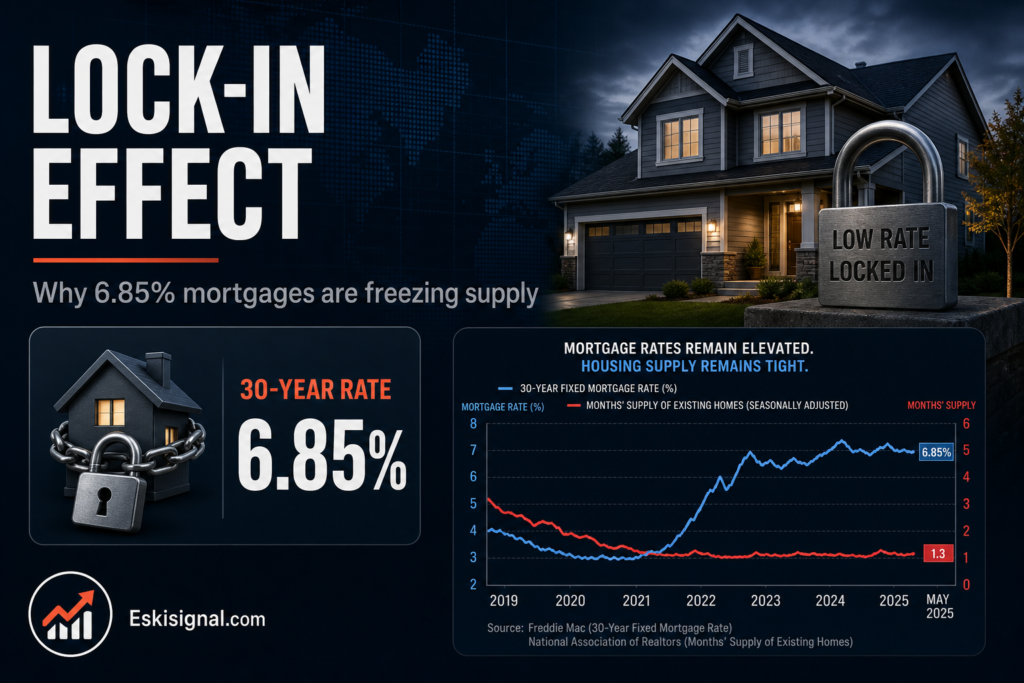
The average 30-year contract rate reached 6.85% in the week ending 4 September, its highest since June 2025, and the median existing-home price sits at a record $434,100. Those two facts are supposed to be in tension. Affordability this poor should be pushing prices down. That it is not is the clearest evidence available that the American housing market is currently a supply story wearing a demand story’s clothes.
This article is for informational and educational purposes only. It is not financial advice, investment advice, or a recommendation to buy, sell, or hold any security, cryptocurrency, or financial product. Always verify data with official sources before making financial decisions.
Short answer: the mortgage is an asset the owner cannot take with them
Short answer: A household holding a 3% fixed mortgage owns something valuable — the right to borrow at far below the current market rate for years to come. In almost all cases that right cannot be transferred to a new property. Selling therefore means surrendering it and re-borrowing at close to 7%, which can raise the monthly payment substantially even when moving to a house of identical value. The result is that owners who would otherwise sell do not, listings stay scarce, and scarce listings support prices even while transaction volumes fall. That is the lock-in effect.
Why this behaves differently from an ordinary demand shock
Rising rates reduce what a buyer can afford, which is a demand effect and should reduce prices. Rising rates also reduce the willingness of existing owners to list, which is a supply effect and should raise them. Both operate simultaneously, and the net result depends on which is larger.
What makes the current cycle unusual is the size of the gap between the rates on existing mortgages and the rate available today, and the fact that the American thirty-year fixed mortgage is prepayable but not assumable in most cases. A borrower may refinance freely when rates fall, and is under no obligation to give up a below-market rate when they rise. That asymmetry is a benefit to individual households and a source of friction for the market as a whole, and it does not exist in most other developed housing markets, where variable rates or shorter fixed terms mean the whole stock reprices within a few years.
| Rate | Level, early September 2026 |
|---|---|
| 30-year fixed, purchase | 6.71-6.73% |
| 30-year, MBA contract rate | 6.85% — highest since June 2025 |
| 15-year fixed | 6.05% |
| 5/1 ARM | 7.03% |
| Median existing-home price | $434,100 |
The ARM pricing above the thirty-year fixed is its own signal. An adjustable rate above a fixed rate is the market saying it expects short rates to stay high or rise, which removes the traditional escape hatch for buyers who cannot afford the fixed payment and expect to refinance later.
Why mortgage rates are not simply the 10-year yield
Mortgage rates track the 10-year Treasury yield plus a spread, and the spread is not a constant. It compensates investors in mortgage-backed securities for the risk that borrowers prepay — which they do disproportionately when rates fall, exactly when the investor least wants their capital returned.
That spread has been historically wide through this cycle, for reasons that have little to do with housing: elevated interest rate volatility raises the value of the prepayment option the borrower holds, and the Federal Reserve, once the largest and most price-insensitive buyer of agency MBS, is no longer adding to its holdings. Anyone forecasting mortgage rates purely from a Treasury forecast is omitting the variable that has moved most.
How lock-in erodes, and it does erode
Lock-in is powerful but not permanent, and it weakens through several channels at once.
The largest is simply life. Job changes, divorces, births, deaths and retirements do not wait for favourable financing, and the share of households experiencing one of these events accumulates every year the market stays frozen. A second is the passage of time itself: each year, a larger portion of the outstanding mortgage stock consists of loans originated at current rates rather than at pandemic-era lows, shrinking the population that has anything to lose by moving.
Two structural channels also matter. Government-backed VA and FHA loans are assumable, which turns a low-rate mortgage into a transferable asset that can be marketed with the property. And homebuilders can do what individual sellers cannot — buy down the buyer’s rate directly and fund it out of margin — which is why new construction has taken share from existing homes in a market where existing supply is frozen.
The honest counterargument
Lock-in has become the default explanation for everything in US housing, and it is doing more work than the evidence strictly supports.
Housing supply was constrained before rates rose, for reasons that predate this cycle entirely: a long shortfall in construction relative to household formation, restrictive local zoning, elevated construction costs and labour shortages in the trades. Those factors would produce tight inventory and firm prices at any mortgage rate. Attributing the whole picture to lock-in also implies that a decline in rates would release a wave of supply and soften prices — but lower rates would simultaneously revive demand, and there is a plausible case that the demand response would be faster than the supply one, producing higher prices rather than lower.
That prediction is testable, and the last time rates fell meaningfully the evidence was mixed, which is the honest state of it.
What this article does not conclude
Nothing here forecasts mortgage rates, house prices, or whether any individual should buy, sell or refinance. Rate quotes differ by source, by borrower credit profile, by loan-to-value ratio, by points paid and by region; the figures cited are national averages from lender surveys taken in the first week of September 2026 and no individual borrower will be quoted exactly those numbers.
Freddie Mac’s weekly survey and the Mortgage Bankers Association’s applications survey are the standard public series, and they routinely differ from each other by more than the weekly change either one reports.