Central banks normally raise rates because the economy is running hot. In September the Federal Reserve raised rates while payroll growth was collapsing. That combination has a name people reach for too quickly and a mechanism that is worth understanding properly, because it determines which assets behave the way the textbook says and which do not.
This article is for informational and educational purposes only. It is not financial advice, investment advice, or a recommendation to buy, sell, or hold any security, cryptocurrency, or financial product. Always verify data with official sources before making financial decisions.
Short answer: a supply shock splits the mandate
Short answer: The Fed has two objectives, stable prices and maximum employment, and they usually point the same way. Demand-driven inflation comes with a strong labour market, so tightening addresses both. A supply shock breaks that alignment: prices rise because something got more expensive to produce or transport, while output and employment weaken. Policy that fights the inflation makes the employment side worse, and policy that supports employment risks letting the price shock settle into expectations. There is no setting that solves both.
How this one arrived
The sequence is unusually legible. Energy costs rose sharply, with refined products leading — US diesel reached a record and middle distillate cracks moved above outright crude prices, a configuration that means the scarcity is in refining capacity rather than in barrels.
That fed into consumer prices. August CPI held at 3.4% year over year but rose 0.4% on the month, up from 0.1% the month before, with gasoline up 3.9%. Core inflation told a different story: 2.4% annually, the lowest in several years, though the monthly core figure at 0.3% came in above the 0.2% expected.
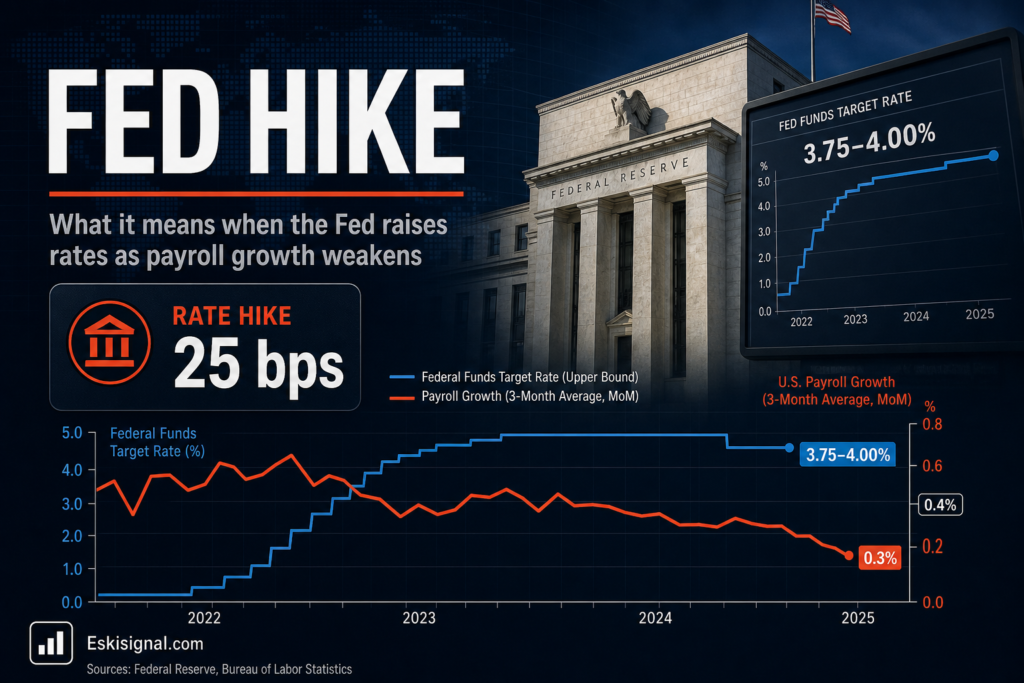
So the picture going into the September meeting was headline inflation driven by energy, core inflation decelerating on an annual basis but firm on the month, and a labour market that had not yet shown its hand. The Fed raised rates 25 basis points to 3.75–4.00% in a unanimous vote.
Why the committee moved anyway
The argument for tightening into a supply shock rests entirely on expectations. A one-off rise in energy prices does not create sustained inflation by itself — it raises the price level once and drops out of the annual comparison twelve months later. It becomes an inflation problem only if households and firms begin to expect higher inflation and act on it through wages and pricing.
A central bank that believes its credibility is at risk will tighten to demonstrate it will not accommodate the shock, accepting weaker employment as the cost. Chair Warsh framed the September move as removing accommodation rather than as tightening, which is a deliberate distinction: it positions the decision as returning policy to neutral rather than as leaning against growth.
The counterargument is equally coherent. Monetary policy cannot produce diesel. Raising rates does nothing to refining capacity, and if long-run inflation expectations are already anchored, the tightening buys credibility that was not actually in question at the cost of employment that was.
Why the 1970s comparison is weaker than it sounds
Every supply shock produces the same reference, and the differences matter more than the similarity.
The 1970s episode featured widespread wage indexation, in which contracts automatically adjusted pay to consumer prices and converted a one-off shock into a self-reinforcing spiral. That institutional structure is largely gone. The economy is also far less energy-intensive per unit of output than it was then, so the same percentage move in oil transmits a smaller shock. And the central bank of that era had no explicit inflation target and a contested commitment to price stability, which is precisely the credibility condition that makes expectations unanchor.
The useful lesson from that period is narrower than the analogy implies: it is about what happens when expectations become unanchored, not a template for how this resolves.
What tends to work and what does not
The cross-asset behaviour in this configuration is less reliable than in an ordinary tightening cycle, and the honest version includes the exceptions.
- The currency. Rate differentials dominate, and a hawkish central bank typically supports its currency. This has been the clearest relationship in the current episode.
- Energy equities. Benefit from the shock itself rather than from policy, which makes them one of the few sectors whose earnings improve as the problem worsens.
- Long-duration equities. Hurt twice, through a higher discount rate and through weaker demand expectations.
- Bonds. The ambiguous one. Tightening lifts front-end yields while weakening growth pulls long yields down, so the curve flattens and the direction of the long end depends on which force the market weights.
- Gold. Theoretically pressured by higher real rates, though the relationship has behaved inconsistently through 2026.
What this article does not conclude
Nothing here predicts whether the Fed is making a mistake. That judgement depends on whether inflation expectations would have drifted without the hike, which is unobservable and will remain contested after the fact.
The configuration also may not persist. A supply shock that reverses — refining capacity returning, a conflict de-escalating — resolves the dilemma without the central bank having to choose. Several of the forecasts cited publicly assume exactly that, which is worth noting when reading any projection built on it.