Every time Bitcoin makes a sharp move, most of the buying and selling driving it isn’t happening in the “spot” market where people actually own coins. It’s happening in perpetual futures — a derivative contract that never expires and has become the default way traders bet on crypto prices. If you’ve ever wondered why crypto charts talk about “funding,” “mark price,” or “perps” instead of just prices, this is the instrument behind all of it.
This article is for informational and educational purposes only. It is not financial advice, investment advice, or a recommendation to buy, sell, or hold any security, cryptocurrency, or financial product. Always verify data with official sources before making financial decisions.
Short answer: what a perpetual futures contract is
A perpetual futures contract, or “perp,” is an agreement to buy or sell an asset at a price that tracks the market, with no set expiration date. Traders open a position — long if they think price goes up, short if they think it goes down — and can hold it indefinitely, so long as they keep enough margin in their account to cover potential losses.
Perps were designed for crypto specifically. Traditional futures markets, like those for oil or gold, settle on a fixed date. Crypto exchanges wanted something that behaved like a futures contract — tradable with leverage, cash-settled, no need to hold the underlying coin — but without forcing traders to roll their position into a new contract every few weeks. The solution was a contract with no expiry at all, kept in line with the real market through a periodic payment between longs and shorts called the funding rate.
How perps differ from traditional futures
The easiest way to see what makes a perpetual contract unusual is to line it up against the dated futures contracts that have existed in traditional finance for over a century.
| Feature | Traditional futures | Perpetual futures |
|---|---|---|
| Expiry date | Fixed (monthly, quarterly) | None — can be held forever |
| Settlement | Physical delivery or cash settlement at expiry | No settlement event; positions close only when the trader closes them |
| Price convergence | Naturally converges to spot price as expiry nears | Kept near spot price continuously via the funding rate |
| Rolling positions | Traders must “roll” into a new contract before expiry | Not needed — same contract stays open indefinitely |
| Typical venue | Regulated exchanges (CME, ICE) | Crypto exchanges (Binance, Bybit, OKX, and others) |
With a dated futures contract, the price gap between the futures price and the spot price closes on its own as the expiry date approaches — that’s just arbitrage doing its job. A perpetual contract has no expiry to force that convergence, so exchanges built a different mechanism to keep the perp price anchored to the real market. That’s where mark price, index price, and funding come in.
Exchanges track two separate numbers for a perp: the index price, which is a composite of spot prices across major exchanges, and the mark price, which is what’s actually used to calculate a trader’s unrealized profit or loss and whether a position gets liquidated. The mark price is smoothed against the index price specifically to reduce the chance that a brief, thin-liquidity wick on one exchange triggers liquidations that shouldn’t really be happening. When people say a perp’s price “de-pegged” from spot for a moment, they usually mean the traded price moved away from the index — not that the contract itself broke.
The funding rate mechanism, briefly
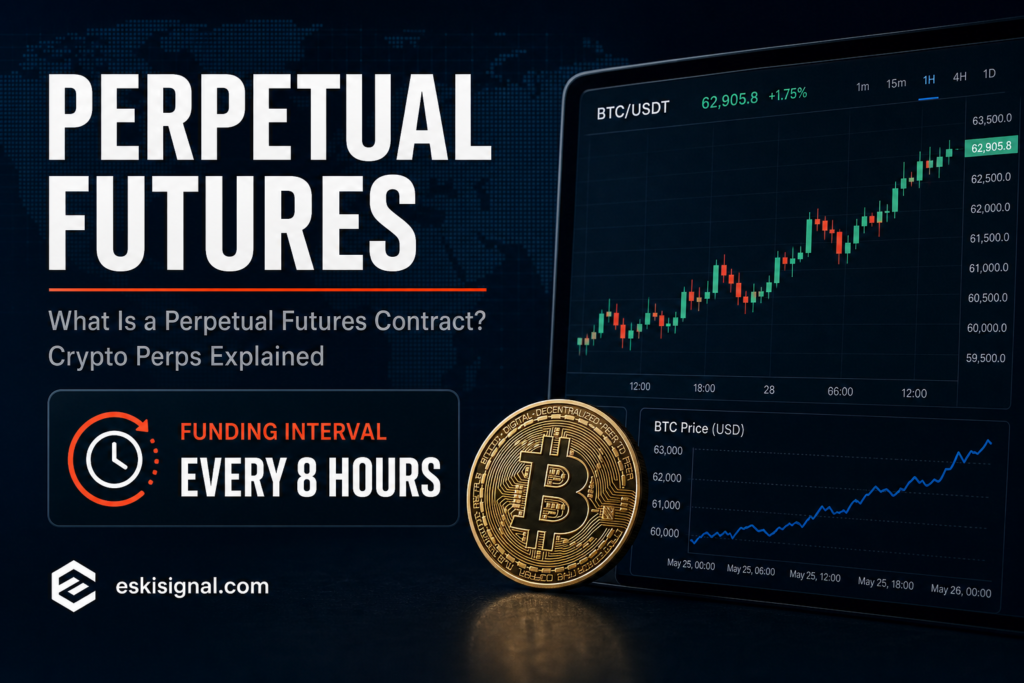
Funding is the tethering mechanism that replaces expiry-driven convergence. At set intervals — commonly every eight hours — traders on one side of the market pay traders on the other side a small fee, calculated from the gap between the perp’s traded price and the index price. If perps are trading above spot, longs pay shorts, which makes holding a long slightly more expensive and nudges the price back down. If perps trade below spot, it works in reverse.
That’s the concept at a high level, and it’s as much detail as this article goes into. EskiSignal has covered the funding-rate math, how it interacts with open interest, and why it can spiral during a crowded trade in the liquidations and cascades explainer — worth reading if you want the mechanics behind why funding spikes sometimes show up right before a violent price move.
How leverage and margin work on perps
Perps are almost always traded with leverage, meaning a trader posts a fraction of a position’s value as margin and borrows the rest synthetically through the exchange. Ten, twenty, even over a hundred times leverage has been offered on some platforms, though many exchanges have trimmed max leverage on retail accounts after past blowups. Higher leverage means a smaller price move against the position wipes out the margin and triggers a liquidation.
This site already walks through maintenance margin thresholds and exactly how liquidation cascades unfold in detail elsewhere, so we won’t repeat it here — see the liquidations explained article for that. The short version for this piece: leverage is a feature of how perps are typically traded, not a requirement of the instrument itself, and it’s the main reason perps carry more risk than simply holding the underlying asset.
Why perps dominate crypto trading volume
On most days, perpetual futures volume across major crypto exchanges outstrips spot trading volume by a wide margin, and it isn’t close. A few structural reasons keep it that way. Perps never expire, so there’s no operational hassle of rolling a position or tracking multiple contract months the way commodity or index traders have to. They’re cash-settled in stablecoins or the base asset, so nobody has to worry about custody of the underlying coin. And they let traders express a view — long or short — with leverage, on an asset class that’s historically been hard to short in spot markets.
There’s also a simplicity argument. One BTC perpetual contract replaces what would otherwise be a whole calendar of quarterly and monthly dated contracts, each with its own liquidity pool. Consolidating that liquidity into a single, never-expiring contract makes it easier for market makers to quote tight spreads, which in turn attracts more volume — a feedback loop that’s part of why perps became the default rather than a niche product.
A real-world example
Say a trader opens a $10,000 long position on a BTC/USDT perpetual contract using 10x leverage, meaning they’ve posted $1,000 of their own margin. Bitcoin’s spot price is $60,000 at the time. If Bitcoin rallies to $63,000 — a 5% move — the position’s value increases by roughly $500, a 50% gain relative to the margin posted, because leverage amplifies both directions.
Along the way, the trader pays or receives funding every eight hours depending on which side of the market is crowded. If longs are dominant and paying shorts, that’s a small ongoing cost of carrying the position — separate from the price move itself. There’s no expiry to worry about, so the trader can hold the position open for a day, a month, or longer, as long as margin stays above the maintenance threshold. That last part — what happens when it doesn’t — is exactly what the liquidations article covers in depth.
Where this shows up on EskiSignal
Perpetual futures sit underneath a lot of what gets covered in EskiSignal’s Crypto vertical, even when the article isn’t explicitly about derivatives. When a piece explains a sudden Bitcoin swing, funding rates and perp open interest are often part of the backstory. When whale and exchange-flow pieces reference large positions being opened or closed, that’s frequently perp activity rather than spot buying or selling. And the site’s broader “why is crypto crashing” style coverage often points back to crowded perpetual futures positioning unwinding all at once as a contributing factor.
Risks and limits
Perps carry risks beyond ordinary spot exposure. Leverage magnifies losses as readily as gains, and a large enough adverse move can wipe out margin entirely, not just reduce it. Funding payments, while usually small, can add up during periods when a market is heavily one-sided and can quietly erode a position that’s technically “right” on direction but held too long. Exchange risk is real too — a perp is a contract with a specific exchange or platform, not a claim on an asset held in a wallet, so counterparty and custody risk apply in a way they don’t for someone simply holding coins.
There’s also the structural fact that perps are often traded by people using far more leverage than they’d use in traditional markets, partly because crypto exchanges have historically allowed it and partly because volatility invites it. That combination is a large part of why liquidation cascades happen with some regularity in crypto specifically, more so than in most traditional futures markets.
None of this means perps are inherently reckless instruments — plenty of traders and market makers use them for hedging rather than directional bets. But the combination of no expiry, easy access to high leverage, and continuous trading does mean the risk profile is different from just buying and holding the underlying asset.
What is a perpetual futures contract, in one sentence?
It’s a crypto derivative that lets traders bet on an asset’s price with leverage and no expiration date, kept in line with the spot market through periodic funding payments instead of a settlement date.
What’s a funding rate?
It’s a periodic payment between long and short traders on a perpetual contract, sized to the gap between the perp’s price and the spot index price. It nudges the contract back toward spot instead of relying on an expiry date to force convergence.
Why don’t perps have an expiry date?
They were designed that way deliberately, so crypto traders wouldn’t need to roll positions between contract months the way commodity or index futures traders do. Funding takes over the job that expiry normally does in a traditional futures contract.
Are perpetual futures risky?
They can be, mainly because of the leverage typically used alongside them and the exchange counterparty risk involved. EskiSignal’s liquidations guide covers how those risks play out mechanically when a market moves sharply.
Sources
- Public documentation and help-center pages from major crypto derivatives exchanges explaining perpetual contract specifications, mark price, and funding formulas
- Academic and industry research on perpetual swap design and price convergence mechanisms
- Aggregated crypto derivatives market data trackers reporting open interest and futures-versus-spot volume splits
- EskiSignal’s own prior reporting on liquidations, leverage, and crypto market structure