Last updated: June 14, 2026, 3:30 PM ET
Market context: U.S. consumer inflation data (CPI), released by the U.S. Bureau of Labor Statistics.
This article is for informational and educational purposes only. It is not financial advice, investment advice, or a recommendation to buy, sell, or hold any security, cryptocurrency, or financial product. Always verify data with official sources before making financial decisions.
Short answer: what the May 2026 CPI report showed
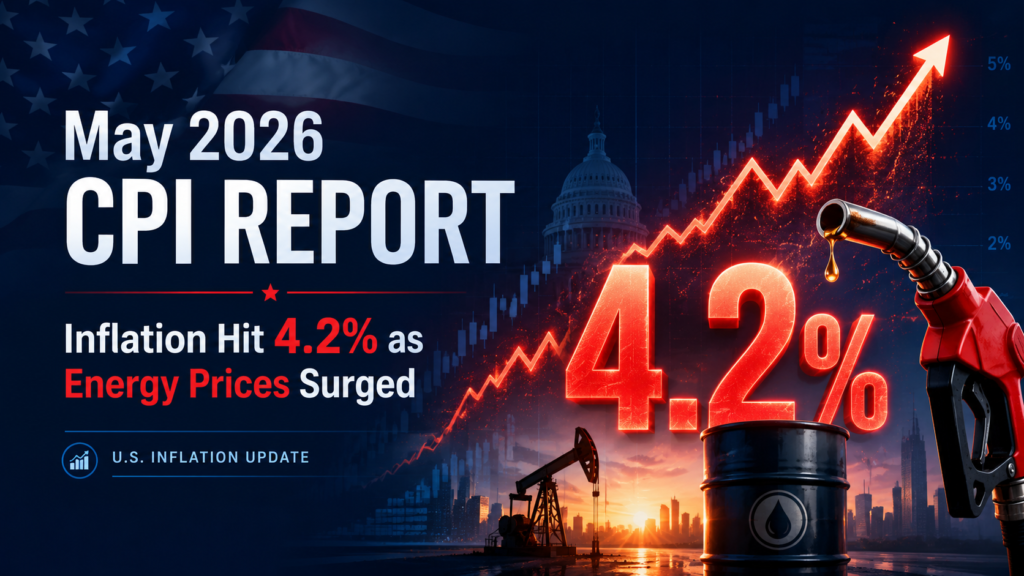
The May 2026 Consumer Price Index (CPI), released by the U.S. Bureau of Labor Statistics on June 10, 2026, showed headline inflation rising 0.5% month-over-month and 4.2% year-over-year — the fastest annual pace since April 2023. Core CPI, which excludes food and energy, rose a more muted 0.2% on the month and 2.9% year-over-year. According to the BLS release, the energy index accounted for over 60% of the monthly all-items increase, with gasoline doing most of the work.
The split between a hot headline number and a calmer core reading is the part the market focused on, because core inflation is what tends to weigh more heavily on Federal Reserve policy discussions.
Sources checked
- U.S. Bureau of Labor Statistics — Consumer Price Index, May 2026 (released June 10, 2026)
- BLS energy and core CPI component breakdowns
- Reported consensus estimates from major financial outlets
Data snapshot
| Metric | May 2026 | Prior (April 2026) | Notes |
|---|---|---|---|
| Headline CPI (MoM) | +0.5% | +0.6% | Below the +0.3% some had penciled in for the month would have been cooler; came in line with the 0.5% consensus |
| Headline CPI (YoY) | +4.2% | ~+4.0% | Fastest annual pace since April 2023 |
| Core CPI (MoM) | +0.2% | ~+0.4% | Roughly half the prior month’s pace |
| Core CPI (YoY) | +2.9% | +2.8% | Still above the Fed’s 2% target |
| Energy (MoM) | +3.9% | +3.8% | Over 60% of the monthly headline increase |
| Energy (YoY) | +23.5% | — | Reflects the ongoing energy price shock |
What happened
Headline inflation accelerated mainly because of energy. The BLS reported the energy index rose 3.9% on the month, led by a sharp jump in prices at the pump. Food prices rose 0.2% on the month. Stripping out those two volatile categories, the underlying picture was softer: core commodities prices actually slipped 0.1%, which analysts noted suggested limited broad tariff pass-through at the time of the reading.
Why it matters
CPI is one of the most closely watched U.S. inflation gauges, and it lands days before the Federal Reserve’s June policy meeting. A 4.2% headline figure gives more hawkish policymakers an argument to keep policy restrictive, while a 2.9% core reading supports the view that underlying price pressures are not broadly re-accelerating. The market reaction was relatively muted on release, which several outlets read as investors looking past the headline to the calmer core.
Key signals table
| Signal | What it suggests | Caveat |
|---|---|---|
| Headline well above core | Inflation surge is concentrated, not broad-based | Energy shocks can spill into other categories over time |
| Core easing to +0.2% MoM | Underlying pressure cooled versus April | One month is not a trend |
| Energy +23.5% YoY | Geopolitical/energy risk is the main driver | Reverses quickly if energy prices fall |
What changed versus prior context
Compared with April’s report, the monthly headline pace eased slightly (0.5% vs 0.6%), but the annual rate pushed to a three-year high as energy base effects built up. The notable shift was core inflation cooling to +0.2% on the month, roughly half the prior pace, which softened the overall message despite the alarming headline.
Risks, uncertainty, and limits
- CPI data for the past several months is subject to revision by the BLS.
- A single soft core print does not confirm a disinflation trend.
- If energy costs feed into services, rents, or wages, core could re-accelerate later.
- This article explains the reported data; it does not predict the next print or market direction.
What to watch next
- June 16–17, 2026: Federal Reserve (FOMC) meeting, with updated economic projections.
- Late June: PCE inflation, the Fed’s preferred gauge, for an alternate read on core pressures.
- July 14, 2026: Next CPI release (June 2026 data), per the BLS schedule.
- Energy prices and any change in the Middle East situation, given energy’s outsized role in this report.
What this report does not conclude
This explainer does not tell readers what to buy, sell, or hold, and it does not forecast the inflation path. It summarizes the BLS data, the components behind the move, and the calendar items the market is watching next.
What was the May 2026 CPI inflation rate?
According to the BLS, headline CPI rose 4.2% year-over-year and 0.5% month-over-month in May 2026. Core CPI (excluding food and energy) rose 2.9% year-over-year and 0.2% month-over-month.
Why was headline inflation so much higher than core?
Energy prices drove most of the increase. The BLS reported the energy index accounted for over 60% of the monthly all-items rise, while core inflation — which excludes food and energy — was far more contained.
When is the next CPI report released?
The BLS scheduled the June 2026 CPI release for July 14, 2026, at 8:30 a.m. ET. Always confirm with the official BLS schedule.
Does this CPI report mean the Fed will raise rates?
This article does not predict Fed action. The report lands before the June 16–17 FOMC meeting; markets were broadly positioned for no change at the time of writing, but the Fed’s decision depends on its own assessment of the data.
Sources
- U.S. Bureau of Labor Statistics — Consumer Price Index, May 2026 news release (June 10, 2026).
- BLS CPI component tables (energy, core, food).
- Major financial outlets’ coverage of consensus estimates and market reaction.