Last updated: June 14, 2026, 3:30 PM ET
Market context: global oil supply, energy prices, and U.S. equity-market sensitivity.
This article is for informational and educational purposes only. It is not financial advice, investment advice, or a recommendation to buy, sell, or hold any security, cryptocurrency, or financial product. Always verify data with official sources before making financial decisions.
Short answer: why the Strait of Hormuz matters to markets
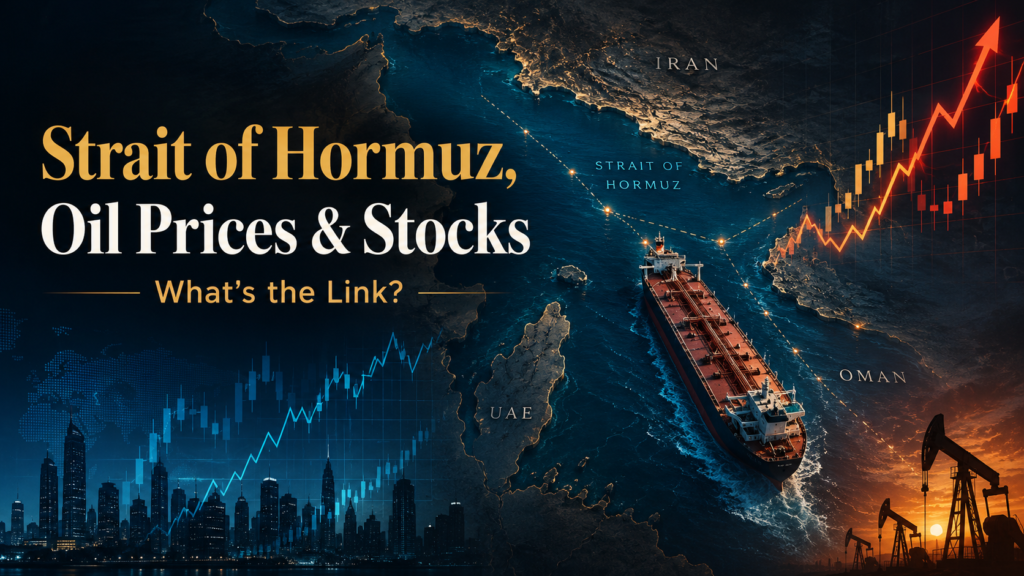
The Strait of Hormuz is the narrow waterway connecting the Persian Gulf to the open ocean, and roughly a fifth of the world’s seaborne oil passes through it. When transit through the strait is disrupted — as has been the case during the 2026 Iran conflict, where reporting describes it as effectively closed at times due to attacks and prohibitive shipping insurance costs — oil prices tend to carry a larger “war-risk premium.” That premium feeds into energy costs, inflation readings, and sector-by-sector equity performance.
This article explains the linkages and what analysts and official sources have said. It does not predict oil prices, the conflict’s path, or the stock market’s direction.
Sources checked
- Federal Reserve Bank of Dallas research on a Strait of Hormuz closure scenario (March 2026)
- Brookings Institution analyses on the strait and oil markets (2026)
- Congressional Research Service background on the strait
- Public reporting on oil benchmarks and equity-sector reactions
Why this chokepoint is unique
| Factor | Detail |
|---|---|
| Share of global oil flow | Roughly 20% of the world’s oil passes through the strait |
| Geography | A narrow maritime chokepoint with no easy full substitute |
| Disruption mechanism in 2026 | Reported attacks on vessels and unavailable/expensive shipping insurance |
| Spare-capacity offset | OPEC+ has some spare capacity, but routing around the strait is limited |
What happened
Following the outbreak of conflict with Iran in early 2026, reporting described the strait as effectively closed at points, with oil benchmarks rising sharply. Brent and WTI traded well above where they began the year. The Dallas Fed published a scenario analysis estimating that a closure removing close to 20% of global oil supply during the second quarter of 2026 could raise the average WTI price toward roughly $98 per barrel and lower global real GDP growth, depending on how long the disruption lasted. These are scenario estimates, not forecasts.
Why it matters for stocks and inflation
Higher energy prices show up in inflation data — the May 2026 CPI report attributed over 60% of its monthly increase to energy. For equities, the impact is uneven. Energy producers and some defense/aerospace names can benefit from higher prices, while fuel-dependent sectors such as airlines face cost pressure. Several analysts have noted that major U.S. indexes are now weighted heavily toward technology and AI-linked companies that are less directly exposed to oil, which is part of why broad index reactions have at times been more muted than the headlines might suggest.
Key signals table
| Signal | What it can indicate | Caveat |
|---|---|---|
| Brent/WTI risk premium | Market pricing of supply-disruption risk | Can unwind fast on de-escalation |
| VIX moves | Shifts in equity risk appetite | Driven by many factors, not just oil |
| Energy vs airlines performance | Sector winners/losers from oil moves | Company hedging varies widely |
| Treasury yields | Growth vs inflation crosscurrents | Mixed signals during shocks |
What changed versus prior energy shocks
Analysts have compared 2026 to the 2022 post-invasion oil spike. A recurring observation in 2026 coverage is that, despite a supply shock described as historically large, oil benchmarks had at times stayed below their 2022 highs, and U.S. equity indexes proved more resilient than some expected — partly due to index composition shifting toward less oil-sensitive sectors. That resilience is a description of what happened, not a guarantee it continues.
Risks, uncertainty, and limits
- The situation is fluid; “open” vs “closed” status has been contested day to day.
- Scenario estimates (e.g., Dallas Fed) are illustrative, not predictions.
- Energy prices can reverse quickly on diplomatic developments.
- This article does not forecast oil, the conflict, or the market.
What to watch next
- Status of transit and shipping insurance through the strait.
- Brent and WTI benchmarks and any OPEC+ supply response.
- Upcoming inflation data (PCE, next CPI) for energy pass-through.
- The June 17 FOMC meeting, given energy’s role in the inflation picture.
What this article does not conclude
This explainer does not tell readers what to buy, sell, or hold, and it does not predict oil prices or the conflict’s outcome. It connects a real geopolitical chokepoint to the energy, inflation, and equity channels analysts watch.
Why does the Strait of Hormuz affect oil prices?
Roughly 20% of the world’s seaborne oil passes through it. Disruption to transit raises supply-risk concerns, which tends to add a risk premium to oil benchmarks like Brent and WTI.
How much could oil rise if the strait closes?
Estimates vary. A March 2026 Dallas Fed scenario suggested a Q2 2026 closure removing close to 20% of global supply could push average WTI toward roughly $98 per barrel, but this is a scenario, not a forecast.
Does a Strait of Hormuz crisis mean the stock market will crash?
Not necessarily. Reporting in 2026 noted U.S. indexes were more resilient than expected, partly because they are weighted toward technology and AI names less directly tied to oil. This article does not predict market direction.
How does this connect to inflation?
Energy is a major CPI input. The May 2026 CPI report attributed over 60% of its monthly increase to energy, which links the strait situation to inflation and, indirectly, to Fed policy discussions.
Sources
- Federal Reserve Bank of Dallas — Strait of Hormuz closure scenario research (March 2026).
- Brookings Institution — analyses on the strait and oil markets (2026).
- Congressional Research Service — background on the Strait of Hormuz.
- Public reporting on oil benchmarks and equity-sector reactions.