Last updated: June 14, 2026, 3:30 PM ET
Topic: dividend mechanics (educational explainer).
This article is for informational and educational purposes only. It is not financial advice, investment advice, or a recommendation to buy, sell, or hold any security, cryptocurrency, or financial product. Always verify data with official sources before making financial decisions.
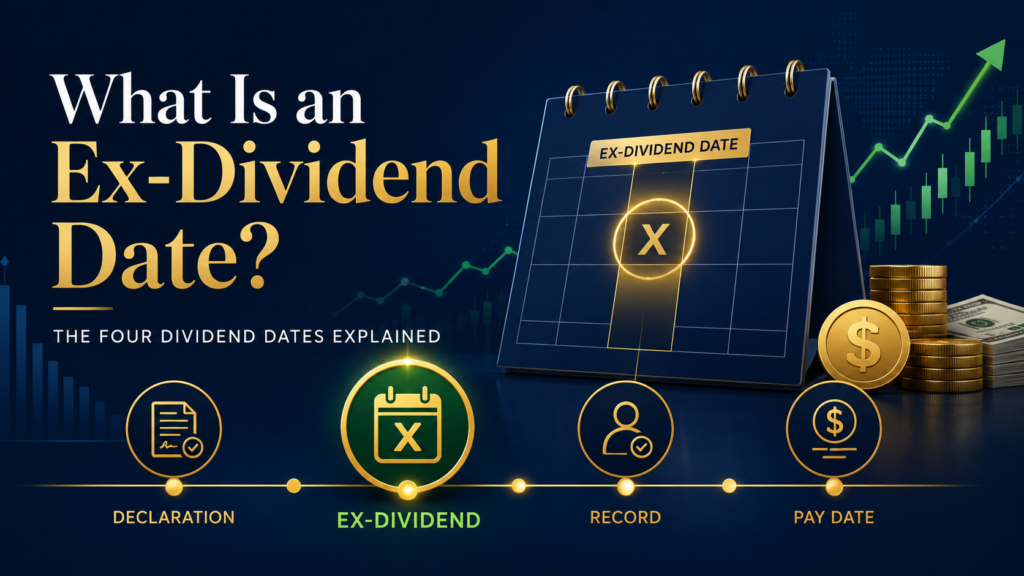
Short answer: what is an ex-dividend date?
The ex-dividend date (or “ex-date”) is the cutoff that determines who receives a dividend or distribution. To be eligible, you generally need to own the shares before the ex-date. If you buy on or after the ex-date, the seller — not you — receives that payment. On the ex-date, a stock’s price typically opens lower by roughly the dividend amount, all else equal, because the upcoming payment is no longer attached to the share.
The four key dividend dates
| Date | What it means | Who acts |
|---|---|---|
| Declaration date | The company/fund announces the dividend | Issuer |
| Ex-dividend date | Cutoff for eligibility — own shares before this date | Investor |
| Record date | The date the issuer checks its books for holders | Issuer |
| Pay date | When the cash is actually paid | Issuer |
Under standard U.S. settlement, the ex-date and record date are typically aligned closely. The practical rule for investors is simple: own the shares before the ex-date to receive the payment.
A simple example
Suppose an ETF declares a distribution with an ex-date of the 10th and a pay date of the 15th. If you buy on the 9th, you are eligible and receive the distribution on the 15th. If you buy on the 10th (the ex-date) or later, you do not receive that distribution — though the price has usually adjusted down by roughly the distribution amount, so you are not simply “missing out” on value for free.
Why this matters for high-distribution ETFs
For frequent payers — including option-income ETFs like the YieldMax family (MSTY, CONY, NVDY, TSLY) or monthly payers — the ex-date schedule drives when you must hold to receive each distribution. A common misunderstanding is the “dividend capture” idea: buying just before the ex-date to grab the payment and selling after. Because the price typically drops by the distribution amount on the ex-date, this does not create free money, and it can trigger taxes and trading costs. This is a mechanics point, not a strategy recommendation.
Where ex-dates show up on EskiSignal
- MSTY Ex-Dividend Dates 2026 — a specific ex-date schedule.
- SCHD Dividend Schedule 2026 — quarterly ex-dates.
- CONY Dividend History — reading a distribution record.
Mini glossary
| Term | Plain-English meaning |
|---|---|
| Ex-date | Cutoff to be eligible for a dividend |
| Record date | When the issuer checks its books |
| Pay date | When cash is paid |
| Dividend capture | Buying before the ex-date to grab the payout (not free money) |
| Price adjustment | The typical ex-date drop by about the dividend amount |
Risks, uncertainty, and limits
- Settlement rules and conventions can change; verify current rules with your broker.
- The ex-date price adjustment is a general tendency, not an exact guarantee.
- Dividend timing has tax implications that vary by account and country.
- This is educational content, not advice or a strategy recommendation.
What this article does not conclude
This explainer defines the ex-dividend date and related mechanics. It does not recommend any strategy, including dividend capture, and it does not provide tax advice.
What is an ex-dividend date?
It is the cutoff date that determines dividend eligibility. You generally must own the shares before the ex-date to receive the dividend or distribution.
If I buy on the ex-dividend date, do I get the dividend?
No. If you buy on or after the ex-date, the seller receives that dividend, not you.
Why does a stock drop on the ex-dividend date?
Because the upcoming payment is no longer attached to the share, the price typically opens lower by roughly the dividend amount, all else equal.
Does dividend capture create free money?
No. Since the price usually falls by about the distribution amount on the ex-date, buying just to capture the payout does not create free value and can add taxes and costs.
Sources
- U.S. Securities and Exchange Commission — investor education on dividends.
- Exchange and settlement conventions for ex-dividend timing.