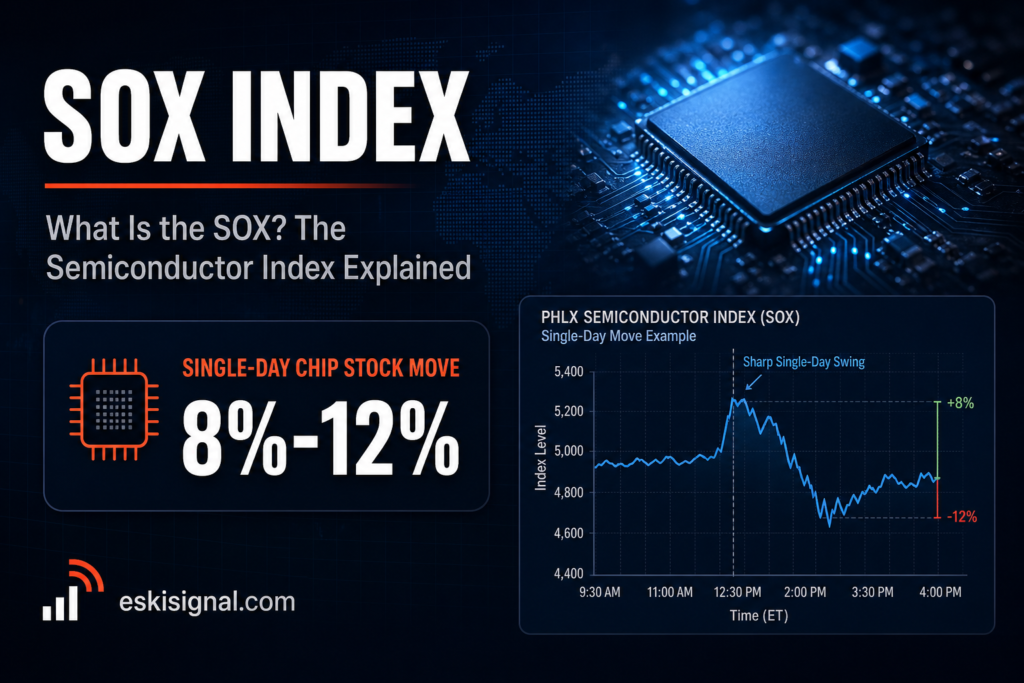
The SOX is the number chip-industry traders glance at before they glance at almost anything else. It’s a basket of roughly 30 semiconductor companies bundled into a single index, and when it swings hard, it usually means something real is happening in AI demand, memory pricing, or global chip supply — not just noise. Here’s what it actually tracks, what’s inside it, and why it tends to move before the rest of the market catches on.
This article is for informational and educational purposes only. It is not financial advice, investment advice, or a recommendation to buy, sell, or hold any security, cryptocurrency, or financial product. Always verify data with official sources before making financial decisions.
Short answer — what the SOX tracks
SOX is the ticker for the PHLX Semiconductor Index, originally launched on the Philadelphia Stock Exchange in the 1990s and now maintained under Nasdaq’s index business. It’s a modified capitalization-weighted index of about 30 U.S.-listed companies that design, manufacture, or sell semiconductors and semiconductor equipment. Think chipmakers, equipment suppliers, and the companies that design the chips even if someone else fabricates them.
The index is meant to act as a proxy for the health of the whole semiconductor industry, not any single company. So when someone says “the SOX was down 4% today,” they’re describing a sector-wide move, even if the drag came from just a couple of heavyweight names.
What’s inside the index (major holdings)
The SOX is weighted, so a handful of giants tend to drive most of the day-to-day movement even though the index holds roughly 30 names total. Weightings shift over time as prices change and as the index is periodically rebalanced, so treat the table below as illustrative rather than a live snapshot.
| Company | What it does |
|---|---|
| Nvidia | GPUs and AI accelerator chips |
| Broadcom | Networking chips, custom AI silicon, software |
| AMD | CPUs, GPUs, data center processors |
| Texas Instruments | Analog and embedded chips |
| Micron | Memory (DRAM) and storage (NAND) chips |
| Qualcomm | Mobile and connectivity chipsets |
| Applied Materials | Chip fabrication equipment |
| KLA | Wafer inspection and process control equipment |
| Lam Research | Semiconductor manufacturing equipment |
| ASML | Lithography machines used to print chips |
Notice the mix: some of these companies design chips, some manufacture them, and some make the machines that make the chips. That’s deliberate. The index is trying to capture the whole supply chain, not just the household names.
SOX vs SMH vs SOXX
This trips a lot of people up. The SOX itself is an index — you can’t buy it directly any more than you can buy the S&P 500 as a single share. What you can buy are exchange-traded funds built to track it, and the two most common are VanEck Semiconductor ETF (SMH) and iShares Semiconductor ETF (SOXX). They track similar baskets but aren’t identical twins.
| Feature | SOX (index) | SMH (ETF) | SOXX (ETF) |
|---|---|---|---|
| What it is | Benchmark index, not tradable directly | Tradable fund tracking a semiconductor index | Tradable fund tracking a semiconductor index |
| Holdings count | ~30 companies | ~25 companies, more concentrated at the top | ~30 companies, broader spread |
| Weighting style | Modified market-cap weighted | Modified market-cap weighted | Modified market-cap weighted |
| How you’d use it | Reference point for sector strength | Actual investable position | Actual investable position |
In practice, financial media often use “the SOX” as shorthand for the sector’s mood, while traders looking to actually put money to work check the ETF’s own fact sheet for exact holdings and weights, since those can drift from the underlying index between rebalances.
Why traders watch the SOX as a market signal
Semiconductors sit near the front of a lot of economic chains. Chips go into phones, cars, data centers, factory equipment, and now a huge wave of AI infrastructure — so demand for chips tends to shift before demand for the finished products shows up in broader economic data. That’s part of why the SOX has a reputation as a leading indicator, or at least a sentiment gauge, for tech more broadly.
There’s also a simple mechanical reason it gets attention: the index is dominated by a small number of enormous companies, so it reacts fast to a single earnings report, a guidance cut, an export-control headline, or a shift in AI capital spending. A sharp SOX move often front-runs moves in the Nasdaq-100 or S&P 500 tech sector, since chip names are frequently the first to report earnings each cycle and the first to reprice on new information.
None of that makes it a crystal ball. It’s a concentrated, volatile index, and reading too much into a single day’s move is a common way to misread the signal.
A real-world example
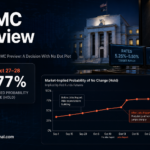
Early July 2026 is a decent illustration of how these pieces interact. Markets had just digested Kevin Warsh’s first FOMC meeting as Fed chair in June, where the committee held rates at 3.50%-3.75% but turned noticeably more hawkish on the dot plot, largely because of an oil price shock tied to the Iran conflict and the brief disruption around the Strait of Hormuz. A subsequent Iran deal later in June helped ease crude prices back down, taking some pressure off inflation expectations.
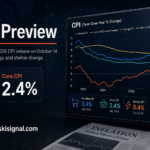
Against that backdrop, chip stocks have their own separate story running in parallel — memory pricing and AI infrastructure demand, which don’t necessarily track the Fed’s rate path at all. As EskiSignal covered separately, a sharp single-day move in names like Micron, Nvidia, Intel, and Broadcom (in the 8-12% range) showed how the SOX can swing hard on sector-specific news even while the broader market is digesting macro headlines like May’s 4.2% CPI print or the +172,000 jobs report. Two different engines, both showing up in the same index.
Where this shows up on EskiSignal
On EskiSignal, SOX moves usually come up in our Markets › Sectors & Rotation coverage, where we track how money rotates between sectors and why a specific group of stocks is having an outsized day. If a chip stock is moving sharply, there’s a decent chance the SOX or its component weights are part of the explanation, and we try to spell out the mechanism rather than just report the percentage change.
Mini glossary
| Term | Plain-English meaning |
|---|---|
| PHLX | Philadelphia Stock Exchange, where the SOX index was originally created |
| Modified cap-weighted | Bigger companies count for more, but with caps so no single stock totally dominates |
| Fab | A semiconductor fabrication plant where chips are physically manufactured |
| Foundry | A company that manufactures chips designed by other companies |
| Memory cycle | The boom-bust pattern in DRAM/NAND pricing driven by supply and demand swings |
| Bellwether | A stock or index whose moves are thought to hint at broader market direction |
Risks and limits
The SOX is concentrated by design, which cuts both ways. A handful of mega-cap names can drag the whole index around even when most of its members are quiet, so a big SOX headline doesn’t always mean broad-based sector strength or weakness. It can just mean one or two stocks had a big day.
The sector is also cyclical and geopolitically sensitive in ways that are hard to fully price in advance — export controls, tariff changes, and supply chain disruptions (like the Strait of Hormuz episode) can all move chip stocks for reasons that have nothing to do with underlying demand. And because so much of the index’s recent story is tied to AI infrastructure spending, a slowdown in that specific theme could hit the SOX harder than it hits the broader market. None of this is a reason to treat the index as predictive on its own — it’s one data point among many.
What does SOX stand for?
SOX is the ticker symbol for the PHLX Semiconductor Index, named for the Philadelphia Stock Exchange where it was originally introduced. It’s now administered as part of Nasdaq’s index family, but the name and ticker stuck.
SOX vs SMH?
SOX is the underlying index, which you can’t buy directly. SMH is an ETF that aims to track a semiconductor index and can be bought and sold like a stock. The two move similarly most of the time but aren’t identical, since SMH holds a specific, somewhat more concentrated basket of names.
Why is it a bellwether?
Chips feed into almost every corner of the economy, from phones to cars to AI data centers, so shifts in chip demand or pricing often show up before those shifts are visible in broader economic data. That’s why traders treat sharp SOX moves as an early signal worth investigating, even though it isn’t a guaranteed predictor of anything.
Can you invest in it?
Not directly, since the SOX is a benchmark index rather than a security. Investors who want exposure typically look at ETFs built to track similar baskets, such as SMH or SOXX, or they research individual component companies on their own.
Sources
- Nasdaq — PHLX Semiconductor Index (SOX) methodology and constituent data.
- Fund provider fact sheets — VanEck Semiconductor ETF (SMH) and iShares Semiconductor ETF (SOXX) holdings disclosures.
- Company investor relations pages for constituent earnings and guidance.
- Federal Reserve public statements and FOMC materials for monetary policy context.