“Emerging markets” is one of those phrases that gets thrown around in every market recap without much explanation — as if everyone already knows exactly which countries count and why it matters. They don’t, and the definition is fuzzier than most headlines let on. This guide breaks down what the term actually means, who decides which countries belong in the club, and why EM assets tend to move differently than U.S. or European stocks.
This article is for informational and educational purposes only. It is not financial advice, investment advice, or a recommendation to buy, sell, or hold any security, cryptocurrency, or financial product. Always verify data with official sources before making financial decisions.
Short answer — what “emerging markets” means
Emerging markets, usually shortened to EM, are countries whose economies and financial markets are more developed than the poorest, least-liquid corners of the world but not yet considered fully mature by the standards of places like the United States, Japan, or Germany. Think of it as a middle tier: bigger stock exchanges, more foreign investment, and more regulatory infrastructure than a frontier economy, but still carrying risks — currency swings, political instability, thinner trading volume — that developed markets have mostly grown out of.
There’s no single government agency that stamps a country “emerging.” The term is really an investment classification, built and maintained by index providers and financial institutions that need a consistent way to group countries for the purposes of building funds, tracking performance, and pricing risk.
Which countries count as emerging (and who decides)
The classification work is mostly done by index providers — MSCI, FTSE Russell, and S&P Dow Jones Indices are the big three — along with input from the IMF and World Bank on broader economic development. MSCI’s framework, which is the one most EM funds are built around, looks at three things: economic development (is per-capita income and market structure closer to developed-world levels?), size and liquidity (are there enough large, actively traded companies?), and market accessibility (can foreign investors actually get money in and out without excessive friction — things like ownership limits, currency convertibility, and how easy it is to open a custody account).
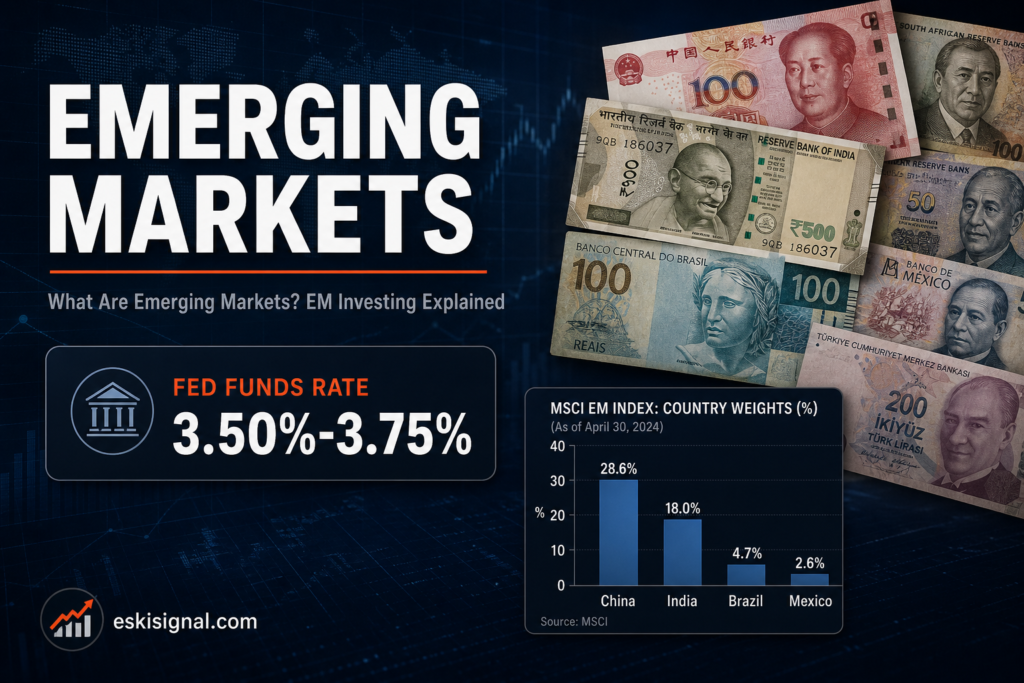
Countries typically classified as emerging include China, India, Brazil, Mexico, South Africa, Indonesia, Thailand, and Poland, among others. Taiwan and South Korea are also included in most EM indexes, though this is one of the more debated calls in the industry — both economies are highly developed by income and technology standards, and some providers have flirted with reclassifying them as developed markets over the years. FTSE Russell, for instance, has treated South Korea differently than MSCI at various points. The upshot: even the experts don’t fully agree on where the line sits, and the exact roster of “emerging” countries shifts slightly depending on which index you’re looking at.
Developed vs emerging vs frontier
| Category | Typical traits | Illustrative examples |
|---|---|---|
| Developed markets | High income levels, deep and liquid markets, strong legal/regulatory systems, freely convertible currency | United States, Japan, Germany, United Kingdom |
| Emerging markets | Growing economies, sizable stock markets, improving but imperfect market access, moderate currency and political risk | China, India, Brazil, Mexico, South Korea, Taiwan |
| Frontier markets | Smaller, less liquid markets, higher political and currency risk, limited foreign investor access | Vietnam, Nigeria, Kenya, Bangladesh |
These categories aren’t fixed forever. Countries can graduate from frontier to emerging, or from emerging to developed, as their markets deepen and open up — South Korea and Taiwan being the classic examples of economies that arguably outgrew the “emerging” label years ago but stayed in it for index-construction reasons.
Why EM behaves differently
Emerging-market assets tend to be more sensitive to a handful of global forces than developed-market assets are, and 2026 has been a fairly clean illustration of why. When the Federal Reserve under new chair Kevin Warsh held rates at 3.50%-3.75% at its June 17 meeting but shifted the dot plot in a more hawkish direction — largely a response to the energy-driven inflation shock tied to the Strait of Hormuz episode earlier in the year — capital markets around the world felt it, but EM currencies and bonds tend to feel it more acutely.
The mechanism is fairly straightforward. A lot of emerging-market government and corporate debt is issued in U.S. dollars rather than local currency. When U.S. rates stay higher for longer, or the dollar strengthens, servicing that debt gets more expensive in local-currency terms, and investors often demand higher yields to hold EM bonds as compensation. EM currencies can also swing more sharply against the dollar than developed-market currencies do, since capital tends to flow toward the U.S. when yields there look attractive and safe.
Commodity exposure adds another layer. Many EM economies — Brazil, South Africa, and various oil exporters among them — are net exporters of oil, metals, or agricultural goods, so their currencies and equity markets often track commodity prices fairly closely. The same 2026 backdrop that pushed gold prices higher and rattled oil markets during the Iran-related conflict has also rippled through EM currencies and stocks, sometimes as a tailwind for commodity exporters and sometimes as a headwind when energy costs squeeze importing countries. May 2026’s 4.2% year-over-year CPI print in the U.S. is part of the same story — inflation surprises tend to move rate expectations, which move the dollar, which moves EM asset prices almost as a side effect.
How investors get EM exposure
Most people who hold emerging-market investments don’t buy individual foreign stocks directly — that usually involves extra paperwork, currency conversion, and sometimes local brokerage accounts. Instead, the common route is through broad-market EM index funds or exchange-traded funds that hold a basket of companies across dozens of emerging countries, weighted by market size. These funds track benchmark indexes built by the same providers doing the classification work — MSCI Emerging Markets, FTSE Emerging, and similar broad benchmarks are the ones most general-purpose EM funds are built around.
There are narrower options too — funds focused on a single country or region, or on EM government bonds specifically, or on EM currencies. Some investors use EM exposure as a small slice of a diversified portfolio rather than a core holding, given the extra volatility involved. None of this is a suggestion to buy any particular fund; the point is just to understand the mechanics of how the exposure typically gets built, since “emerging markets” as a category is really only investable through some kind of pooled vehicle for most retail investors.
Where this shows up on EskiSignal
EM assets rarely move in isolation — they’re tangled up with the same dollar, rate, and commodity stories that show up across the rest of this site. If gold is climbing on geopolitical stress, or oil futures are swinging on a Middle East supply scare, or the yield curve is sending a recession signal, there’s usually an EM angle sitting quietly underneath all three.
Mini glossary
| Term | Plain-English meaning |
|---|---|
| EM | Shorthand for “emerging markets” used across trading desks and financial media |
| MSCI | A major index provider whose emerging-markets classification is the reference point most EM funds use |
| Frontier market | A smaller, less liquid market considered a step below emerging in development and accessibility |
| Local-currency debt | Government or corporate bonds issued in a country’s own currency rather than dollars |
| Hard-currency debt | Bonds issued in a major reserve currency like the U.S. dollar, common in EM sovereign borrowing |
| Capital flight | A rapid outflow of investment from a country, often triggered by rate or political shocks |
| Market accessibility | How easily foreign investors can buy, sell, and repatriate money from a country’s markets |
Risks and limits of EM
The same traits that can make emerging markets appealing over long stretches — faster economic growth, younger populations, industries still building out — are tied directly to the risks. Currency volatility is a persistent one: a stock can rise in local-currency terms and still lose money for a dollar-based investor if the local currency falls against the dollar. Political risk is another recurring theme, since policy changes, elections, or instability can move markets faster and harder than in more institutionally stable developed economies.
Liquidity is thinner in a lot of EM markets too, meaning prices can gap more sharply on relatively modest trading volume. And EM as a category isn’t one uniform bloc — a commodity exporter like Brazil and a manufacturing-heavy economy like Taiwan can respond to the same global event in opposite directions, so treating “emerging markets” as a single homogeneous trade can be misleading. None of this makes EM inherently good or bad as a category — it just means the risk profile is different, and diversification within EM itself matters as much as deciding whether to hold EM at all.
What defines an emerging market?
An emerging market is generally defined by index providers like MSCI based on economic development, market size and liquidity, and how accessible the market is to foreign investors. There’s no single official definition, so the exact list of countries can vary slightly between providers.
Why are emerging markets considered riskier?
EM assets tend to see more currency volatility, thinner trading liquidity, and greater sensitivity to political and policy shifts than developed markets. Many EM governments and companies also borrow in U.S. dollars, which makes them more exposed to swings in the dollar and U.S. interest rates.
How do you invest in emerging markets?
Most investors gain exposure through broad-market EM index funds or ETFs that track a benchmark like MSCI Emerging Markets, rather than buying individual foreign stocks directly. Narrower options also exist for specific countries, sectors, or EM bonds.
What are some examples of emerging market countries?
Commonly cited examples include China, India, Brazil, Mexico, South Africa, Indonesia, Taiwan, and South Korea, though the last two are sometimes classified differently depending on the index provider.
Sources
- MSCI — Market Classification Framework methodology.
- FTSE Russell — Country classification and equity index methodology documents.
- IMF and World Bank — economic development and country classification data.
- Federal Reserve — FOMC statements and press conference transcripts.